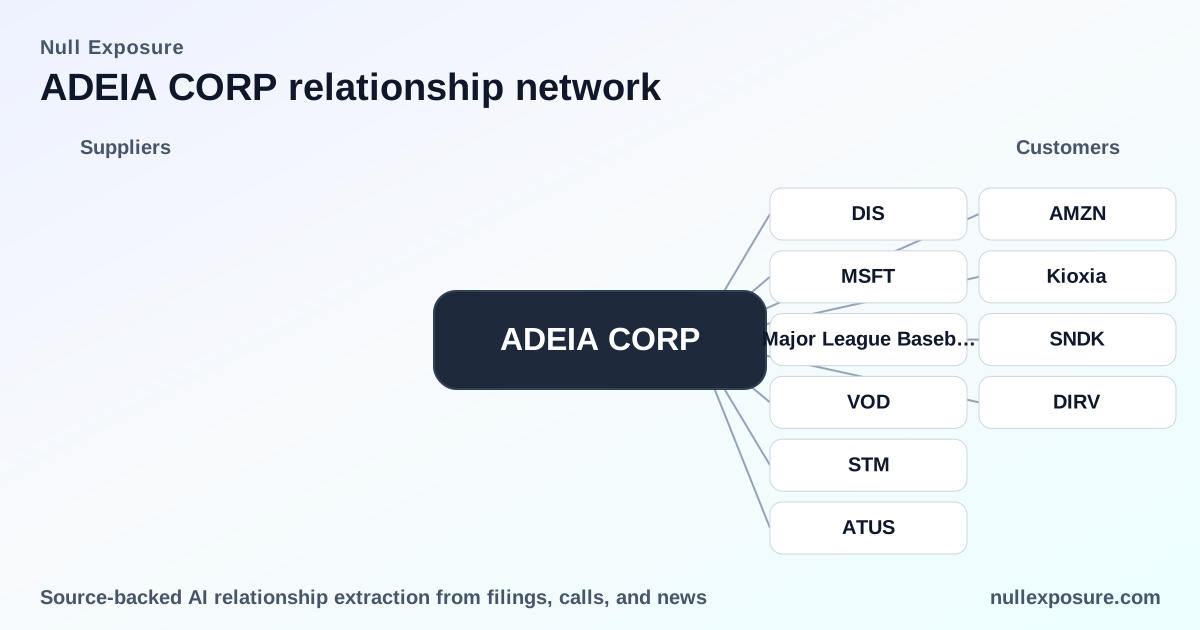
Adeia’s customer map: licensing deals, concentration and why enterprise partners move the needle
Adeia monetizes through IP licensing across two focused portfolios — media (OTT/Pay-TV) and semiconductor technologies — collecting a mix of multi‑year fixed fees, minimum guarantees and usage-based royalties (per-subscriber or per-unit). Recent contracts with global OTT platforms and leading chipmakers have shifted revenue mix toward recurring, enterprise-scale licenses that materially support 2025–2026 results. For investors evaluating counterparty risk and growth runway, the headline: Adeia is executing large, long-term license agreements with very large counterparties that drive both near-term revenue and durable royalty streams.
For an at‑a‑glance view of Adeia’s coverage and source summaries, visit https://nullexposure.com/.
How Adeia’s business model shapes its commercial posture
Adeia operates as a licensor — not a product vendor — so its contracting posture is inherently rights‑centric, long‑term and enforcement‑aware. Company disclosures and recent releases establish three operational characteristics that underwrite the financial profile investors should model:
- Licensing-first, recurring economics. Adeia derives the majority of revenue from IP licenses and recognizes royalties on per-subscriber or per-unit bases alongside fixed minimum guarantees, creating a hybrid recurring revenue stream.
- Enterprise concentration and materiality. Financial statements disclose a small number of customers that together represent a large share of receivables and revenue; this concentration increases earnings volatility but also enables sizable, predictable cash flows when contracts are multi‑year.
- Global reach with North American concentration. Contracts span OTT and semiconductor ecosystems globally, yet the company still reports most revenue and collections on a North American consolidated basis.
These are company-level signals: Adeia’s contracts skew long-term and usage-based, counterparties are large enterprises, the relationship role is primarily licensor/licensee, and IP licensing is the single reportable segment.
Why litigation and settlements are part of the commercial playbook
Adeia’s model includes active IP enforcement and negotiated settlements that often convert disputes into license revenue. Recent public announcements show both resolved disputes (converted into long-term licenses) and newly filed litigation that accompanies licensing activity — an operational dynamic investors should treat as a commercial lever, not an anomaly.
Relationship-by-relationship: what each counterparty means for revenue and risk
- Disney / The Walt Disney Company (DIS) — Adeia signed a long-term media IP license with Disney that resolved outstanding litigation and was cited as a primary driver of an upward revision to 2025 guidance. This contract positions Disney as a major OTT licensee for Adeia’s media portfolio (press release: GlobeNewswire, Feb 23, 2026; Adeia investor communications Dec 2025).
- Microsoft (MSFT) — Adeia announced a multi-year media license with Microsoft in early 2026, referenced among the 26 new agreements that supported record results and helped shift revenue toward OTT customers (SahmCapital summary, Mar 2026; GlobeandMail earnings transcript, Q4 2025).
- Advanced Micro Devices (AMD) — Adeia entered into a multi‑year semiconductor IP license with AMD that also settled outstanding litigation between the parties, granting AMD access to Adeia’s semiconductor portfolio (company announcement via GlobeNewswire, May 2026; TradingView coverage).
- United Microelectronics Corporation (UMC) — Adeia expanded and renewed its semiconductor licensing relationship with UMC, extending collaboration into hybrid bonding and advanced packaging technologies (GlobeNewswire release, Mar 11, 2026; Singapore Yahoo News coverage).
- Vodafone (VOD) — Adeia signed a multi‑year renewal with Vodafone for access to its media portfolio, reinforcing recurring media revenue from an international Pay‑TV operator (Adeia results release, Feb 23, 2026).
- Major League Baseball — Adeia executed a multi‑year license with Major League Baseball granting access to its media portfolio; MLB is listed as a strategic new media customer in Adeia’s earnings commentary (GlobeandMail earnings transcript, Q4 2025; GlobeNewswire summary of results).
- STMicroelectronics (STM) — Adeia cites semiconductor deals including STMicro as contributors to semiconductor revenue growth in 2025 (earnings call transcript reporting $26M semiconductor revenue in 2025, GlobeandMail, Q4 2025).
- Altice USA (ATUS) — Adeia listed renewals with Altice USA as part of the renewal base that underpins recurring revenue stability (earnings call transcript, GlobeandMail, Q4 2025).
- Amazon (AMZN) — Adeia counts Amazon as a licensed OTT customer, with management noting that Amazon and Disney represent two of the largest OTT providers under license (earnings call transcript, GlobeandMail, Q4 2025).
- Kioxia — Adeia referenced historical NAND-related agreements with Kioxia (originally signed in March 2023) as part of its NAND strategy and revenue base (earnings call transcript, GlobeandMail, Q4 2025).
- SanDisk / SNDK — Adeia noted previous licensing agreements with SanDisk (signed March 2023) that remain relevant to its NAND-related revenue (earnings call transcript, GlobeandMail, Q4 2025).
- DIRECTV (DIRV) — Adeia acknowledged that DIRECTV has filed litigation challenging the need for a new license agreement, illustrating that some negotiations remain contested and litigated (earnings call transcript, GlobeandMail, Q4 2025).
- DISH Network Corporation (DISH) — Adeia initiated patent infringement litigation against DISH, with management stressing DISH and its predecessors have historically licensed Adeia’s technologies, reflecting both enforcement posture and pursuit of license revenues (press release covered by SahmCapital, Apr 1, 2026).
What investors should read into the mix of customers
- Big‑ticket, long‑term contracts with scale customers translate into substantive near-term revenue and recurring royalties — the Disney, Microsoft, Amazon and AMD agreements demonstrate Adeia’s ability to convert disputes or negotiations into multi‑year licenses.
- Concentration remains the primary risk vector. Adeia’s financial disclosures show a small number of customers make up a large portion of receivables and revenue, so loss or non‑renewal of a major license would be financially meaningful.
- Legal activity is embedded in the commercial model. Settlements and licensing conversions (Disney, AMD) have proven cash‑accretive; contemporaneous litigation (DISH, DIRECTV challenges) represents both downside and leverage in negotiations.
- Revenue recognition is hybrid. Expect a mix of fixed-fee contributions and usage‑based royalties that scale with subscriber counts or unit shipments; modeling should reflect minimum guarantees and variable royalty ramps.
If you want a consolidated view of Adeia’s customer relationships and how they affect revenue sensitivity, see the company’s press releases and earnings call materials aggregated at https://nullexposure.com/.
Final takeaways for allocators and operators
Adeia’s commercialization model is license-first, enterprise-focused and legally active; recent contracts with household OTTs and leading semiconductor firms materially improve revenue visibility while keeping concentration and litigation as core risk factors. For valuation and operational diligence, emphasize scenario analysis around renewal probability for the largest licensees and the cadence of usage-based royalties tied to OTT subscriber trends and semiconductor unit cycles.