Analog Devices (ADI): Customer Relationships That Drive Revenue and Risk
Analog Devices (ADI) designs and sells mixed-signal and power-management integrated circuits to a broad set of industrial, automotive, communications and consumer OEMs, and monetizes primarily through product sales distributed via both direct channels and third‑party distributors. The company’s go‑to‑market blends a high-volume hardware franchise with significant distributor dependency—a structure that scales revenue but concentrates working‑capital and inventory exposure in channel partners. For deeper relationship mapping and ongoing updates, see https://nullexposure.com/.
The investment thesis in one paragraph
ADI is a premium analog and mixed‑signal semiconductor company that converts engineering differentiation into high-margin hardware sales and recurring end-customer adoption. Revenue generation is product‑sale driven, heavily channeled through distributors (over half of revenue in fiscal 2025), while direct OEM engagements anchor strategic design wins (automotive, wireless RAN, and industrial sensing). The combination supports durable margins but introduces counterparty and timing risk tied to distributor inventory cycles and short‑duration customer contracts.
How ADI sells and where the structural risks live
ADI’s public disclosures and filings describe a clear operating posture: short‑term sales contracts, global reach, and material reliance on distributors. Key operating signals from the company-level disclosures:
- Contracting posture — short-term: ADI reports that it “typically does not have long‑term sales contracts with our customers,” and that unsatisfied performance obligations generally relate to product deliveries with original expected durations of one year or less. This creates revenue sensitivity to near-term order flows and end‑market volatility.
- Channel concentration — material distributor exposure: Sales to third‑party distributors were approximately 56% of revenue in fiscal 2025, with distributor receipts of roughly $6.1 billion for fiscal 2025 (vs. $5.5 billion in fiscal 2024). This is a material feature of the business and a primary working‑capital vector for investors to monitor.
- Global footprint and counterparty mix: ADI sells worldwide through direct sales, distributors and reps; the company also recognizes revenue from U.S. government and prime contractors and accounts for those contracts over time in specific cases.
- Product focus — hardware ICs: Substantially all customer contracts contain a single performance obligation: the sale of mixed‑signal IC products. The business is product centric, not subscription or services centric.
These characteristics together describe a mature hardware vendor with predictable margins and cyclical top‑line exposure driven by channel behavior and short contract duration.
What ADI’s headline customers tell us about strategy and market positioning
Below are the customer relationships surfaced in recent public reporting and news, each summarized in plain English with source context.
Dolby (DLB): ADI in the automotive audio stack
Dolby highlights collaboration with automotive SoC and DSP suppliers including Analog Devices as it pushes Dolby Atmos into more car models, indicating ADI’s role as a supplier of DSP/SoC components for in‑vehicle audio systems. Source: Dolby press material covering CES initiatives (Dolby, referenced March 2026).
Keysight / KEYS: ADI hardware used in RAN validation demos
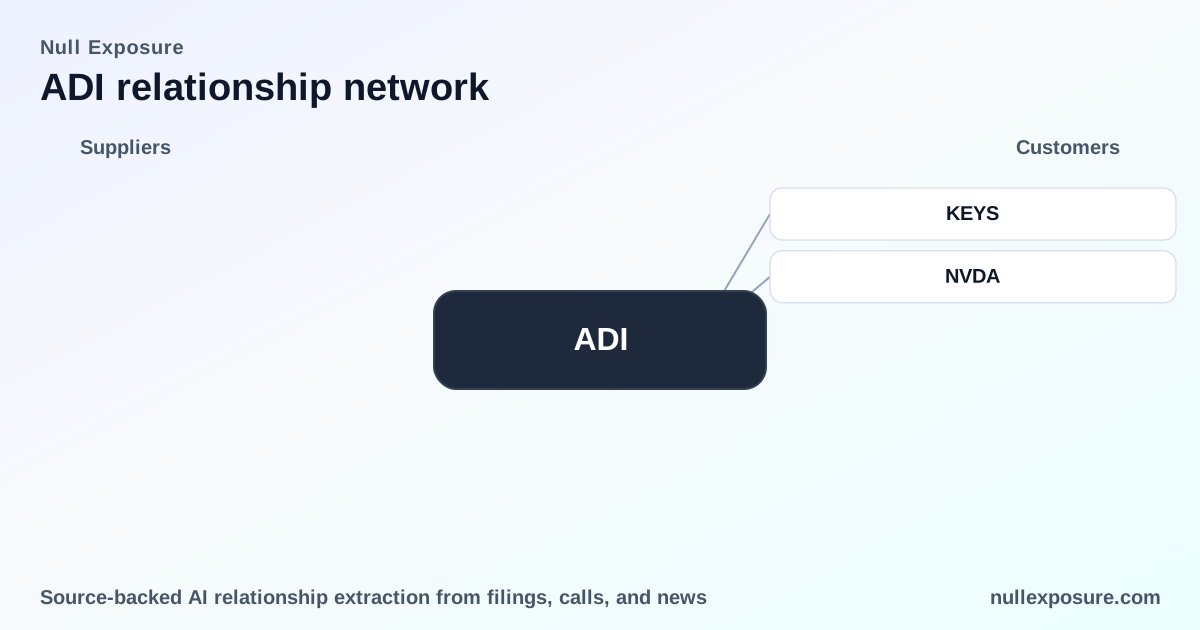
Keysight’s AI RAN demonstration integrates commercial radio hardware including Analog Devices’ Titan O‑RU platform, showing ADI’s product being used in advanced wireless research and validation toolchains for AI‑driven RAN testing. Source: StockTitan report on a Keysight–Samsung demonstration (Keysight/KEYS, March 2026).
Keysight Technologies (duplicate entry): convergence of test gear and ADI radio units
A second result from the same Keysight coverage reiterates that Keysight’s toolset runs with commercial radio hardware such as ADI’s Titan O‑RU, underscoring repeated media emphasis on ADI’s positioning in next‑generation RAN testbeds. Source: StockTitan coverage of Keysight and Samsung (Keysight Technologies, March 2026).
NVIDIA (NVDA): ADI hardware featured alongside GPU‑centric testbeds
The Keysight/NVIDIA demonstration list includes commercial radio hardware such as Analog Devices’ Titan O‑RU platform alongside NVIDIA Aerial and DGX hardware, signaling ADI’s components are integrated into complex AI‑RAN stacks used for end‑to‑end validation. Source: StockTitan write‑up describing the AI RAN demo (NVIDIA/NVDA, March 2026).
Arrow Electronics (ARW): distributor relationship in mobility supply chains
An article on mobility innovation references SAVART’s collaboration with Arrow, which sources components from suppliers including Analog Devices, indicating distributor channel flows where Arrow supplies ADI parts into mobility product development. Source: EEAsia profile of Arrow‑enabled mobility projects (Arrow/ARW, May 2026).
What this relationship map implies for investors
- Strategic breadth, not end‑market exclusivity: ADI’s presence across automotive audio (Dolby), wireless testbeds (Keysight/NVIDIA) and distributor networks (Arrow) shows product breadth and multisector design wins—supporting revenue diversification.
- High channel leverage: The issuer’s disclosed 56% distributor share of revenue and $6.1 billion distributor sales in fiscal 2025 are central to cash flow timing and inventory risk; monitoring distributor inventory and order cadence is essential for forecasting ADI’s near‑term revenue.
- Product criticality in specialized stacks: Inclusion of ADI hardware in advanced RAN testbeds and automotive audio systems indicates technical stickiness where once‑designed‑in components create multi‑period revenue potential through successive vehicle or network deployments.
- Short contract life increases cyclicality: Because ADI does not rely on long‑term binding customer contracts, top‑line volatility tracks end‑market ordering and the distributor channel rather than contractual revenue streams.
Bottom line for operators and investors
Analog Devices is a high‑quality hardware company whose economics are anchored in product margins and broad channel distribution; this model scales well but concentrates timing and working‑capital risk in distributors and near‑term order flows. For investors evaluating ADI’s customer map, the headline relationships with Dolby, Keysight, NVIDIA and Arrow validate ADI’s strategic placement in automotive and wireless ecosystems while reinforcing the imperative to monitor distributor health and short‑duration contract exposure.
For ongoing relationship monitoring and to cross‑reference partner mentions across filings and press, visit https://nullexposure.com/.