ADMA Biologics: a concentrated customer base, expanding distribution, and what that means for investors
ADMA Biologics manufactures and sells plasma‑derived immune globulin products (ASCENIV, BIVIGAM, Nabi‑HB) and monetizes through product sales to specialty distributors, wholesalers and infusion providers, plus selective contract manufacturing services. Revenue is highly concentrated among a handful of customers, while recent distribution agreements are broadening go‑to‑market reach — a dynamic that drives both upside and concentrated counterparty risk. For a concise portal into our coverage and tools, visit https://nullexposure.com/.
The quick bottom line investors need
ADMA’s business model is dual: manufacture at its Boca Raton facility and sell through third‑party distributors, specialty pharmacies and infusion centers. The company reports that two customers accounted for approximately 72% of consolidated revenue in FY2024, and three customers comprised roughly 91% of accounts receivable at year‑end 2024 — a concentration profile that elevates counterparty and credit risk while amplifying the impact of distribution wins. According to the company overview, ADMA delivered roughly $510m in trailing‑twelve‑month revenue with solid gross margins but historically lumpy operating performance.
Customer roll call — who drives revenue and receivables
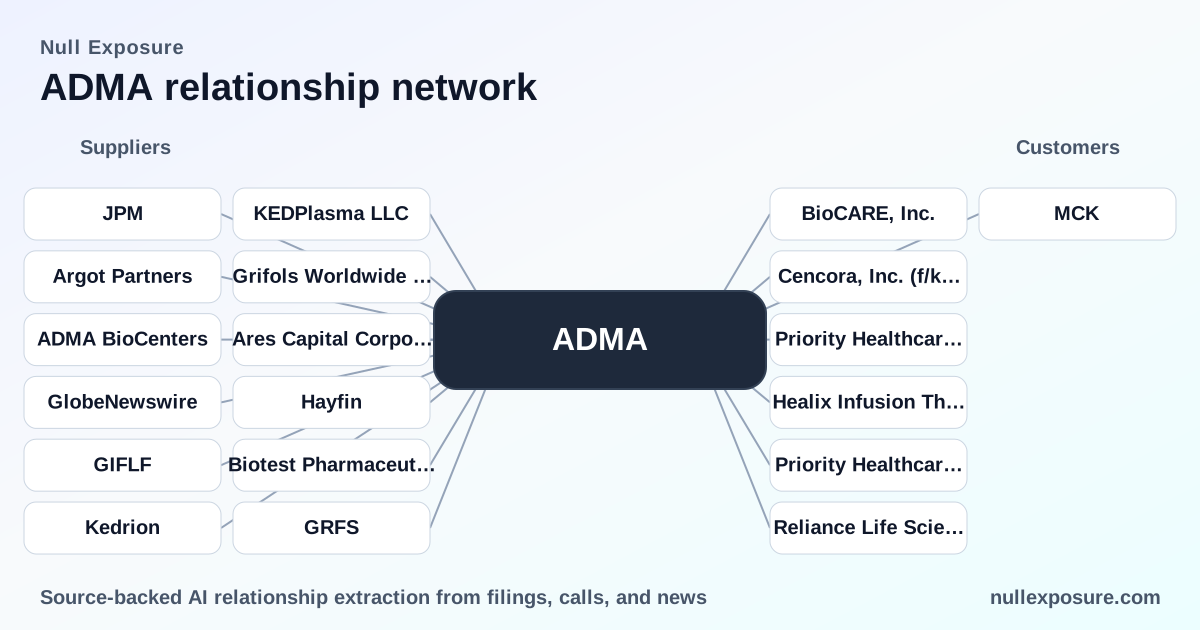
The filings and company disclosures list the counterparties that underlie ADMA’s revenue and receivable concentrations. Below are each relationship described in plain English with the public source.
BioCARE, Inc.
BioCARE is one of two customers that together drove an aggregate of 72% of ADMA’s consolidated revenues for the year ended December 31, 2024; this makes BioCARE a top revenue driver and material counterparty. According to ADMA’s 2024 Form 10‑K, BioCARE plus CuraScript represented approximately 72% of consolidated revenues in FY2024.
Priority Healthcare Distribution, Inc. d/b/a CuraScript SD Specialty Distribution
CuraScript (Priority Healthcare Distribution d/b/a CuraScript SD Specialty Distribution) is the other member of the two‑customer pair that generated the bulk of FY2024 revenue, positioning it as a critical distributor channel for ADMA products. ADMA’s 2024 Form 10‑K reports BioCARE and CuraScript together accounted for about 72% of consolidated revenues for FY2024.
Priority Healthcare Distribution, Inc.
The legal entity Priority Healthcare Distribution, Inc. is also referenced in ADMA’s filings as a principal revenue source for FY2024; filings single out the priority distributor relationship when describing top clients and revenue concentration. ADMA’s 2024 Form 10‑K repeats that Priority Healthcare Distribution and BioCARE represented an aggregate of 72% of the company’s consolidated revenues for the year ended December 31, 2024.
Healix Infusion Therapy, LLC
Healix is listed among the three customers that together represented about 91% of consolidated accounts receivable as of December 31, 2024, indicating a meaningful receivables exposure to specialty infusion providers. ADMA’s 2024 Form 10‑K identifies Healix as one of the three customers comprising approximately 91% of consolidated accounts receivable at year end 2024.
Cencora, Inc. (f/k/a AmerisourceBergen Corporation)
Cencora (formerly AmerisourceBergen) is grouped with BioCARE and Healix as part of the three counterparties that made up roughly 91% of accounts receivable at December 31, 2024, signaling large outstanding receivable balances with major wholesaler channels. This is stated in ADMA’s 2024 Form 10‑K.
Reliance Life Sciences Pvt. Limited
Reliance is cited in ADMA’s disclosures as one of five customers that collectively accounted for approximately 98% of consolidated accounts receivable as of December 31, 2023, highlighting prior concentration across a small set of global customers. The 2024 Form 10‑K references Reliance in the company’s customer receivable concentration discussion for FY2023.
McKesson Specialty (MCK)
During Q4 2025 ADMA executed a new authorized distribution agreement with McKesson Specialty for ASCENIV and BIVIGAM, a strategic distribution expansion expected to open additional sites of care and patient populations; this was disclosed in the company’s 2026 press materials and covered across multiple industry news outlets. A January 12, 2026 ADMA press release on GlobeNewswire and subsequent coverage on Finviz and StockTitan note the new McKesson Specialty distribution agreement executed in Q4 2025.
What the contract and relationship constraints reveal about ADMA’s operating model
The company’s disclosures supply clear operating signals that affect underwriting and operational risk:
- Contracting posture — spot and framework coexist. ADMA sells excess plasma in the open “spot” market while also operating under supply agreements, indicating a hybrid contracting model that allows pricing flexibility but introduces volume and pricing volatility. This is described in the company’s public filings.
- Customer types are mixed. ADMA serves individual physician specialists and immune‑compromised patients indirectly via distributors and infusion centers, while government payers are a primary source of payment in some international markets — a mix that combines clinical stickiness with reimbursement sensitivity.
- Geographic footprint is North America‑centric with selective international sales. Net revenue is primarily generated in the United States, though ADMA reports product payments in the EU and spot sales outside the U.S., pointing to a dominant domestic market with limited international diversification.
- Concentration and criticality are high. Multiple filings emphasize that a handful of customers account for the majority of revenue and receivables; ADMA characterizes this exposure as potentially material and critical to the company’s financial condition.
- Firm plays multiple roles. ADMA is both manufacturer and seller of approved products (Boca Raton facility) and occasionally performs contract manufacturing and lab services for third parties, which diversifies revenue sources but keeps the manufacturing asset central to value creation.
- Relationships are active and commercially mature. ASCENIV and BIVIGAM are commercial products with ongoing pull‑through; ADMA’s disclosures describe continuing expansion in prescriber and patient bases that drove utilization in 2024 and into 2025.
Investment implications — upside and risk checklist
- Upside: The McKesson Specialty distribution agreement materially improves channel reach and could accelerate market penetration for ASCENIV and BIVIGAM; contract manufacturing and in‑house fill/finish capabilities provide optionality. (See GlobeNewswire Jan 2026 and media coverage.)
- Risk: Very high customer concentration (72% revenue from two customers; 91% of AR with three customers) is the single largest operational risk, creating outsized earnings sensitivity to counterparty behavior or payment timing (ADMA 2024 Form 10‑K).
- Reimbursement sensitivity: Government and payer pressure on pricing is an explicit constraint and a routine headwind for plasma‑derived products in some markets.
- Operational dependency: The Boca Raton manufacturing footprint is critical to both product supply and third‑party services, concentrating operational risk in a single principal asset.
For deeper counterparty analytics and comparative exposure dashboards, visit https://nullexposure.com/ for our investor tools.
Conclusion — how to think about ADMA as an exposure
ADMA is a niche biopharma operator with proven commercial products and a concentrated customer book that simultaneously magnifies upside from distribution wins and raises acute counterparty and credit risk. The McKesson Specialty agreement is a tangible commercial catalyst; however, investors must price the company’s earnings and valuation with the reality that a very small number of distributors and infusion providers drive the bulk of revenue and receivables according to ADMA’s FY2024 disclosures.