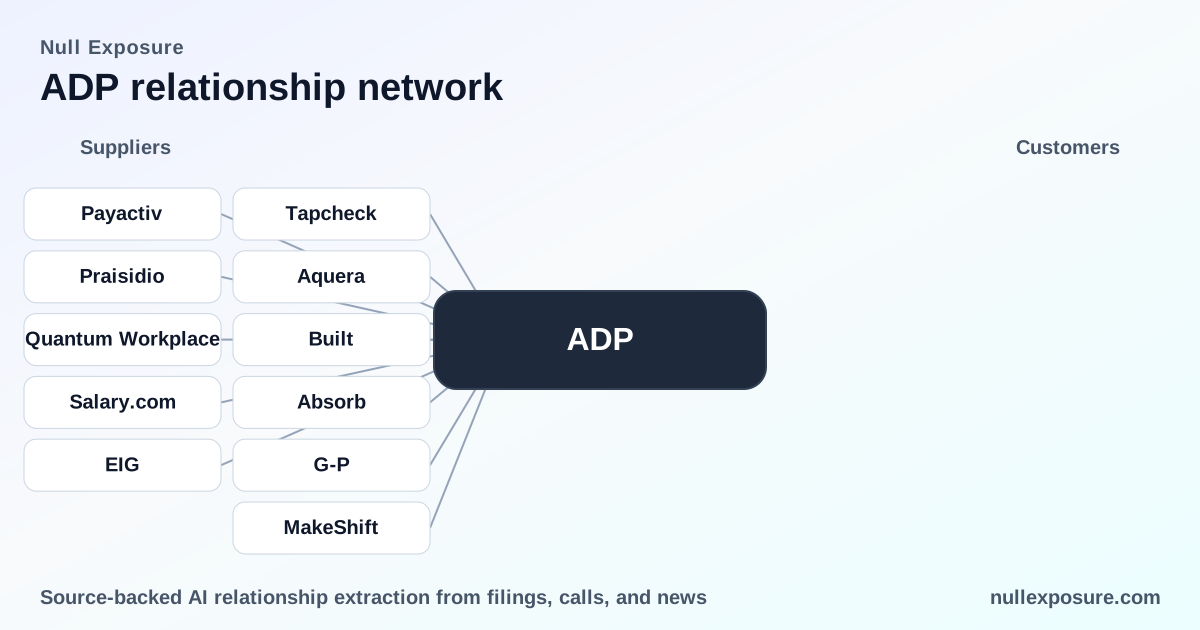
ADP’s customer map: durable payroll economics amplified by distribution partners
Automatic Data Processing (ADP) sells cloud-based Human Capital Management (HCM) software and payroll services to small businesses, mid-market firms, and large enterprises, monetizing through recurring service fees, subscription software, payroll fund investment income, and multi-year implementation fees. ADP’s economics are built on high-retention, recurring revenue and broad distribution, with FY2025 revenue around $21.6 billion and operating margin north of 30%, giving investors a predictable cash flow profile and a platform to monetize partnerships and channel integrations.
For a concise, investor-facing summary of partner exposures and their operational implications, visit https://nullexposure.com/.
How ADP contracts and serves customers — what the operating model looks like
ADP runs a hybrid software-plus-services model that tilts toward long-duration commercial relationships and recurring fees. Company filings state contract terms range from 30 days to seven years, with many products sold on initial terms of two to seven years and estimated client retention of roughly 13 years in Employer Services. This contracting posture produces stable topline visibility and high customer lifetime value.
Key company-level operational signals:
- Contracting posture: A mix of long-term and short-term agreements exists, but the business is dominated by multi-year engagements for major implementations, consistent with ADP’s focus on recurring payroll and HCM services (company filings, FY2025).
- Customer mix: ADP serves small businesses through RUN, mid-market via ADP Workforce Now, and large enterprises with ADP Lyric HCM; the product architecture supports segmentation across the commercial spectrum (company product literature).
- Geography and scale: ADP is global — serving over 1.1 million clients and paying more than 42 million workers in 140+ countries — though the United States remains the material market, with a majority of revenues concentrated in NA (FY2025 filing).
- Concentration and criticality: No single client accounted for more than 2% of FY2025 revenues, signaling low revenue concentration; however, payroll is mission-critical for clients, creating stickiness and high switching costs (FY2025 filing).
- Maturity and role: Relationships are mature and characterized by long tenures and recurring service delivery; ADP functions primarily as a service provider blending software and outsourcing (FY2025 filing).
- Revenue composition: The business mixes services and software revenue streams—payroll processing fees, investment income on payroll funds, implementation fees, and subscription/license fees—supporting resilient margins (FY2025 filing).
The Fiserv relationship — direct distribution into payments and point-of-sale
Fiserv (FISV) and ADP have co-developed integrations that place ADP payroll functionality inside Fiserv’s Clover point-of-sale and merchant ecosystem, broadening payroll distribution into merchant channels. According to Fiserv’s 2025 Q4 earnings call, the partnership has produced “strong sales collaboration” and represents a build-out with significant long-term potential for workforce management solutions (Fiserv 2025 Q4 earnings call, March 2026). A Fiserv / ADP press release describing the integration noted that ADP’s payroll services were technically integrated into Clover to simplify cash flow and payroll management for small businesses (ADP press release via Fiserv media center, FY2024).
- Fiserv’s public remarks frame the relationship as sales and distribution-focused, accelerating ADP’s reach into small-business merchants through Clover terminals and Fiserv’s payments channel (Fiserv 2025 Q4 earnings call, March 2026).
- ADP and Fiserv positioned the integration as a product-level convenience play that bundles payroll into merchant workflows, simplifying financial operations for small firms (ADP / Fiserv press release, FY2024).
Why this matters: Fiserv gives ADP an embedded distribution pathway into the small-business payments stack, supporting cross-sell of RUN and other small-business solutions while leveraging Fiserv’s merchant relationships for faster client acquisition and onboarding (ADP press material; Fiserv investor commentary).
For more signal-driven partner analysis and competitive context, see https://nullexposure.com/.
Implications for investors and operators — concentration, growth levers, and risk
ADP’s partner strategy is an accelerator rather than a replacement for its core direct-sales motion. Investors should weigh the following points:
- Durable economics: Long retention and recurring fees underpin stable free cash flow, justifying ADP’s premium multiple relative to traditional software peers (operating margin ~30%, FY2025 results).
- Low single-client concentration: Fiscal 2025 filings show no client exceeded 2% of revenues, which reduces idiosyncratic counterparty risk while increasing the importance of broad distribution and scale.
- Channel-driven growth potential: Partnerships like Fiserv are high-leverage distribution plays that can lower customer acquisition cost for small-business segments and accelerate adoption of payroll-adjacent services.
- Geographic exposure: ADP is global but materially U.S.-centric in revenues; international expansion introduces FX and regulatory complexity that require operational investment (FY2025 filing).
- Operational risks: Core risks include regulatory compliance across payroll jurisdictions, integration execution with partners, and product parity across segments. The company’s long-term contracts and service orientation mitigate churn risk but raise execution stakes on implementations.
What to monitor next quarter
Investors and operators should monitor three concrete signals:
- Partner-sourced client wins and ARR contribution disclosed in quarterly commentary (to quantify Fiserv channel effectiveness).
- Retention trends and net revenue retention across RUN, Workforce Now, and Lyric segments (to confirm cross-sell and pricing power).
- International revenue growth versus U.S. – given U.S. dominance in revenues, any acceleration overseas is material to upside.
Final takeaways
ADP is a high-quality, service-forward software business: it combines multi-decade client tenure, recurring payroll economics, and selective channel partnerships (Fiserv being a notable example) to extend distribution into payments and small-business merchant flows. The company’s low client concentration, long contract terms, and global scale make it a stable cash-generative platform, while partner integrations represent the primary vector for incremental growth in small-business penetration.
For a focused breakdown of ADP’s partner exposures and how they affect competitive positioning and valuation, visit https://nullexposure.com/.