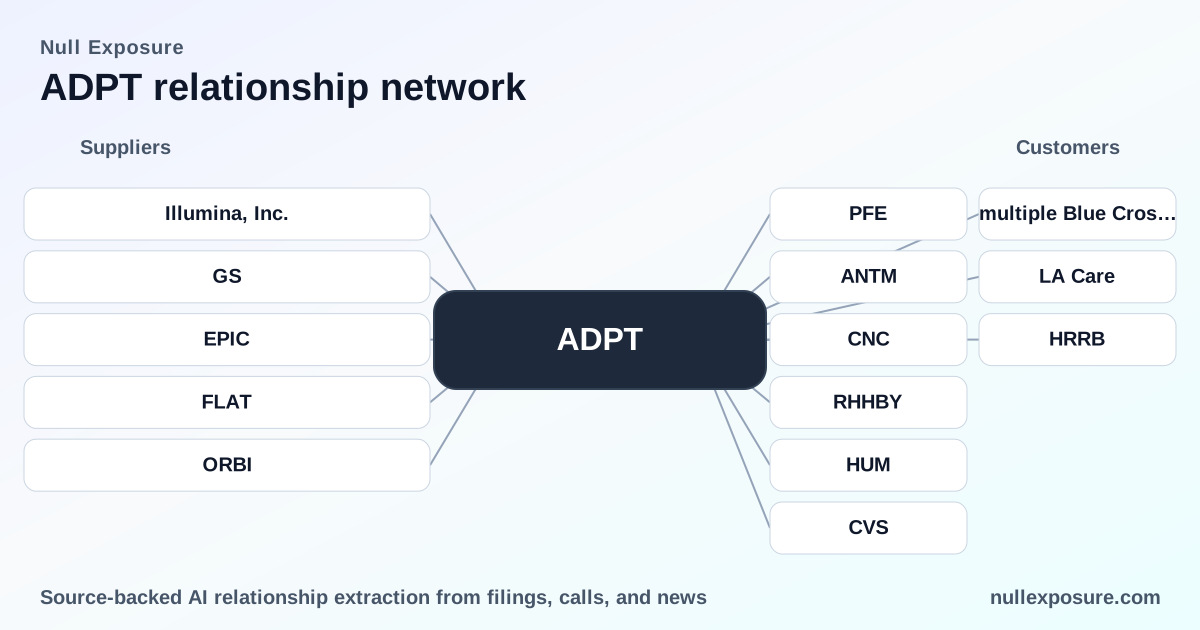
Adaptive Biotechnologies: customer relationships driving a services-plus-licensing growth vector
Adaptive Biotechnologies (ADPT) monetizes a dual commercial model: clinical diagnostic testing (clonoSEQ) sold to clinicians and payors, and research/immune-medicine services plus data licensing sold to biopharma and academic customers. The company generates recurring testing revenue from MRD services while increasingly extracting higher-margin, one‑off licensing and target‑discovery fees from large pharmaceutical partners. For investors, the critical question is whether recurring diagnostic volume and newly announced data licensing deals with large pharma can together sustain margin expansion and justify a premium multiple. Learn more at https://nullexposure.com/.
How ADPT makes money — the business in plain language
Adaptive runs a services business at scale while layering a licensing play on top. The core revenue engines are:
- MRD clinical testing (clonoSEQ): a fee-per-report diagnostic sold to ordering physicians and billed through commercial and government payors. Company disclosures show test volume growth (76,105 tests in 2024 versus 56,496 in 2023), underlining an active, transactional revenue base.
- Immune Medicine services and data licensing: sequencing and analytical services for biopharma plus paid access to T‑cell receptor (TCR) / antigen mapping for AI-driven discovery and target identification. Recent data licensing deals with Pfizer materially increased Immune Medicine revenue to $9.8M in Q4 2025 (from $3.8M a year earlier).
This hybrid model positions Adaptive as both a seller of diagnostic services and a service provider/licensor to large-enterprise pharma and research institutions, giving it exposure to stable clinician-driven revenue and high‑upside, lumpy pharma agreements.
Every customer relationship surfaced (concise, source‑backed)
Below are the customer and partner relationships identified across recent company filings and press coverage. Each entry is a plain-English summary with the cited source context.
Pfizer (PFE)
Adaptive disclosed two distinct non‑exclusive agreements with Pfizer in mid‑December 2025: one for applying its TCR discovery platform to rheumatoid arthritis and another to license TCR–antigen binding data for Pfizer’s AI/ML drug discovery; management attributes the Q4 2025 Immune Medicine revenue increase (to $9.8M) largely to these Pfizer data licensing deals. Source: Q4 2025 earnings call (reported Mar 2026) and press coverage summarizing the December 2025 announcements (SimplyWallSt, StockTitan, Mar 2026); a StockTitan note also referenced up to about $890M in potential RA‑related milestones tied to a Pfizer agreement.
Candel Therapeutics (CADL)
Adaptive performed T‑cell receptor sequencing for Candel Therapeutics’ trial, supporting persistence analyses of an infused therapeutic in treated patients, indicating ADPT’s role as a laboratory and analytic provider for biotech trials. Source: GlobeNewswire press release (Mar 17, 2026).
Anthem
Adaptive signed a new agreement with Anthem as part of a broader set of renegotiated payer contracts, signaling wider commercial coverage and reimbursement conversations with national payors. Source: Q4 2025 earnings call transcript summarized by InsiderMonkey (Mar 2026).
Centene
Centene is listed among newly executed agreements in Adaptive’s recent commercial payer renegotiations, suggesting expanded access and billing channels into managed Medicaid/Medicare populations. Source: Q4 2025 earnings call transcript summary (InsiderMonkey, Mar 2026).
Genentech (RHHBY)
Adaptive continues to recognize noncash revenue amortization from its prior Genentech collaboration, confirming an ongoing collaboration revenue stream and legacy milestone/license accounting effects. Source: Q4 2025 earnings commentary (InsiderMonkey, Mar 2026).
Humana (HUM)
Humana was named as one of eight major payer contracts successfully renegotiated, reflecting material progress in commercial reimbursement and coverage relationships. Source: Q4 2025 earnings call transcript (InsiderMonkey, Mar 2026).
TVGN (TVGN / Voyager Therapeutics context)
Adaptive sequenced samples for TVGN‑489 persistence analyses, demonstrating use of ADPT’s sequencing services in cell therapy follow‑up and translational studies. Source: EDGAR/ADVFN item referencing trial sample processing (May 2026).
Neogenomics (NEO)
Neogenomics described its partnership with Adaptive as strategic rather than directly revenue‑generating, indicating that laboratory distribution or co‑offerings extend Adaptive’s reach into broader diagnostics networks. Source: The Globe and Mail / Motley Fool coverage of Neogenomics Q4 2025 call (Mar 2026).
LA Care
LA Care is included among the new agreements with payors cited by management, which broadens ADPT’s payer coverage in state and regional plans. Source: Q4 2025 earnings call transcript summary (InsiderMonkey, Mar 2026).
Multiple Blue Cross plans
Management reported renegotiations with multiple Blue Cross plans, showing expansion of contractual coverage across regional Blue networks. Source: Q4 2025 earnings call transcript summary (InsiderMonkey, Mar 2026).
Horizon
Horizon was specifically named among the payers re‑contracted, further indicating a programmatic push to secure billing relationships across regional insurers. Source: Q4 2025 earnings call transcript summary (InsiderMonkey, Mar 2026).
Aetna (CVS)
Aetna was cited among the renegotiated payer contracts, consistent with efforts to normalize reimbursement across national commercial insurers. Source: Q4 2025 earnings call transcript summary (InsiderMonkey, Mar 2026).
(For each relationship above, the primary source is the Q4 2025 earnings call and attendant media coverage in March–May 2026 unless otherwise noted.)
What the constraints tell investors about ADPT’s operating design
The corporate disclosures and evidence produce a coherent picture of how Adaptive contracts, where it sells, and what that means for revenue predictability:
- Contracting posture — licensing and service mix: Company statements and media excerpts indicate an active licensing strategy (data licensing to Pfizer) alongside conventional fee‑for‑service testing. Licensing uplifts are episodic and higher‑value; testing revenue is recurring and unit‑driven.
- Counterparty diversity and concentration: Counterparties span individual clinicians and patients (diagnostics), government payors, non‑profit academic labs, and large pharma enterprises. This reduces single‑channel exposure but places outsized importance on a handful of pharma licensing wins for step‑function revenue upside.
- Geographic footprint and maturity: ADPT reports a global footprint with penetration in NA, EMEA and APAC via direct testing and international technology transfers, supporting scale in both clinical and research segments.
- Role and criticality: Adaptive operates as both seller (diagnostics) and service provider/licensor (biopharma); its clonoSEQ assay is embedded in active clinical trials (170+ active trials reported historically), making it operationally critical to partners running MRD endpoints.
- Relationship stage and revenue profile: Many relationships are active and commercial; payer contract renegotiations and the Pfizer licensing deals indicate movement from R&D collaborations to monetized, contractual commercial arrangements.
Investment implications — clear takeaways for analysts
- Positive: The transition to paid data licensing contracts with large pharma (notably Pfizer) is a high‑leverage revenue stream that materially increased Q4 2025 Immune Medicine revenue and introduces milestone upside (public reporting cited ~$890M in RA‑related potential for a Pfizer deal).
- Balanced by risk: Licensing revenues are lumpy and create earnings volatility; sustaining margin improvement requires both continued diagnostic volume growth and repeatable pharma licensing.
- Operational strength: Broad payer renegotiations (including Anthem, Humana, Aetna, Centene, LA Care and Blue Cross plans) improve reimbursement coverage and reduce commercial execution risk over time.
- Strategic optionality: The company’s dual role — high‑frequency diagnostic services plus high‑value data licensing — gives investors optionality if Adaptive can replicate pharma licensing across multiple partners.
If you want a deeper counterparty map or a run‑rate stress test combining recurring MRD revenue with potential licensing milestones, review our coverage hub at https://nullexposure.com/ for modeled scenarios and a relationship‑weighted sensitivity analysis.
Adaptive is now a commercial‑stage services company with an emerging licensing revenue engine; the next 12–18 months of pharma deal flow and payer execution will determine whether the stock justifies its premium valuation multiple.