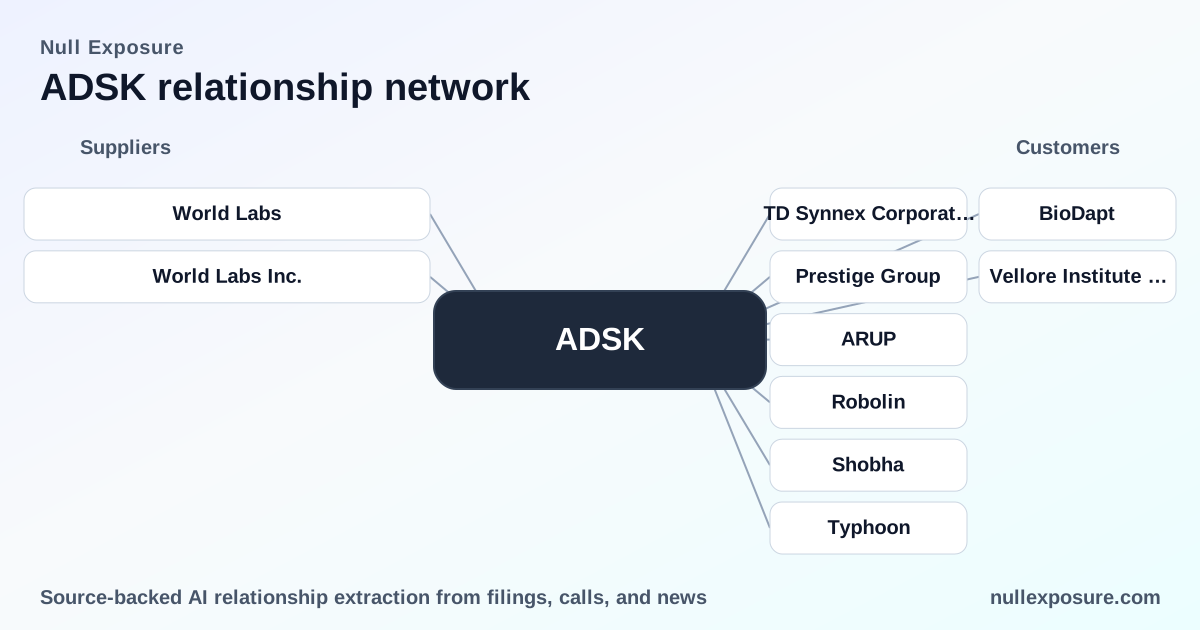
Autodesk’s customer map: how product, partners and platform drive recurring revenue
Autodesk operates a multi-modal commercial engine: it sells term subscriptions and cloud services to enterprises and small businesses, and it offers a usage-based Flex token model for intermittent or project-driven users. The company monetizes through high-margin software and cloud offerings, complemented by Solution Providers and distributors that expand reach globally—a structure that produces high recurring revenue (97–98% of net revenue) and strong net revenue retention while concentrating a meaningful share of revenue through a small number of distribution channels.
If you want a searchable, annotated feed of these customer relationships and filings, visit https://nullexposure.com/ for more structured coverage.
How Autodesk’s customer relationships are structured in practice
Autodesk’s commercial posture is deliberate: subscription-first, supplemented by usage-based tokens and partner-led distribution. The result is a hybrid contracting model that balances predictable recurring cash flows with incremental, elastic revenue from Flex consumption. Company disclosures and recent public announcements produce several clear signals about concentration, counterparty mix, and go-to-market maturity:
- Contracting posture: The business is predominantly subscription-driven with a growing usage-based Flex option; Autodesk introduced a token-based Flex transaction model across regions during fiscal 2023–2024, enabling daily-rate consumption for project spikes.
- Concentration and channel risk: Autodesk continues to rely on both direct enterprise sales and indirect channels; a single distributor remains material to topline (see TD Synnex below).
- Counterparty mix and criticality: Customers range from large enterprise and government accounts to small businesses and educational institutions, indicating both large-account dependence and broad SMB exposure.
- Geographic coverage: Sales and support are global across the Americas, EMEA and APAC, with targeted enterprise wins in APAC highlighted in recent press.
- Maturity and retention: The subscription model is mature—recurring revenue accounted for ~97–98% of net revenue and NRR was in the 100–110% range as of FY2025—supporting stable monetization but exposing the company to competitive displacement risk in large accounts.
Below I catalog every customer relationship noted in our source set and provide plain-English takeaways with source attributions.
The customer list — one-line takeaways and sources
-
TD Synnex Corporation
Autodesk’s largest distributor remains a major revenue conduit: revenue through TD Synnex and affiliates accounted for 33% of net revenue in FY2025, down from 39% in FY2024. This underscores meaningful channel concentration that investors must monitor for renewal and contract terms. According to Autodesk’s FY2025 Form 10‑K filing, TD Synnex materially contributes to net revenue. -
Prestige Group (India)
Prestige Group selected Autodesk as its core design delivery platform in a competitive RFP and signed a three‑year enterprise partnership to digitize project lifecycle and standardize execution across its portfolio. This is a notable APAC enterprise expansion that validates Autodesk’s Forma/Cloud offerings in large real‑estate portfolios (reported in CRN Asia and reiterated on Autodesk’s earnings call commentary in Q4 FY2026). -
Globant (GLOB)
Globant was named an Autodesk Tandem Digital Twin Solution Provider, expanding a 15‑year collaboration to accelerate digital twin deployments across airports, smart buildings and manufacturing. That strategic services partnership deepens commercial motion around Tandem and physical‑AI use cases, per Globant/press coverage and market reports (April 2026 announcements covered by MarketScreener and InsiderMonkey). -
ARUP
ARUP, the global engineering consultancy, is standardizing on Autodesk Forma to enable data‑centric workflows, real‑time collaboration, and AI‑driven insights across multidisciplinary teams—an enterprise adoption that illustrates Forma’s traction in design and engineering services, as discussed on Autodesk’s Q4 FY2026 earnings call transcript. -
Robolin
Robolin (an ENR Top 400 contractor) adopted Forma for Construction, replacing a competitive solution to unify preconstruction, construction, and virtual design and construction workflows—evidence of migration activity within the contractor segment, mentioned on Autodesk’s Q4 FY2026 earnings call. -
Shobha
Shobha, a vertically integrated real estate developer, uses Autodesk’s Flex offering to scale usage across projects and regions while maintaining cost visibility—an example of how Flex supports project-driven consumption in large developers (noted on the Q4 FY2026 earnings call). -
Typhoon
Typhoon, a Belgian industrial manufacturer, selected Autodesk’s manufacturing solutions to replace legacy, unintegrated tools that were reducing engineering hours and collaboration efficiency—illustrating Manufacturing Cloud and Fusion adoption in industrial OEMs (cited on the Q4 FY2026 earnings call). -
Vellore Institute of Technology (VIT)
Autodesk expanded its relationship with VIT in India, where students are now applying industrial‑grade Autodesk software to real‑world design challenges—this represents Autodesk’s education channel penetration and long‑term pipeline cultivation in APAC (reported on the Q4 FY2026 earnings call). -
BioDapt
Autodesk partnered with BioDapt to apply Fusion’s AI capabilities to advanced prosthetics, a targeted collaboration that showcases product‑level AI use cases and the Manufacturing Cloud’s addressable scope in highly specialized engineering problems, per market reports and commentary in March 2026 (MarketBeat and SimplyWallSt summaries).
What these relationships imply for investors
Autodesk’s customer roster signals a clear commercial playbook: win anchor enterprise accounts and industry partners while monetizing a broad base through subscriptions and Flex consumption. The mix of engineering consultancies (ARUP), systems integrators/service partners (Globant), large regional developers (Prestige, Shobha), and manufacturing customers (Typhoon, BioDapt) demonstrates that Autodesk is executing a platform expansion across built‑environment and manufacturing verticals.
Key implications:
- Revenue quality remains high: With ~97–98% recurring revenue and NRR between 100–110%, revenue durability is a core strength.
- Channel concentration is a material risk: A single distributor accounted for one‑third of net revenue in FY2025—monitor distribution contracts and channel migration to direct transaction models.
- Product-led upsell opportunities exist: Partnerships that extend Tandem digital twins and Fusion AI into verticalized workflows create expansion levers beyond base subscriptions.
- Execution and competition matter: Enterprise wins validate product-market fit, but retention and displacement in large accounts will determine long‑term margin expansion and multiple re‑rating.
Investors should weigh these dynamics alongside macro capex trends in construction and manufacturing and Autodesk’s execution on cloud, AI, and partner integrations.
Risks and watch‑points for the next 12–24 months
- Renewal outcomes with large distributors and named accounts (given the 33% distributor concentration disclosure) will drive short‑term revenue volatility.
- Competitive displacement in large enterprise workflows could pressure NRR if migration to alternative platforms accelerates.
- Adoption of Flex tokens improves total addressable monetization but creates variable revenue that can increase quarter‑to‑quarter volatility.
For a curated view of customer relationships and to drill down into the primary sources behind each relationship note, visit https://nullexposure.com/.
Bottom line
Autodesk runs a subscription‑anchored, partner‑amplified commercial model with an increasingly diversified set of enterprise and industry partners using both subscription and usage‑based consumption. High recurring revenue and growing platform partnerships are core strengths; channel concentration and enterprise retention are the principal risks to monitor.