ADT customer relationships: why recurring subscriptions and channel deals determine valuation
ADT monetizes through a large base of monthly subscription monitoring contracts, supplemented by one‑time sales and installations of hardware. The business converts customer acquisition into long‑lived intangible assets—subscriber relationships amortized over extended lives—creating predictable, high‑visibility cash flows that underwrite margin expansion and buybacks. For investors and operators, the key question is how partner distribution and technology licensing amplify recurring revenue while keeping exposure concentrated in the U.S. residential and small‑business markets. For more structured signals on counterparties and contract terms, see Null Exposure’s research hub: https://nullexposure.com/
ADT’s model is straightforward: sell and install devices, then capture contractual monthly fees; augment that core with channel partnerships and technology licensing that scale subscribers and product penetration. The company’s recent moves—an Origin AI acquisition and licensing deals with European players, plus new retail channels—shift the growth vector from pure organic subscriber adds to partner‑led expansion.
How ADT’s customer economics actually work (and why contracts matter)
ADT sells security and smart‑home solutions and records revenue primarily as recurring monitoring fees, with hardware sales as a secondary, lower‑margin stream. ADT’s standard consumer contracts run two, three or five years with automatic renewals and the company accounts for subscriber assets on a pooled basis and amortizes those subscriber acquisition costs over an estimated 15‑year customer life, which makes each new contract a multi‑year cash generator reflected on the balance sheet (ADT 10‑K, FY2024).
This operating posture creates several company‑level characteristics you must price into the stock:
- Contracting posture: long‑term and sticky. The combination of multi‑year standard terms and automatic renewal mechanics produces durable recurring revenue and predictable churn dynamics.
- Concentration: U.S. residential and small business. ADT explicitly states it is focused on the U.S.; revenue from outside the U.S. is immaterial (ADT 10‑K, FY2024).
- Revenue criticality and maturity: services first, hardware second. Monitoring and related services drive margins and cash generation; hardware sales are complementary and less material to recurring margin profile.
- Relationship staging: active and measurable scale. As of December 31, 2024, ADT served approximately 6.4 million security monitoring subscribers, a base large enough to support scale economics and retention‑driven capital allocation (ADT 10‑K, FY2024).
These features combine into a business that trades more like a high‑visibility subscription services company than a one‑time hardware seller; model accordingly.
Distribution and strategic partners that move the needle
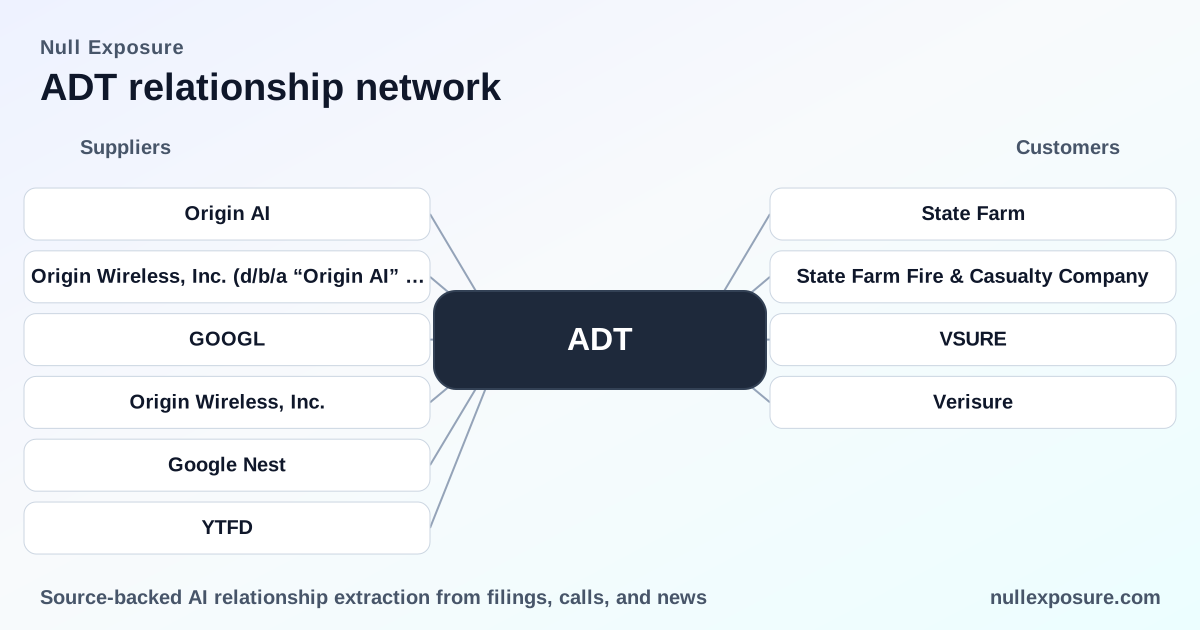
ADT’s partner ecosystem influences subscriber growth, technology access and international reach. Below are the relationships surfaced in filings and market reports; each is summarized with source attribution.
-
State Farm — discounted ADT offers for policyholders. ADT provides home security products and professional monitoring to State Farm customers at reduced cost, effectively using an insurance distribution channel to add subscribers and lower customer acquisition cost. (ADT 10‑K, FY2024)
-
State Farm Fire & Casualty Company — longstanding trademark agreement. ADT’s 10‑K references a Trademark Agreement dated September 25, 2012 among ADT entities and The ADT Corporation, documented in filings as part of legacy arrangements with insurance affiliates. (ADT 10‑K, FY2024)
-
Verisure (Nasdaq Stockholm: VSURE) — multi‑year licensing partner for Origin AI sensing. ADT announced a five‑year renewable commercial licensing agreement under which Verisure will license Origin AI’s proprietary AI sensing technology to scale AI‑driven security globally, creating a predictable licensing revenue stream tied to the Origin AI acquisition. (GlobeNewswire press release, Feb 24, 2026; ADT 4Q/Full‑Year 2025 results press release, Mar 2, 2026)
-
Verisure — sector reporting on deal economics and scale. Market writeups note the Origin AI acquisition price and the companion commercial agreement—ADT acquired Origin AI for roughly $170 million in cash and secured a $30 million five‑year commercial licensing commitment from Verisure, which de‑risks part of Origin AI’s revenue ramp. (TradingView report, Mar 9, 2026)
-
Verisure — continued market coverage reinforcing the arrangement. Multiple outlets reiterated the same multi‑year commercial licensing narrative and reaction in trading commentary, signaling market validation of the licensing approach. (GlobeNewswire, Finviz, StockTitan coverage, Feb–May 2026)
-
Amazon — retail channel for ADT Blue consumer line. Management disclosed that the ADT Blue product line will launch on ADT’s website in late May and expand to online retail channels including Amazon over the summer, opening a high‑volume e‑tail distribution path for consumer devices. (Q1 2026 earnings call transcript, The Motley Fool, Apr 30, 2026)
Why the Origin AI / Verisure deals change the investment lens
The Origin AI acquisition and subsequent Verisure licensing contract reposition ADT from a purely U.S.‑centric services company toward a global technology licensor for sensing and AI capabilities. The financials reported in market coverage—$170 million purchase price and a $30 million five‑year commercial agreement—provide direct, attributable cash inflows and a route to monetize technology beyond ADT’s subscriber base (TradingView, Mar 9, 2026; GlobeNewswire, Feb 24, 2026).
Strategic implications for investors:
- Revenue mix diversification: licensing revenue from partners like Verisure complements domestic subscription cash flows and lowers pure‑subscriber growth dependence.
- Leverage and margin impact: the acquisition is modest relative to ADT’s EBITDA base, so scale economics and margin expansion are attainable if licensing proliferates.
- Execution sensitivity: successful global scaling depends on partner uptake and the ability to translate AI sensing into contractual, recurring fees outside ADT’s existing U.S. footprint.
For ongoing signal monitoring and partner tracking, visit Null Exposure’s platform: https://nullexposure.com/
Bottom line: what to price into the model now
- Core thesis remains subscription‑centric and U.S.‑focused. ADT is a seller and service provider with long‑term contractual economics and a 6.4 million subscriber base that supports predictable cash conversion (ADT 10‑K, FY2024).
- Channel and licensing deals are incremental value drivers. State Farm distribution and Amazon retail broaden acquisition channels; the Origin AI purchase plus Verisure licensing create a nascent but tangible technology revenue stream.
- Key risk vectors are execution and customer retention. Pricing should reflect churn dynamics embedded in long‑term renewals, the ability to scale third‑party licensing beyond pilot agreements, and concentration in the U.S. residential and small‑business market.
Investors should underwrite ADT as a subscription business with measured optionality from its technology licensing strategy; the company’s partner agreements materially improve visibility into near‑term revenue ramps while leaving core exposure squarely in the domestic services franchise.