Aebi Schmidt: Revenue from engineered vehicles, attachments and aftermarket services — what customers tell investors
Aebi Schmidt designs and manufactures specialty municipal and industrial vehicles and attachments, monetizing through new equipment sales, retrofit conversions, and high-margin aftermarket parts and service contracts for municipal and commercial fleets. The firm’s revenue mix is grounded in durable capital equipment sales, recurring parts/service and selective OEM conversions that position Aebi as a mission-critical supplier for winter maintenance and municipal operations.
Explore the full relationship set and sourcing at Null Exposure: https://nullexposure.com/
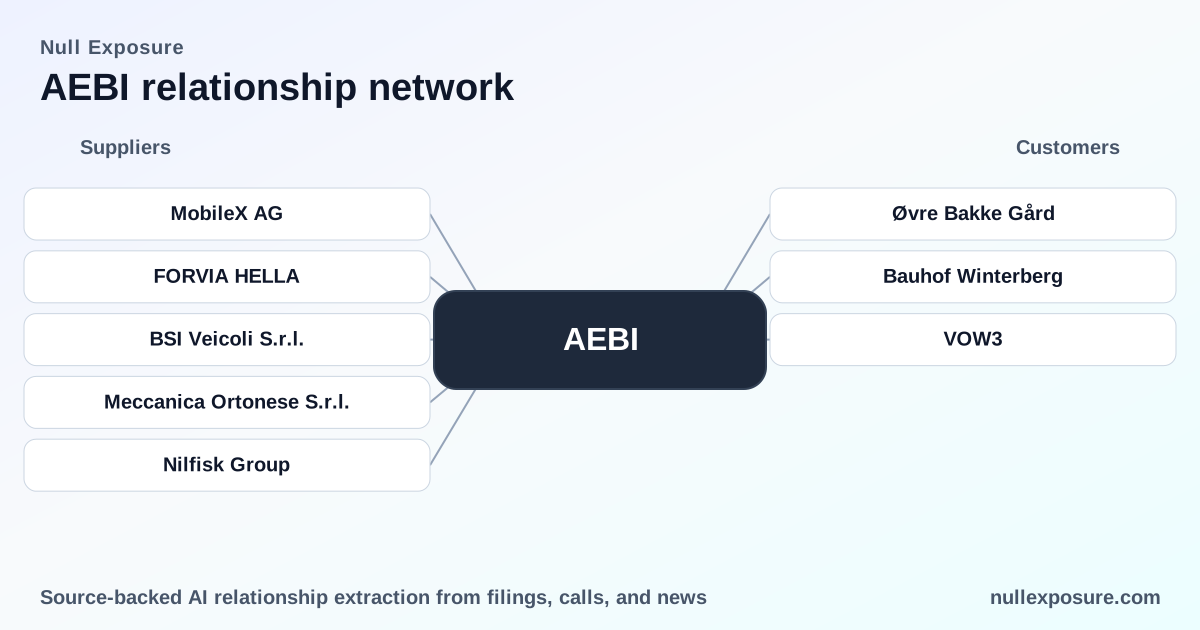
Field-level customer evidence: five relationships that matter
The collected customer mentions are discrete, operational confirmations of Aebi’s end markets: municipal depots, individual commercial operators, aftermarket retrofit work with vehicle OEMs, and a mention tied to a North American commercial fleet name. Each entry below is a concise, plain-English takeaway with the original source.
Øvre Bakke Gård — repeat buyer for skid-mounted sweeper
Øvre Bakke Gård moved from testing a used Schmidt machine in 2023 to deploying a new Schmidt Wasa 300 + sweeper for the 2024 season, indicating uptake by specialty agricultural/estate operators for year-round cleaning and maintenance tasks. According to a Bauhof-Online article (published March 9, 2026): https://www.bauhof-online.de/d/aebi-schmidt-holding-ag-wasa-300-ueberzeugt-im-norwegischen-asker/.
Bauhof Winterberg — municipal depot long-term trial of Flexigo 150
The municipal maintenance unit Bauhof Winterberg conducted a long-term test of the Schmidt Flexigo 150 with a new attachment, signaling interest from public works departments in Aebi’s multi-function sweepers for municipal street care. Reported by Bauhof-Online (March 9, 2026): https://www.bauhof-online.de/d/aebi-schmidt-holding-ag-flexigo-150-besteht-langzeittest-in-winterberg/.
Shyft (SHYF) — commercial fleet strength mention linked to North America orders
A news piece referencing commercial vehicle demand cites strong North American growth and legacy walk-in-van orders tied to Shyft, which is reported in the same feed that mentions Aebi’s customer context; this suggests Aebi’s products touch wider commercial fleet markets through integration or supply-chain activity in North America. See the Intellectia news summary (May 2, 2026) that references Shyft’s order trends: https://intellectia.ai/news/stock/swatch-faces-innovation-crisis-and-governance-challenges.
VOW3 — OEM conversions for winter service on Amarok platform
A traffic/industry article documents that Aebi Schmidt Deutschland performed conversions of the VW Amarok for winter service use, showing capability and revenue potential from vehicle modification and OEM collaboration. The article (covering spring reporting of the conversion program) is on Verkehr (March 9, 2026): https://www.verkehr.co.at/pickup-fuer-den-winterdienst/.
VW Nutzfahrzeuge — explicit example of a modified Amarok SingleCab
The same Verkehr article profiles VW Nutzfahrzeuge models converted by Aebi Schmidt Deutschland (Amarok SingleCab with powertrain and 4MOTION adaptations), reinforcing Aebi’s role as a trusted retrofit/installer for light commercial vehicle winterization. Source: Verkehr write-up on winter conversions (March 9, 2026): https://www.verkehr.co.at/pickup-fuer-den-winterdienst/.
What the customer map implies about Aebi’s operating model
The customer list is coherent and confirms several company-level operating characteristics that are material for investors:
- Contracting posture — relationship-driven, project and retrofit sales. Aebi sells capital equipment and conversion projects that are typically negotiated and tested in the field; the Bauhof Winterberg and Øvre Bakke Gård items are examples of long-test cycles that convert into purchase decisions.
- Concentration — distributed, low single-customer concentration. Public works units, individual estate operators, OEM conversion programs and commercial fleets create a diversified base rather than dependence on a single large buyer.
- Criticality — mission-critical for winter operations and municipal cleanliness. The product set—sweepers, spreaders, retrofitted light vehicles—is operationally critical for clients that must maintain roads and services in winter and high-use seasons, supporting sticky aftermarket revenue.
- Maturity and product lifecycle — long-lived assets with recurring service revenue. Vehicles and attachments have long service lives; the pattern of trial → purchase → retrofit/service supports a predictable aftermarket revenue stream and parts demand.
- Channel mix — direct municipal sales, retrofit/OEM partnerships, and commercial fleet penetration. Evidence includes municipal depot trials, standalone farm/estate purchases, and OEM-modified Amarok conversions.
These signals position Aebi as a specialty-equipment supplier with high aftermarket capture potential and a business model built on negotiated equipment sales plus recurring service and parts.
Investment implications — risk and upside distilled
- Upside: durable aftermarket and retrofit economics. The customer evidence highlights repeatable replacement/service cycles and OEM retrofit work, supporting margin resilience beyond cyclical equipment sales.
- Risk: seasonal and regional concentration in winter services. While customers are diverse by type, revenue has seasonal peaks tied to winter maintenance and protected geographies where winter is severe; this creates uneven cash flow across quarters.
- Operational leverage: product acceptance via field trials accelerates funnel conversion. Municipal pilots like Bauhof Winterberg demonstrate the commercial path from trial to procurement — a positive for marketing efficiency and customer acquisition costs.
- Exposure to vehicle OEM cycles. Conversion work (VW Amarok example) links Aebi to OEM production volumes and model cycles; this is an incremental revenue stream but can be lumpy.
Key takeaway: Aebi’s customer set demonstrated here supports a business model centered on durable hardware sales with high-margin aftermarket service; investors should value the company for recurring parts/service capture and differentiated retrofit capabilities while accounting for seasonal and OEM-cycle volatility.
How investors and operators should use this customer intelligence
- For corporate diligence: prioritize verification of municipal service contracts, aftersales service penetration rates, and historical conversion programs with OEMs.
- For portfolio managers: model higher earnings stability than pure capital-equipment peers because of aftermarket service revenue, but apply seasonal smoothing and sensitivity to European winter severity.
- For operators: replicate the trial-to-purchase path observed (pilot units, local demos) to accelerate municipal adoption in new markets.
If you want an aggregated view of Aebi’s customer relationships and to track new mentions as they surface, visit Null Exposure for ongoing coverage: https://nullexposure.com/
Final read: concise investor checklist
- Confirm depth of aftermarket/service contracts and parts margins.
- Monitor OEM conversion pipelines and timing relative to vehicle model cycles.
- Model seasonality explicitly; stress-test near-term cash flow for mild winters.
- Use field-trial evidence (municipal pilots) as a leading indicator for order conversion.
Bottom line: The customer mentions reviewed here validate Aebi Schmidt’s position as a specialist supplier to municipalities, commercial fleets and OEM conversion programs, and they reinforce the company’s core monetization levers: durable equipment sales plus recurring, high-margin aftermarket services.