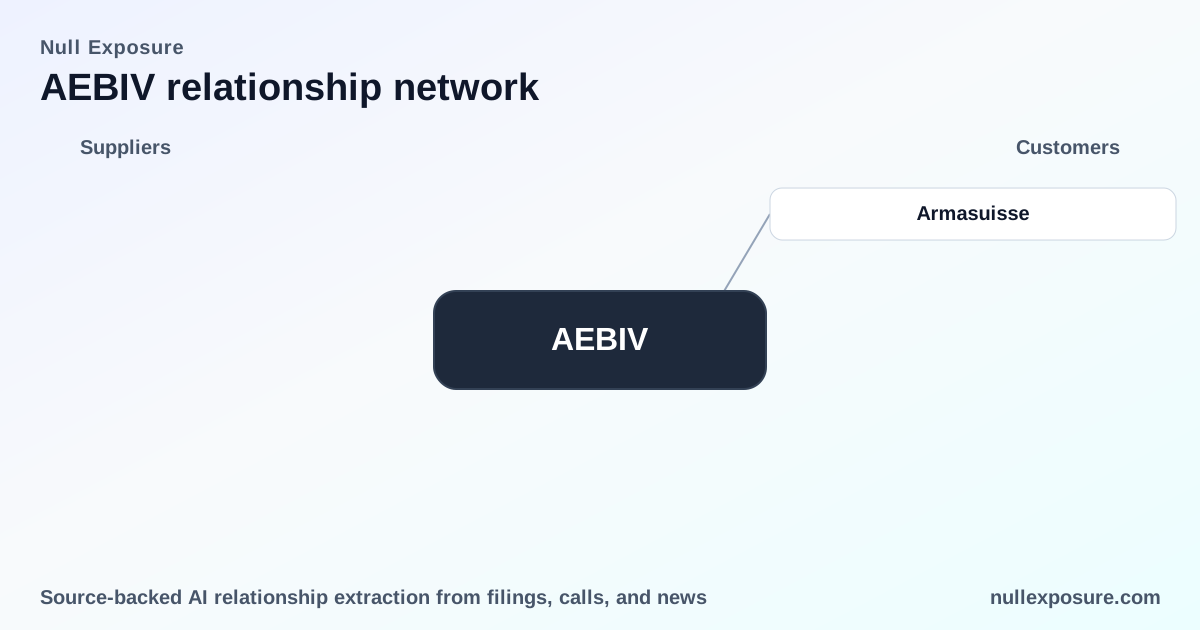
AEBIV — Customer Relationships: Armasuisse Procurement and What It Means for Investors
AEBIV generates revenue by selling and supporting heavy-capital equipment to institutional buyers and public-sector operators, capturing value through unit sales, installation, and recurring maintenance or service contracts. The business model is driven by discrete procurement wins with meaningful aftermarket economics, so tracking sovereign and municipal customers is central to forecasting revenue cadence and margin durability. For deeper coverage of AEBIV relationships and procurement signals visit NullExposure.
Quick take: why one procurement note matters more than the headline
A single confirmed institutional purchase can be a meaningful signal for a company with a capital-equipment sales profile. AEBIV’s customer base skews government and enterprise — contracts are lumpy, contract terms are long, and aftermarket service drives recurring margin. The reported Armasuisse engagement highlights all three dynamics: a procurement decision after testing, a finite unit order, and an implied service lifecycle that follows equipment deployment.
What the record shows: Armasuisse chose ten Schmidt Supra 4002 units
Armasuisse conducted field trials and subsequently procured ten Schmidt Supra 4002 snow-throwing units for its fleet. This transaction is cited in a Swiss transport publication referencing the procurement and its testing phase in FY2018. (TIR Transnews, Switzerland; March 9, 2026).
- The article states that Armasuisse selected ten units of the Schmidt Supra 4002 following trial evaluations, indicating a completed procurement decision and a discrete capital order (TIR Transnews, March 9, 2026).
How this single relationship fits into the commercial picture
This procurement signals several practical commercial realities for AEBIV and similar capital-equipment suppliers:
- Validated product fit through trials. An institutional buyer moved from testing to purchase, which shortens the lead time to contract award and improves the odds of follow-on orders or aftermarket services.
- Lumpy revenue with high aftermarket leverage. Ten units represent a one-time revenue event for equipment sales but create a recurring service base — spare parts, scheduled maintenance, and potential upgrades.
- Reputational value in institutional channels. A public-sector procurement can function as a reference for other municipal or defense customers and de-risks future procurement cycles.
For investors, the Armasuisse note is a positive signal in the sales funnel — a concrete, closed order rather than a pipeline mention — and should be weighted accordingly in revenue models and aftermarket margin forecasts.
Operating model and business-model characteristics you must monitor
Below are company-level signals that define how AEBIV will perform operationally and commercially. These are presented as structural features of the business model rather than attributions to any single buyer.
Contracting posture and procurement channels
AEBIV operates predominantly in a formal procurement environment. Sales are dominated by tender-based contracts and negotiated government purchases, which means sales cycles are elongated and procurement outcomes are binary. Winning requires compliance, references, and demonstrated field performance.
Concentration and revenue volatility
Customer concentration is an inherent feature. A handful of institutional orders can represent material chunks of near-term revenue, so models must assume quarter-to-quarter volatility and plan for revenue lumpiness. Diversification across geographies and customer types is a mitigant, but concentration risk remains a core exposure.
Criticality and aftermarket economics
Equipment sold into municipal and defense fleets is mission-critical during peak seasons (e.g., winter operations). This creates a high-margin aftermarket opportunity: spare parts, preventive maintenance, and rapid-response repair services. Aftermarket revenue typically inflates lifetime customer value and stabilizes margins between discrete capital sales.
Maturity, renewal cycles, and visibility
Replacement cycles for heavy equipment span several years, producing low-frequency but high-value procurement events. Visibility into future sales requires active monitoring of fleet age, announced trials, and budget cycles at customer agencies. A win in one procurement cycle often results in multi-year service revenue.
How to translate the Armasuisse relationship into an investment monitor
Investors should convert the procurement signal into actionable monitoring checkpoints:
- Track follow-on service contracts and spare-part orders tied to the ten units; these will confirm the aftermarket revenue capture.
- Monitor procurement pipelines in other municipalities or defense agencies for references to the Schmidt Supra 4002 or the vendor, which can indicate scaling.
- Watch budget calendars for the next replacement cycle; public-sector purchasing rhythms are predictable and inform long-term revenue cadence.
If you want systematic tracking of these kinds of procurement signals, see coverage and tools at NullExposure.
Key risk factors to price into models
- Procurement concentration: One large buyer can shift guidance materially; models must incorporate scenario paths for both customer retention and attrition.
- Service execution risk: Aftermarket margin depends on field-service capability; shortcomings here compress lifetime margins.
- Budget and political cycles: Public-sector demand follows budget approvals and seasonal needs; a downturn in capital budgets delays or cancels orders.
- Supply and delivery timing: Delays in production or logistics materially affect revenue recognition for lumpy equipment sales.
Closing assessment
The Armasuisse procurement is a discrete, verifiable win that validates product fit and establishes a serviceable base of equipment — a valuable datapoint for forecasting AEBIV’s near-term revenue and aftermarket margin potential. Investors should treat this as a positive operational signal, but price in concentration and timing risk given the capital-equipment sales model. Active monitoring of service contracts and subsequent institutional references will determine whether this remains an isolated order or the start of a scalable revenue stream.