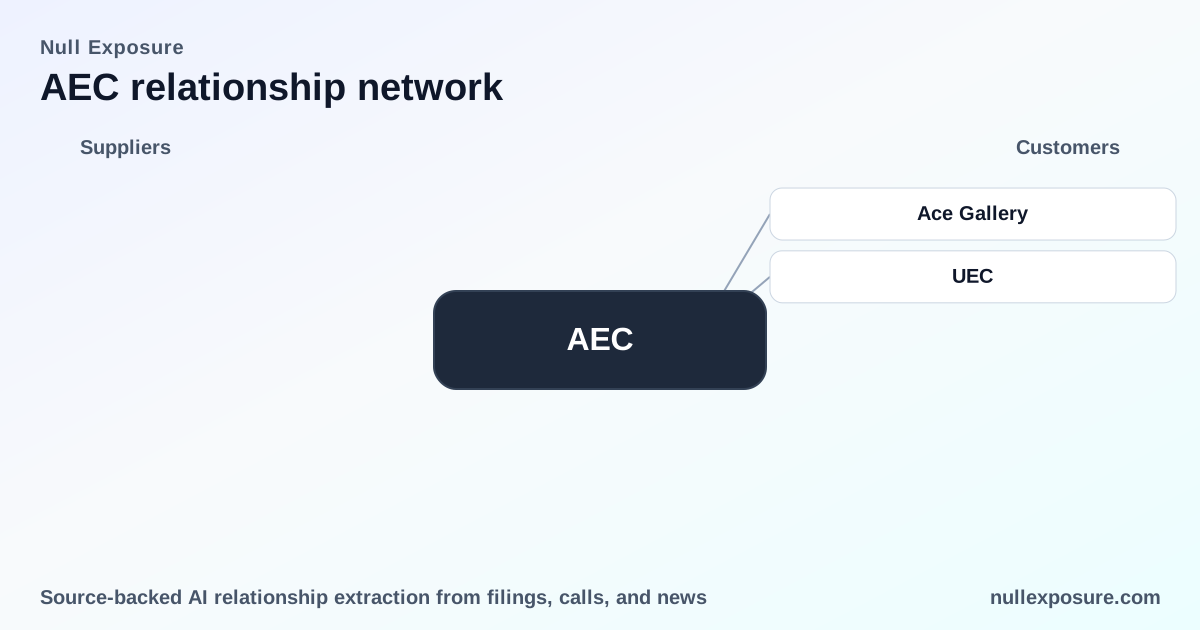
AEC customer-relationship map: what investors need to know
Thesis — Anfield Energy Inc. (AEC) operates as a real estate investment trust that acquires, manages and renovates multifamily residential properties and monetizes through rental cash flow and asset appreciation. Investor focus should be on capital partnerships and financing cadence, ownership concentration, and how legacy real-estate transactions recorded under the AEC ticker intersect with recent financing from an insider investor. For a concise view of underlying relationship signals, visit https://nullexposure.com/.
Why these relationships matter for valuation and financing
Anfield’s public profile combines operating real estate activity with a compact capital base and high insider ownership (over 31% insider share). That ownership profile, coupled with documented non-brokered private placements, reveals a contracting posture that is direct and concentrated: management executes negotiated financings rather than wide public underwritings. With reported negative EBITDA and negative EPS alongside a market capitalization under $100 million, equity dilution and partner-by-partner financing decisions are material to the company’s ability to execute its property strategy.
Relationship-by-relationship: the facts investors should track
-
Brookfield Asset Management Inc. — legacy M&A linked to Associated Estates Realty Corp.
An RTTNews report recounts that Associated Estates Realty Corp. agreed to be acquired by a Brookfield affiliate in a transaction valued about $2.5 billion (the item references FY2015 activity). This record under the AEC grouping signals a historical M&A event tied to the AEC name space rather than a current operating customer of Anfield Energy. (RTTNews, FY2015 announcement archived 2026: https://www.rttnews.com/2485762/brookfield-asset-management-to-buy-associated-estates-realty-in-2-5-bln-deal.aspx) -
Ace Gallery — tenant at Desmond Tower tied to an Associated Estates acquisition narrative.
A local news story describes Associated Estates acquiring the Desmond Tower, a building that housed tenants including Ace Gallery, and planning residential conversion that would add apartments and structured parking. This item indicates tenant composition and redevelopment intent tied to a property referenced in the AEC relationship set. (Larchmont Buzz, March 2026 coverage of the Desmond Tower acquisition: https://larchmontbuzz.com/larchmont-village-news/associated-estates-purchases-historic-desmonds-tower/) -
UEC (UEC Energy Corp.) — insider subscription receipts in a private placement (FY2026).
A GlobeNewswire release documents that Anfield sought shareholder approval for issuance of 896,861 subscription receipts to UEC Energy Corp., a subsidiary of Uranium Energy and described as an insider and controlling shareholder, at US$4.46 per subscription receipt for gross proceeds of US$4,000,000. This is a direct cash infusion from an insider-related entity and is contractually structured as a non-brokered private placement. (GlobeNewswire, February 6, 2026: https://www.globenewswire.com/news-release/2026/02/06/3234082/0/en/Anfield-Energy-Announces-Special-Shareholder-Meeting-and-Mailing-of-Related-Documents.html) -
Uranium Energy Corp. — indicated subscriber to the concurrent private placement (FY2025).
A December 2025 notice reports that Uranium Energy Corp. indicated intent to subscribe for up to 896,861 subscription receipts in a concurrent non-brokered private placement, supporting up to US$4,000,000 of gross proceeds to the company. That repeated disclosure across communications confirms the financing pathway and the reliance on a corporate affiliate of a controlling shareholder for near-term capital. (SahmCapital, December 25, 2025 announcement: https://www.sahmcapital.com/news/content/anfield-energy-amends-previously-announced-private-placement-us6000000-non-brokered-life-offering-of-common-shares-and-concurrent-us4000000-non-brokered-private-placement-of-subscription-receipts-2025-12-25) -
Uranium Energy Corp. (duplicate reference) — parallel coverage of the same subscription receipts intent (FY2025).
A companion item restates that Uranium Energy indicated an intention to subscribe for the subscription receipts at the issue price in the concurrent offering, again for gross proceeds up to US$4,000,000, reinforcing that the company’s latest financing was structured through an affiliated buyer under non-brokered terms. (SahmCapital, December 25, 2025: https://www.sahmcapital.com/news/content/anfield-energy-amends-previously-announced-private-placement-us6000000-non-brokered-life-offering-of-common-shares-and-concurrent-us4000000-non-brokered-private-placement-of-subscription-receipts-2025-12-25)
What these linkages imply about operating posture and risk
- Contracting posture — direct, negotiated capital injections. The public disclosures show non-brokered private placements with an affiliate of a controlling shareholder rather than broad-market underwritings, signaling a deliberate, relationship-driven financing approach.
- Concentration — capital and governance are concentrated. Insider ownership above 30% and direct subscriptions by an affiliate make Anfield’s capital access and governance dependent on a small set of connected parties.
- Criticality — financing is strategically material. With reported negative EBITDA (approximately -$15.96m) and negative EPS (-$0.95), the company requires periodic capital to execute property acquisitions and renovations; the UEC/Uranium transactions supply that liquidity.
- Maturity — mix of legacy and current signals. Relationship records include a legacy FY2015 M&A reference tied to Associated Estates and active 2025–2026 financing disclosures, indicating a combination of historical name overlap and present capital activity that investors must disambiguate when modeling.
Investment implications and monitoring checklist
- Governance and control risk is elevated. High insider percentage (31.1%) and low institutional ownership (roughly 15%) focus scrutiny on related-party financing and minority shareholder protections.
- Financing cadence is a valuation driver. The non-brokered $4.0M subscription receipts are material relative to market cap (~$89.1M) and to operating losses; track closing, dilution, and any attached warrants or conversion mechanics.
- Legacy name overlap requires careful data hygiene. The AEC relationship set includes items tied to Associated Estates Realty Corp.; investors must reconcile historical records with current Anfield Energy filings to avoid misattributing legacy deals to the present REIT.
- Operational metrics deserve close read. Reported RevenueTTM is listed as 0 while key margins and profitability are negative; investors must evaluate whether the company’s asset base is producing rental cash flow or whether redevelopment activity suppresses near-term revenue.
For ongoing tracking and to interrogate these partner signals in context, access a consolidated view at https://nullexposure.com/.
Bottom line for operators and investors
Anfield’s near-term equity value is tightly coupled to insider financing and execution of asset-level renovations. The presence of repeated, non-brokered subscriptions from an affiliate of a controlling shareholder is an explicit financing channel but also concentrates risk. Investors should prioritize confirmation of definitive financing terms, ownership dilution impact, and a reconciled ledger that separates legacy Associated Estates references from current Anfield assets before drawing valuation conclusions.