Aegon (AEG) — Strategic Unwinding and Repositioning: What counterparties tell investors
Aegon NV is a diversified insurer that generates revenue from life insurance, pensions, annuities and asset management across the Americas, Europe and Asia. The company is executing a clear monetization strategy: sell regulated domestic businesses, crystallize cash and equity stakes, and redeploy capital toward a U.S.-centric operating platform anchored by legacy Transamerica distribution. For investors this is a transition from a geographically diversified insurer to a more focused, capital-light franchise with recurring fee and protection income as the priority. For a quick company-level view, visit https://nullexposure.com/.
What the recent deal flow signals about strategy and capital allocation
Aegon’s public counterparties over the last 18 months form a coherent pattern: portfolio monetizations and legal redomiciliation, concentrated capital returns and non-core disposals that materially change the company’s regulatory footprint and revenue mix. The market reaction to these transactions is already reshaping valuation metrics and future earnings composition: expect lower exposure to legacy European retail life books and greater emphasis on U.S. distribution and annuity-growth products.
Observed counterparties and what each relationship means for Aegon
-
Standard Life Plc / Standard Life (SDLF.LON / ABDN) — Aegon agreed to sell its UK operations to Standard Life for roughly GBP 2.0 billion, a transaction that includes both cash and an equity stake in Standard Life as part consideration; this materially reduces Aegon’s UK exposure and generates immediate liquidity. Source: Bloomberg (Apr 15, 2026) and related filings reported by Reinsurance News and StockTitan (May 2026).
-
VENU (VENU) — Aegon is listed as a partner in venue and hospitality developments, indicating strategic commercial partnerships outside core insurance underwriting, useful for fee income or cross-sell opportunities. Source: GlobeNewswire press release (Oct 17, 2025).
-
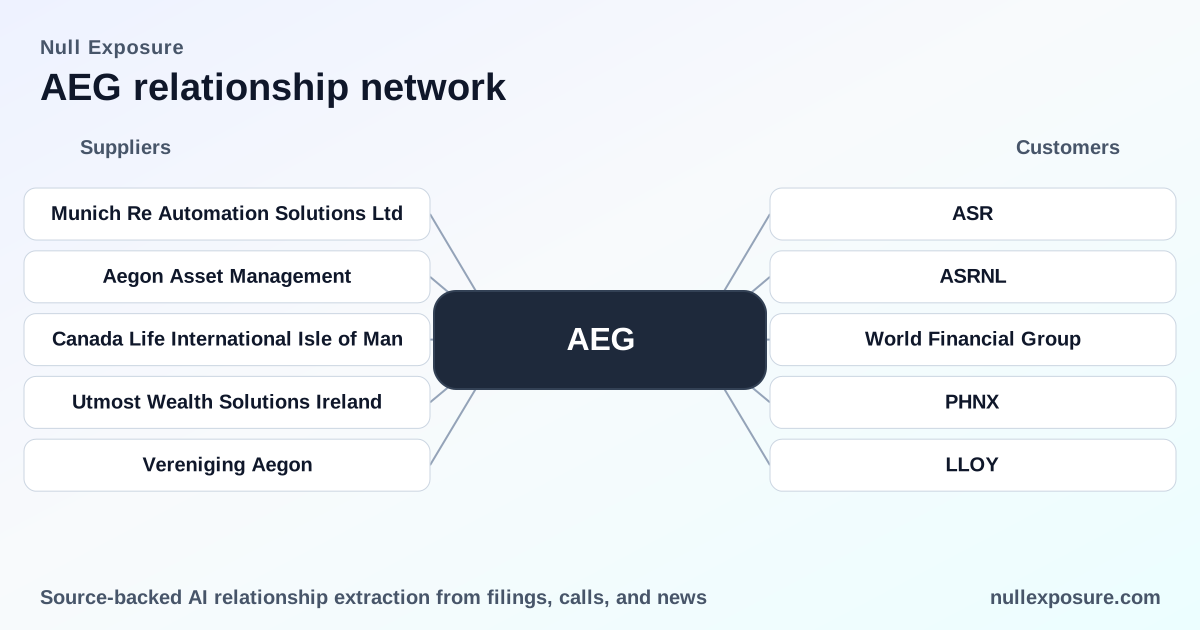
a.s.r. / ASR / ASR Nederland (ASRNL) — Aegon sold its Dutch life insurance operations to ASR in 2023 and subsequently initiated corporate redomiciliation steps; that disposal removed Aegon’s regulated Dutch life business and is a major enabler for its subsequent domicile and legal-structure changes. Source: Bermuda Reinsurance Magazine and ReinsuranceNews (Mar 2026) and Insurance Business coverage (Mar 2026).
-
World Financial Group — Aegon (as Transamerica) plans to drive growth via World Financial Group and a Protection Solutions business, signaling a distribution-led growth plan in the U.S. with targeted life and annuity channel partnerships. Source: Insurance Business magazine (Mar 9, 2026).
-
Lloyds Banking Group (LLOY) — During a strategic review of Aegon’s UK arm, Lloyds was publicly cited among potential bidders, underscoring competitive interest from large UK financial groups for life & pensions assets. Source: Insurance Business (Mar 9, 2026).
-
Phoenix Group (PHNX) — Phoenix was named in market reports as another potential acquirer in the UK strategic review, indicating the asset pool Aegon marketed has strong buyer interest from specialized life consolidators. Source: Insurance Business (Mar 9, 2026).
Note: multiple press items and filings repeat the Standard Life transaction across media outlets (TipRanks, MarketBeat, StockTitan); those items corroborate the GBP 2.0 billion headline and structure (partial equity stake plus cash). Source: MarketBeat and TipRanks (Apr–May 2026).
Company-level operating-model signals (constraints)
- Contracting posture: Aegon is a seller — a sustained program of divestments indicates management’s willingness to relinquish legacy, regulated businesses to accelerate strategic repositioning and liquidity generation.
- Concentration shift: The portfolio is becoming more U.S.-centric; disposals reduce geographic diversification and increase concentration in Transamerica-distribution-linked products.
- Criticality and regulatory exposure: Loss of regulated domestic businesses in the Netherlands and the UK materially changes Aegon’s regulatory profile and capital requirements, simplifying model complexity but increasing sensitivity to a single regulatory regime.
- Maturity profile: The firm is de-risking legacy books and pivoting to fee and protection income, shifting cash flows from long-duration, capital-intensive guarantees toward potentially higher-margin, distribution-led offerings.
What these relationships imply for revenue, risk and valuation
- Near-term cash and solvency boost: Sales to ASR and Standard Life deliver significant cash proceeds and equity stakes that strengthen liquidity and capital metrics, improving near-term balance-sheet flexibility.
- Earnings mix transformation: Expect recurring fee income and U.S. protection sales to replace a portion of ceded European life earnings, altering the predictability and volatility profile of future EPS.
- Valuation re-rating potential: The market will value the new Aegon more on U.S. distribution economics and less on European embedded value; forward P/E and price-to-book should reflect that transition given existing metrics (forward P/E ~9.3, P/B ~1.13 as of latest quarter).
Risk checklist investors should monitor
- Execution risk on the completed sales and integration of any retained stakes.
- Regulatory outcomes tied to redomiciliation and the shift in legal domicile.
- Concentration in U.S. markets and distribution partners — distribution risk becomes first-order.
- The market’s appetite for insurer consolidation assets; secondary-market valuations for sold units set precedents for remaining assets.
Conclusion — how to position
Aegon is executing a deliberate divest-and-focus plan that converts legacy, regulated books into liquidity and strategic equity positions while repositioning the franchise toward U.S. growth channels. This is a balance-sheet-heavy playbook that reduces legacy complexity and amplifies distribution-led returns; investors should reweight expectations toward fee and protection growth and track capital redeployments closely. For a consolidated view of counterparties and to monitor Aegon’s evolving counterparty map, visit https://nullexposure.com/.
For investors and operators tracking Aegon, the near-term story is capital conversion and regulatory simplification; the medium-term story is growth through U.S. distribution economics and annuity/protection product scaling.