Aehr Test Systems: customer relationships, concentration risk, and where revenue really comes from
Aehr Test Systems designs and sells wafer-level and packaged-part test and burn-in systems to semiconductor manufacturers, contract assemblers, and test service providers, monetizing through high-ticket hardware sales, recurring spare parts and service contracts, and short-term service engagements. Revenue is concentrated, geographically skewed toward Asia, and driven predominantly by hardware, with complementary services recognized over generally one-year or shorter contracts. For investors evaluating AEHR customer relationships, the priorities are simple: track order cadence from large customers, regional demand in APAC, and the company’s ability to convert system orders into service and spare-part annuities. Learn more at https://nullexposure.com/.
How Aehr actually makes money — the industrial economics
Aehr’s commercial model combines capital-equipment sales with associated services (installation, training, spares and field service). The company reported fiscal revenues heavily weighted toward its full-wafer contact product lines: approximately 66% of net revenues in fiscal 2025 came from full-wafer systems, with packaged-part product lines making up the balance. Gross profit and operating dynamics reflect a hardware-first company that supplements margins with services and consumables.
Revenue recognition is transactional and short-duration for services: the company recognizes service revenue over time as the customer receives benefit, and performance obligations include systems, contactors, spare parts, and installation/training. This makes near-term revenue visibility closely tied to order flow and deployment schedules rather than multi-year, locked-in service contracts.
Customer concentration: a structural constraint
Aehr’s revenue profile is highly concentrated. Revenues from the five largest customers accounted for approximately 77% of net revenues in fiscal 2025, and two customers represented roughly 39% and 15% of net revenues in that year. According to the company’s filings, the firm expects this concentration to persist. This level of customer concentration is business-critical: order delays, reductions, or receivable issues at one large customer can produce material quarter-to-quarter movement in revenue and cash flow.
Geography and where demand sits
Aehr sells globally but operations and shipped revenues demonstrate a clear regional skew. Asia accounted for roughly 63% of net revenues in fiscal 2025, the United States for about 30%, and Europe around 7% per the company’s disclosures. The company markets worldwide to semiconductor manufacturers and burn-in/test service companies, but APAC is the dominant demand center, which concentrates both opportunity and geopolitical/regional supply-chain risk.
Sales channels and contract posture
The company sells primarily through a direct sales force and uses independent distributors in certain international markets. Contractually, Aehr operates with short-term service and support agreements: services are recognized over time as customers receive benefit, typically under contracts of one year or less. That structure supports fast monetization of services but reduces sticky, long-duration recurring revenue.
Current customer relationships investors should know
Below are the customer relationships surfaced in the public record and what they mean for revenue and operations.
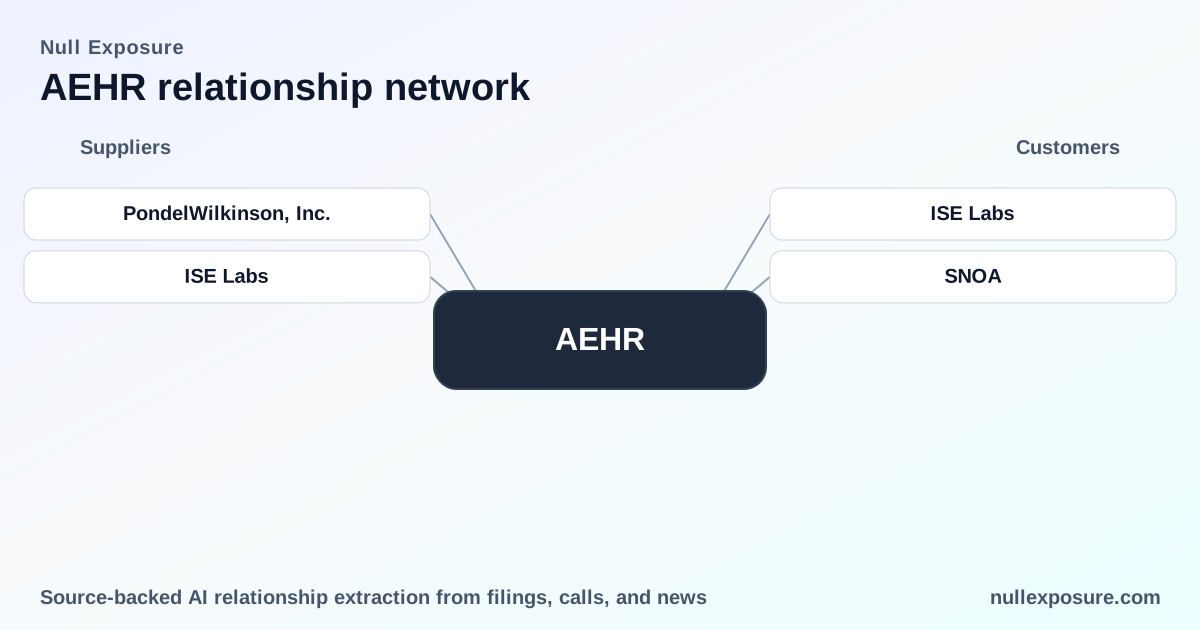
ISE Labs — expanding partnership for wafer-level test and burn-in
Aehr announced a strategic expansion of its partnership with ISE Labs during FY2026 to deliver advanced wafer-level test and burn-in services for next-generation HPC and AI applications, signaling a move to pair equipment sales with managed test services. This development indicates Aehr is supporting higher-value service workflows in addition to system shipments. According to an earnings call transcript published March 9, 2026, the company described this expansion as strategic in scope (InsiderMonkey, FY2026).
Takeaway: the ISE Labs relationship ties equipment revenue to downstream service demand and positions Aehr in the wafer-level burn-in services market.
SNOA — Sonoma PPBI system orders worth $5.5M+
Aehr announced over $5.5 million in Sonoma PPBI systems orders in FY2026, recorded in market commentary and press aggregation on March 9, 2026. The item surfaced under SNOA as an inferred symbol in market reports, tying system shipments to a named customer order flow (Yahoo Finance, March 9, 2026).
Takeaway: the Sonoma/SNOA order demonstrates continued hardware demand and meaningful single-order economic impact on near-term revenue.
Sonoma — customer order that drives near-term hardware revenue
The same market report that cited SNOA named Sonoma in connection with the $5.5M PPBI systems orders, confirming a specific customer-level purchase that will flow into fiscal shipments and service opportunities (Yahoo Finance, March 9, 2026).
Takeaway: this disclosed Sonoma order exemplifies how isolated large system orders materially influence quarterly results under Aehr’s concentrated customer base.
Operating-model constraints investors should treat as company-level signals
The public evidence yields a consistent set of operating constraints that frame investment analysis:
- Contract type — short-term: Service revenue is recognized over time for customer benefit under contracts generally one year or less, implying revenue is transactional and sensitive to order timing.
- Geography — APAC dominant, global presence: Asia generated the majority of net revenue in the latest fiscal year, with meaningful U.S. and smaller European receipts; the sales footprint is global but APAC-driven.
- Materiality — critical concentration: Top-five customers historically account for a very large share of revenue (77% in 2025), creating outsized customer risk.
- Relationship roles — buyer and distributor channels: The company acts as a direct seller to manufacturers and uses distributors in select international markets, a mixed channel posture that localizes sales execution.
- Segment mix — hardware-first with services: Full-wafer systems represent the bulk of revenue, while services and spare parts are performance obligations that support recurring revenue but currently play a secondary role.
All of the above are drawn from the company’s filings and recent disclosures in FY2025–FY2026.
Investment implications and what to watch next
For investors and operators, three monitoring points are decisive:
- Order cadence from top customers. Given concentration, a single large order can swing quarterly revenues materially. Track announced system orders and backlog disclosures.
- APAC demand and supply-chain dynamics. With the majority of shipments landing in Asia, regional semiconductor capex cycles and trade policy shifts directly affect Aehr’s revenue.
- Conversion of system sales into service annuities. The company’s strategic partnerships (for example, with ISE Labs) are evidence of management pushing into higher-margin, repeatable service flows; measure progress by disclosed service revenue trends and multi-year service agreements if and when they emerge.
Analysts place a target above the current price even as trailing profitability shows pressure: the company reported negative EPS on a TTM basis and operating margin compression, but forward multiples imply expectations for margin recovery and higher utilization. Monitor quarterly filings and customer announcements for confirmation of that trajectory.
If you want a data-driven view of how these customer relationships feed into Aehr’s order book and revenue trajectory, explore deeper at https://nullexposure.com/.
Bottom line
Aehr is a capital-equipment company whose near-term financial results are dominated by a small set of large customers and APAC demand. Strategic partnerships that extend equipment sales into wafer-level test services are positive for revenue quality, but concentration and short-duration service contracts keep earnings volatile. Investors should prioritize order flow, customer-specific disclosures, and the company’s ability to convert large system wins into durable service revenue.