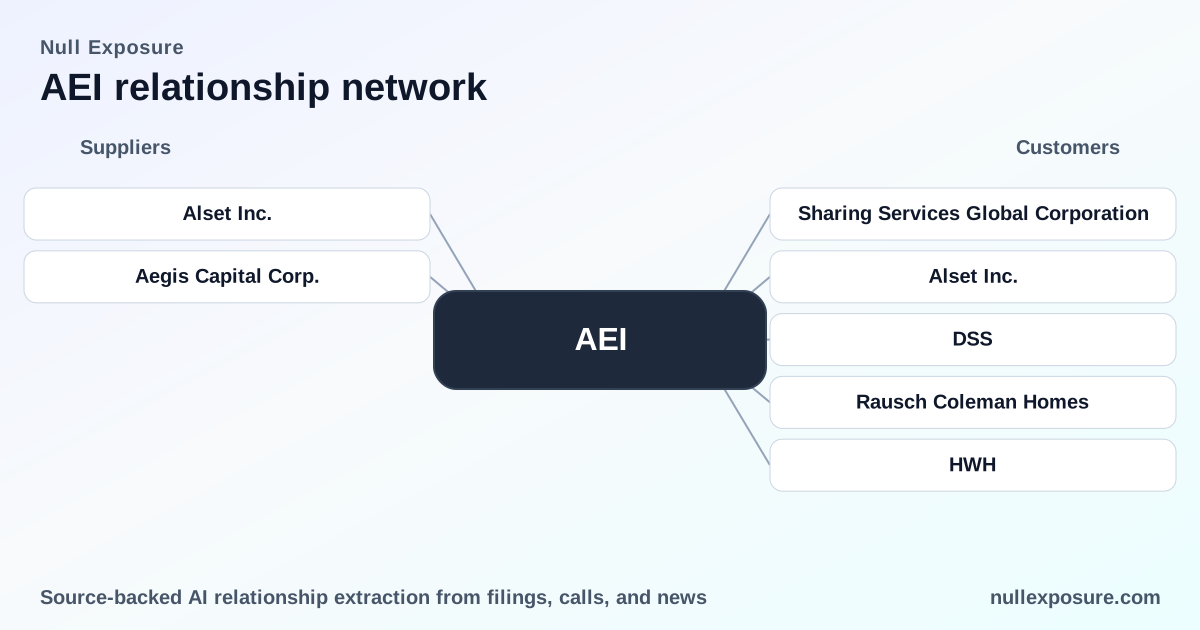
AEI (Alset EHome International Inc): counterparty map and investor takeaways
Alset EHome International (AEI) is a diversified holding company that monetizes primarily through property development and lot/home sales, supplemented by single‑family rental income, digital transformation services, and biohealth product sales. The balance sheet also reflects an active investment posture: AEI extends loans, receives convertible promissory notes and warrants, and completes intra‑group asset transfers and disposals to optimize capital and segment focus. For a consolidated view of AEI’s counterparty relationships and what they imply for revenue concentration and downside risk, see Null Exposure’s mapping at https://nullexposure.com/.
The short read for investors
- Revenue concentration is acute: property development accounted for roughly 79% of 2024 revenue, with two customers driving the vast majority of that segment.
- Contracting is mixed: spot, short‑term leases and a small number of longer leases coexist—this produces lumpy, project‑timed cash flows rather than stable subscription revenue.
- AEI uses convertible instruments as a deal and financing tool, accepting convertible notes/warrants from counterparties and issuing notes in related‑party transactions.
- Geographic footprint is US‑centric (93% of revenue) with small APAC exposure, which matters for macro sensitivity and execution complexity.
- Corporate ownership and liquidity are constrained: insiders own the large majority of shares and institutional ownership is low, increasing governance and liquidity considerations.
Visit Null Exposure for more contextual maps of these relationships: https://nullexposure.com/.
Customer and counterparty relationships — what the record shows
Below are the counterparties identified in AEI’s customer/transaction records with plain‑English summaries and source context.
Sharing Services Global Corporation
AEI and its subsidiary HWH purchased multiple convertible promissory notes issued by Sharing Services Global Corporation (SHRG), each in $250,000 tranches, reflecting intercompany financing and investment exposure. According to AEI’s FY2024 Form 10‑K, the company and its subsidiary HWH executed a series of securities purchase agreements in 2024 acquiring multiple SHRG convertible notes in $250,000 amounts (FY2024 10‑K).
DSS (as reported by Bitget)
AEI has provided loan financing to DSS in exchange for convertible notes and warrants, indicating AEI’s use of credit to acquire equity‑linked upside in third parties. A May 2026 Bitget news item reported that Alset will provide loan financing to DSS and receive a combination of convertible notes and warrants in return (Bitget, May 2026).
DSS, Inc. (stock transaction referenced in SEC material)
AEI previously transacted with DSS in a share‑swap/stock purchase context: AEI agreed to sell a subsidiary holding shares of True Partner Capital Holding Limited in exchange for DSS common stock. A StockTitan copy of an SEC filing (Pre‑14C) recounts a February 28, 2022 Stock Purchase Agreement in which AEI agreed to exchange a subsidiary’s holding for 17,570,948 shares of DSS common stock (SEC filing via StockTitan, filing text).
Document Security Systems Inc. (historic deal reference)
AEI executed a material asset transaction with Document Security Systems (DSS) via a US$50 million share swap completed on August 24, 2020, which was reported as a significant non‑operating income event historically. A 2021 NextInsight article recounted the US$50 million share swap with NYSE‑listed Document Security Systems completed in 2020 (NextInsight, 2021).
HWH / HWH International / HWH International Inc.
AEI has multiple transactional relationships with HWH entities, including intra‑group asset transfers and the sale of a near‑total stake in Hapi Metaverse to HWH via convertible promissory note consideration. TradingView coverage and AEI 8‑K disclosures show that in early 2026 Alset signed a term sheet to sell 505,341,376 shares (99.55% of Hapi Metaverse) to HWH International, with $19.91 million payable via a convertible promissory note; AEI’s FY2024 10‑K also documents prior HWH‑related convertible note purchases (TradingView, March 2026; 8‑K filing via StockTitan, 2026; FY2024 10‑K).
Alset Inc. (intra‑group disposal reference)
AEI recorded disposals and intra‑group restructurings of food & beverage operations, noting that HWH International Inc. was disposed of to Alset Inc. on November 20, 2024, consistent with portfolio rationalization. A February 2026 summary of AEI’s FY2025 unaudited results highlighted the disposal of food and beverage operations (MiniChart, Feb 2026).
Rausch Coleman Homes
AEI sold the first phase of a residential subdivision (124 lots) to Rausch Coleman Homes while retaining the balance of lots for its EHome development program, reflecting a builder buyer‑strategy for lot monetization. A 2021 NextInsight piece described Phase 1 sales of lots to Rausch Coleman Homes with the remaining lots earmarked for Alset EHome development (NextInsight, 2021).
What the constraints tell investors about AEI’s operating model
AEI’s disclosures and extracted constraints create a consistent company‑level profile:
-
Contracting posture is mixed and project‑driven. AEI recognizes most lot sales at the point title transfers (spot recognition), runs one‑year residential leases (short‑term), collects annual membership fees recognized over a one‑year term (subscription), and in isolated cases uses longer two‑year model home leases (long‑term). This mix yields lumpy project revenue with seasonal/timing risk rather than recurring SaaS‑style cash flows.
-
Revenue geography and concentration are concentrated. AEI reports roughly 93% of revenue from the United States and a modest APAC contribution (7% from Singapore in 2024). Importantly, two customers together accounted for approximately 100% of property and development revenue split ~30%/70% in 2024, a pattern that creates single‑counterparty dependency risk for AEI’s core revenue line.
-
Materiality and segment focus are clear. Property development drove ~79% of 2024 revenue while rentals and other activities made up the remainder; digital transformation revenues were effectively immaterial in 2024. AEI’s role is primarily seller of real property and developer, supplemented by service delivery through Hapi Metaverse and distribution via HWH World in biohealth.
-
Deal sizes and working capital exposure are mid‑range. Evidence of credits to NVR and security deposit balances suggests counterparty accounting balances in the $100k–$1M band, consistent with development and rental‑scale exposures.
Investment implications and risk checklist
- Concentration risk is the dominant single risk factor. With two customers accounting for the bulk of property development revenue, any disruption to those relationships or to builder demand materially compresses AEI’s topline.
- Balance‑sheet actions and convertible instruments increase execution complexity. AEI’s use of convertible notes and intra‑group share transfers reduces pure cash‑flow clarity and substitutes equity‑linked credit exposure for straight cash sales.
- Liquidity and governance issues are notable. Insider ownership exceeds 90%, the public float is small and institutional ownership is minimal, amplifying control risk and limiting market liquidity for shareholders.
- Operational exposure is US housing market dependent with modest APAC upside. AEI’s economics will track US single‑family housing cycles and builder purchase appetite, with only small revenue insulation from APAC biohealth or services.
For a deeper counterparty map and time‑series tracing of these convertible note positions, visit Null Exposure’s research hub: https://nullexposure.com/.
AEI is a high‑conviction, high‑concentration small‑cap with an active corporate finance playbook; investors should value the company as a real‑estate development operator that supplements returns through convertible financings and asset restructurings, and price in both the upside from successful lot dispositions and the asymmetric downside of customer concentration and low public liquidity.