Advanced Energy (AEIS): Customer Relationships Driving a Precision‑Power Moat
Advanced Energy Industries designs, manufactures and sells precision power conversion, measurement and control products to OEMs, distributors and end users, monetizing primarily through product sales and complementary support services (warranties, maintenance and repairs). Revenue is largely recognized at shipment, supplemented by ratable recognition of extended service agreements, producing a business that combines high gross margins on engineered hardware with a small but meaningful recurring services stream. With roughly $1.8 billion of trailing revenue and a concentrated customer mix, AEIS’s commercial performance is a function of both cyclical capital spending in semiconductor and data‑center supply chains and durable, mission‑critical product positioning.
Read more on AEIS customer intelligence at https://nullexposure.com/.
How AEIS sells, where it earns, and what that means for investors
AEIS operates as a single reporting segment focused on power‑electronics conversion products. Its commercial model is predominantly spot and purchase‑order driven: most revenue is recognized at a point in time when goods ship because control passes to customers on delivery. The company supplements transactional sales with deferred, ratable revenue for extended warranties and maintenance plans, creating a modest layer of recurring revenue and an installed‑base service channel.
Geographically AEIS is global: direct sales operations in the United States, Asia and Europe, with reported revenue lines in the U.S., Taiwan, Japan and Mexico—illustrating broad end‑market exposure across NA, APAC, EMEA and LATAM. Distribution channels coexist with direct OEM selling; AEIS lists distributors as part of its go‑to‑market mix, which supports scale but dilutes a purely captive relationship model.
Concentration and maturity are material to the investment case. In 2025, three customers represented 23%, 19% and 12% of revenue, respectively, confirming a high‑concentration revenue profile that amplifies both upside when those customers accelerate and downside when they pause. At the same time, AEIS products are engineered, mission‑critical components for advanced semiconductor processing and high‑density GPU clusters—high technical criticality that supports pricing power and long replacement cycles. The net effect: volatile topline tied to capital cycles, but resilient margins driven by specialization and services.
What the constraint signals mean for due diligence
- Contracting posture: spot/Purchase‑order dominant, with limited blanket long‑term purchase commitments; service contracts (warranties/maintenance) provide predictable but smaller revenue flows.
- Concentration: top customers materially influence revenue, so supplier relationships and customer order cadence are central to forecasting.
- Criticality: Products are core power‑electronics for complex OEM equipment, implying high switching costs and technical lock‑in for customers deploying AEIS units in fabs or GPU clusters.
- Maturity and segmentation: single reporting segment focused on hardware with added services, consistent with a company that monetizes engineered capital goods plus aftermarket service.
These are company‑level signals drawn from AEIS’s disclosures and should be applied across relationship analysis rather than attributed to any single customer unless explicitly stated by the company.
Read our broader coverage and signals collection at https://nullexposure.com/ for institutional workflows.
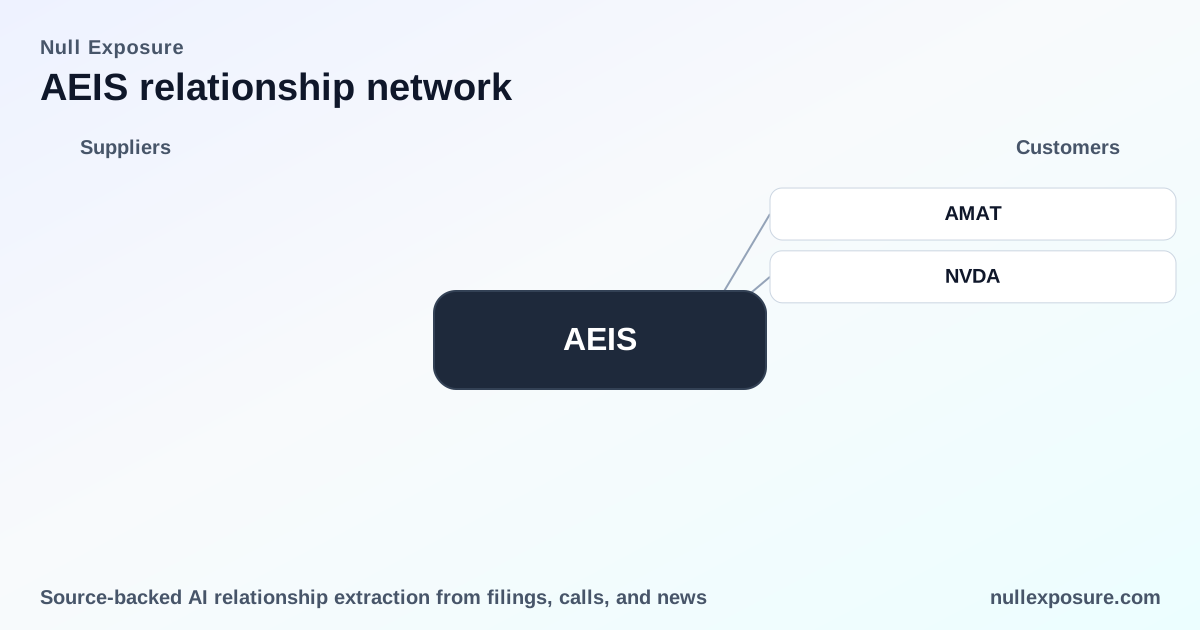
Customer relationships in focus: Applied Materials and Nvidia
Applied Materials (AMAT)
Advanced Energy supplies precision plasma power systems used in advanced node semiconductor manufacturing, positioning AEIS as a component supplier supporting transitions down to 2nm process technology. A FinancialContent market commentary highlighted AEIS’s role providing the plasma power systems that help equipment makers such as Applied Materials enable next‑generation fabs. (MarketMinute, Jan 5, 2026 — https://markets.financialcontent.com/wral/article/marketminute-2026-1-5-powering-the-ai-revolution-advanced-energy-industries-hits-record-highs-as-data-center-demand-surges)
Nvidia (NVDA)
AEIS’s NDQ1600 and NDQ1300 DC‑DC converters are cited as essential components in high‑density GPU clusters, enabling efficient 48V‑to‑12V power delivery that reduces thermal throttling for Nvidia’s Blackwell and forthcoming Rubin architectures—tying AEIS’s product demand to the data‑center GPU cycle. This linkage was noted in the same FinancialContent market note connecting AEIS product adoption to Nvidia’s GPU platforms. (MarketMinute, Jan 5, 2026 — https://markets.financialcontent.com/wral/article/marketminute-2026-1-5-powering-the-ai-revolution-advanced-energy-industries-hits-record-highs-as-data-center-demand-surges)
Investment implications: upside, exposures, and operational levers
- Upside: AI and advanced‑node semiconductor investment are direct demand drivers. If fabs scale for 2nm and data centers expand GPU fleets, AEIS benefits via component share gains and higher unit volumes. The FinancialContent piece underscores this channeling of AI/data center demand into AEIS revenue streams.
- Exposure: customer concentration and PO‑driven contracting create pronounced quarterly volatility; a few large OEM orders can swing results materially. Monitoring order flow from major equipment OEMs and hyperscalers is essential.
- Margin resilience: The combination of engineered hardware and after‑sales services supports above‑average gross margins and operating leverage, but investors should price in cyclicality given capital‑equipment dynamics.
- Operational levers: AEIS can smooth revenues by expanding ratable service contracts, broadening distributor penetration in under‑served regions (LATAM/EMEA), and continuing to integrate vertically with OEM platforms where its power modules become design‑wins.
Bottom line for operators and research users
AEIS is a classic engineered‑components company: high technical relevance with a transactional sales model and concentrated customers. That configuration creates asymmetric outcomes — strong upside when key customers invest in next‑generation fabs or GPU deployments, and notable revenue risk when those capital cycles pause. For market participants, the most informative signals will be order intake and design‑win announcements with major OEMs and hyperscalers, and any shift toward longer‑term service contracts that can durably reduce revenue volatility.
Key takeaway: AEIS’s revenue is driven by a small set of high‑impact customers (including Applied Materials and Nvidia), sold primarily on purchase orders with a modest but strategic service layer—this combination underpins strong margins but requires active monitoring of customer capex cycles.