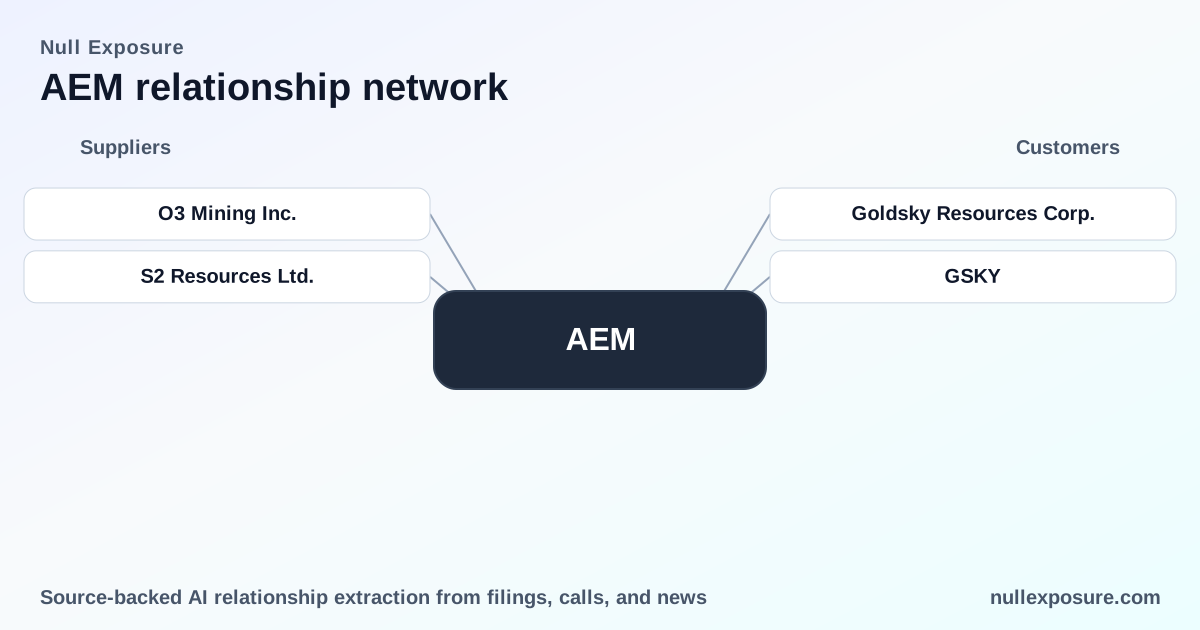
AEM customer relationships: royalty receipts, asset sales and what they signal for investors
Agnico Eagle Mines Limited (AEM) operates as an integrated gold producer — exploring, developing and mining in Canada, Sweden and Finland — and monetizes primarily through gold production, asset rationalizations and the sale of non-core interests plus royalty arrangements. With a market capitalization near $90 billion and strong margins (profit margin ~39.5%, operating margin ~62.8%), AEM’s commercial posture is that of a mature producer that sells ounces while selectively monetizing optionality in exploration assets via sales and royalty grants. For investors evaluating customer and partner exposure, the near-term narrative centers on asset dispositions (Barsele), royalty counterparties (multiple royalty houses) and strategic funding/support to junior partners. For a concise institutional view of counterparty signals, visit https://nullexposure.com/.
Why these relationship disclosures matter to investors
Agnico’s commercial relationships are not typical supplier-customer lines — they are strategic monetizations: equity and cash proceeds for exploration stakes, long-lived royalty streams, and funding to juniors that expand AEM’s optionality. Royalty counterparties and one-off asset sales change the profile of future cash flows and counterparty credit exposure, while funding to juniors signals pipeline replenishment and exploration confidence. These relationships therefore affect both near-term cash and the long-term reserve and resource trajectory.
A snapshot of the relationship set (what the press tracked in FY2026)
Below I list every counterparty referenced in public reporting in the period covered and summarize the commercial action in plain English, followed by the source context.
-
Goldsky Resources Corp. / GSKY — AEM agreed to sell its 55% interest in the Barsele gold project in Sweden to Goldsky in exchange for cash, equity and a 2% net smelter return (NSR) royalty on the project; the deal is expected to close by June 30, 2026. According to The Globe and Mail (Mar 9, 2026) and AEM news releases (Jan 28, 2026), consideration included US$20m, issuance of Goldsky shares and the 2% NSR.
Source: The Globe and Mail (Mar 9, 2026); company release (Jan 28, 2026). -
Triple Flag Precious Metals Corp. (TFPM) — Triple Flag holds royalty coverage over AEM’s Hope Bay complex (including a 1% NSR noted in commentary), and Triple Flag highlights a material increase in resources at AEM’s Patch Seven; Triple Flag’s remarks position its royalty as district-scale coverage across assets AEM operates. Triple Flag’s investor commentary and earnings call (Q4 2025 / Mar 2026) frame this as royalty exposure to an advancing AEM development.
Source: Triple Flag Q4 2025 earnings call transcript (Mar 2026); Yahoo Finance coverage (May 4, 2026). -
Vior Gold Corporation Inc. (VIO) — Vior agreed to acquire a package of Quebec properties (Kinebik, Peacock, Launay) from Agnico for CAD 6.2 million, representing AEM’s sale of non-core exploration parcels in the Abitibi Greenstone Belt. This is a straightforward asset disposal that converts low-priority exploration holdings into cash for AEM.
Source: SimplyWall.st summary of May 2, 2026. -
OR Royalties (OR) — OR Royalties’ portfolio includes a 3–5% NSR royalty on AEM’s Canadian Malartic Complex, which OR calls a cornerstone asset in its portfolio; multiple press notes and investor updates reference that stream as core exposure to AEM’s production at Canadian Malartic.
Source: GlobeNewswire press (Jan 29, 2026) and Resource Capital / MarketBeat coverage (Feb–May 2026). -
Gold Royalty Corp. (GROY) — Gold Royalty highlighted operational progress at Odyssey — an AEM-operated asset on which GROY holds a partial NSR (0.5–3.0%) — citing AEM’s update that shaft sinking is ahead of schedule and that staged completion points are expected through 2027 and 2031. This is a royalty counterparty benefitting from AEM’s organic project execution.
Source: InvestingNews summary referencing AEM’s Feb 12, 2026 update (reported Mar 9, 2026). -
Metalla Royalty & Streaming Ltd. (MTA) — Metalla notes that Fosterville production (operated by other parties but referenced to AEM reporting) supports the value of its 2.5% GVR royalty coverage on extensions of the Fosterville license; AEM’s production commentary underpins Metalla’s asset economics.
Source: PR Newswire financials and asset update (Oct 29, 2025; cited Mar 2026). -
Fury Gold Mines Limited (FURY) — Fury disclosed receipt of funding from AEM (CAD 3.08 million), reflecting Agnico’s practice of providing exploration funding to junior partners, which preserves AEM’s preferential access to promising ground while shifting near-term cash burden to operators or joint ventures.
Source: SimplyWall.st summary (May 3, 2026).
Key takeaways for investors
-
Agnico is actively monetizing non-core exploration assets and converting optionality into cash and royalties. The Barsele sale to Goldsky is a clear example: cash, equity in the buyer, and a retained 2% NSR maintain upside while shifting operating risk to the buyer. (The Globe and Mail; company release Jan 28, 2026.)
-
Royalty counterparties are diverse and include dedicated royalty houses (OR, GROY, MTA, TFPM). These relationships create long-dated, near-passive revenue streams for the counterparties while leaving AEM’s production and operating risk largely on the company — a structural difference from a typical sales customer. (Resource Capital; InvestingNews; PR Newswire; Triple Flag call, Mar–May 2026.)
-
Agnico uses selective funding of juniors to preserve pipeline optionality at relatively low cost. The Fury funding demonstrates AEM’s preference to retain exploration upside without sole ownership of capital commitments. (Fury disclosure, May 2026.)
Operating-model constraints and company-level signals
There are no explicit constraint excerpts tying contractual restrictions to specific counterparties in the public relationship results set. At the company level, however, several operating-model characteristics are clear and relevant to counterparty risk:
-
Contracting posture — strategic asset sales plus royalty grants. AEM is willing to sell controlling stakes in projects (Barsele) while keeping royalties, indicating a disposition to de-risk capital allocation and crystallize value without sacrificing long-term upside.
-
Revenue concentration — geographically diversified but asset-concentrated cash flows. AEM is a multi-jurisdictional miner (Canada, Sweden, Finland) with some cornerstone royalties (Canadian Malartic) that are material to royalty counterparties, implying specific asset-level criticality even as corporate revenue streams remain diversified across mines.
-
Counterparty criticality — royalties create durable third-party cash flows that hinge on AEM operational execution. Royalty holders have upside but are dependent on AEM’s mine planning, capital execution and metal price exposure.
-
Maturity and predictability — mature producer with stable margins and dividend policy. AEM’s financial profile (high operating margin, consistent EBITDA and dividend yield) supports its ability to meet obligations and execute on development timelines that underpin royalty economics.
Risks investors should monitor
-
Execution risk at project-level assets (e.g., Odyssey, Hope Bay) directly affects royalty cash flow realizations. Royalty counterparties’ returns are highly sensitive to schedule slippage or grade changes in AEM-operated mines. (Gold Royalty & Triple Flag disclosures, Mar–May 2026.)
-
Market and commodity sensitivity remains primary macro risk to all counterparties. Royalty streams and sale proceeds retain exposure to gold price volatility; AEM’s strong margins today do not immunize future operational shocks.
Final assessment and next steps
Collectively, these relationships show Agnico’s dual strategy of harvesting non-core value while retaining upside through royalties and selective funding — a conservative capital allocation posture that reduces near-term capital intensity and preserves resource optionality. For institutional investors and operators analysing counterparty exposure, focus on project execution timelines (Hope Bay, Odyssey, Canadian Malartic) and contractual royalty terms: these determine the ultimate cash conversion for third parties and the retained upside for AEM.
For a structured view of AEM’s counterparty exposures and to track how asset-level actions translate into partner cash flows, see our coverage and analytics at https://nullexposure.com/.