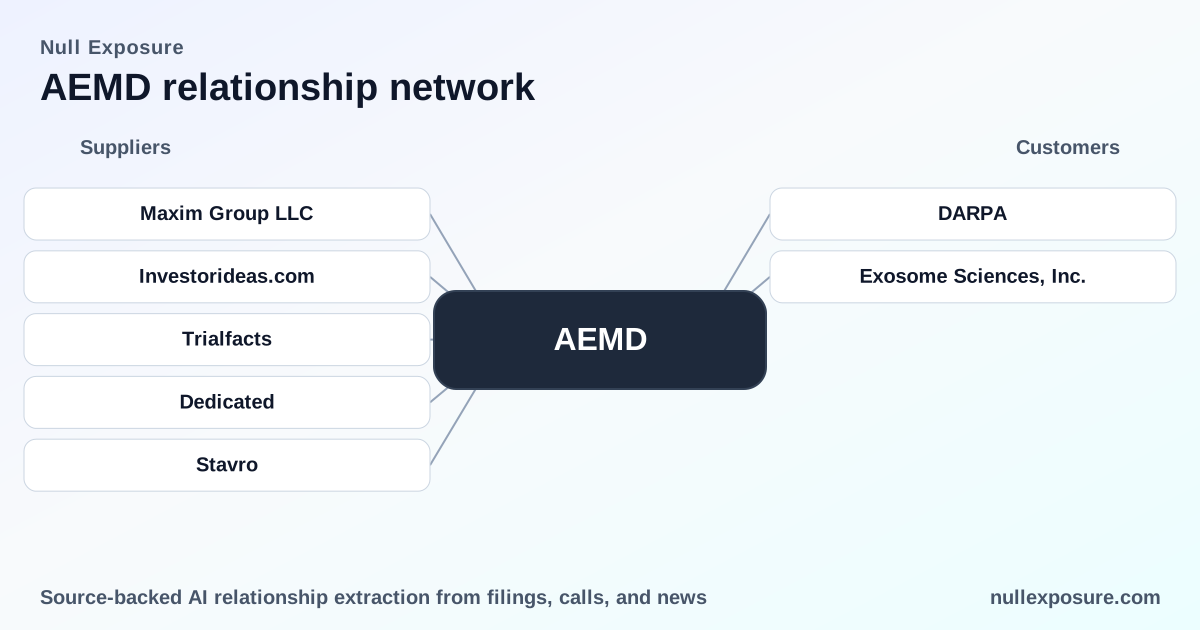
AEMD Customer Relationships: How partnerships and contracts shape value for investors
Aethlon Medical develops the Hemopurifier and related diagnostic technologies and monetizes through a mix of product development, licensing and collaborative agreements, government contracts/grants, and distributor pathways as it transitions from clinical-stage development toward commercialization. Revenue today is limited and episodic; the company’s value drivers are contractual milestones, government and research partnerships, and the commercialization of the Hemopurifier and diagnostic offerings. For relationship-level intelligence and tracking, visit https://nullexposure.com/.
Why customer and partner mapping matters for AEMD investors
Aethlon is a small-cap medical-device developer where each partnership is materially relevant to clinical progress, regulatory positioning, and potential near-term revenue. The relationship set shown in public records is compact — reflecting a development-stage company that advances through targeted collaborations rather than broad commercial sales today. From a governance and operating-model perspective, several company-level signals stand out:
- Contracting posture: Aethlon engages through time-limited contracts and Material Transfer Agreements (MTAs), and historically has worked with U.S. government research programs, indicating continued dependence on grants and contract milestones to fund R&D. The company’s disclosures explicitly flag the uncertain outlook for future government contracts.
- Concentration and criticality: A small universe of strategic partners and research relationships implies concentration risk — each partner’s progress has outsized operational and valuation impact. The Hemopurifier is identified internally as a core product across filings.
- Maturity and commercialization pathway: The business remains clinical-stage, pursuing regulatory and clinical milestones and establishing international footholds (notably an Australia subsidiary created to pursue clinical research and commercialization in APAC).
- Channel and counterparty complexity: Distributors and sellers are mentioned in risk language around recalls and international commercialization, signaling a mixed direct-and-distributor go-to-market approach as the company scales.
These company-level constraints are explicit in Aethlon’s public disclosures and inform how partners translate into revenue and execution risk.
Customer relationships — the concise roll call
DARPA (Defense Advanced Research Projects Agency)
Aethlon has developed a device under a multi-year research contract to reduce sepsis in combat-injured soldiers, positioning the Hemopurifier within defense-funded programs that validate the technology against strict performance requirements. According to a PR Newswire release tied to company disclosures referencing FY2013 initiatives, Aethlon described a five‑year contract with DARPA to advance a device focused on sepsis reduction.
Source: PR Newswire company release referencing FY2013.
Exosome Sciences, Inc.
Aethlon contributed diagnostic-related technology, including the Enzyme Linked Lectin Specific Assay (ELLSA), to Exosome Sciences to detect exosomes associated with HIV, TB, and various cancers, reflecting a licensing or technology-transfer relationship that leverages Aethlon’s diagnostics IP. This collaboration was described in the same PR Newswire release that detailed Exosome Sciences’ launch and Aethlon’s role in FY2013.
Source: PR Newswire company release referencing FY2013.
Stavro
Under a Material Transfer Agreement, Stavro is evaluating compatibility between Aethlon’s Hemopurifier and Stavro’s SLAMB simplified blood‑treatment platform, an early-stage technical collaboration that could inform integration or co-development opportunities. The arrangement is documented in an SEC filing reported via StockTitan in FY2026.
Source: SEC 8-K reported via StockTitan (FY2026).
What these relationships mean for revenue and valuation
- Near-term revenue signal is limited. Aethlon’s trailing revenue and margins remain small while R&D, contract milestones, and potential licensing fees drive valuation ahead of mass commercialization — reflected in negative EPS and modest market capitalization.
- Government and research contracts provide validation and non-dilutive funding. Engagements like the DARPA-funded work increase technical credibility and can fund development phases without immediate equity dilution, but Aethlon’s filings explicitly caution that such contracts are not guaranteed going forward.
- Technology-transfer and MTA engagements de‑risk technical adoption but not commercial scale. Collaborations with diagnostics entities and MTAs with platform companies are tactical steps toward product fit and distribution, but converting these into stable sales depends on regulatory clearances and scaled manufacturing.
- Distribution and commercialization risk is explicit. The company warns that recalls or supply‑chain issues involving distributors could divert resources and harm reputation, underscoring the operational complexity of transitioning from clinical-stage device to marketable product.
Key takeaway: partnerships provide validation, development funding and technical pathways to market, but they do not replace the need for regulatory milestones and commercial execution to deliver lasting revenue.
Operational constraints and capital-readiness signals
Aethlon’s public constraint excerpts outline strategic realities investors should internalize:
- Government counterparty exposure: The company has historically worked with U.S. government programs and notes uncertainty about securing future government grants or contracts — this is a company-level funding and validation dependency.
- APAC expansion intent: A wholly‑owned Australia subsidiary was formed in October 2022 to pursue oncology clinical research and eventual commercialization in that region, signaling an explicit geographic expansion strategy into APAC.
- Channel complexity: Risk language about distributors and recalls indicates the company expects to rely partly on international distributors or third‑party sellers as it commercializes, which elevates operational risk around quality control and regulatory compliance.
- Product concentration: Aethlon’s public description centers on the Hemopurifier as the core product, which concentrates technical and commercial risk on a single clinical-stage therapeutic device.
These constraints should be assessed against cash runway, milestone timing, and partner dependency when modeling upside and downside scenarios.
Actionable signals for investors and operators
- Monitor contract filings and award notices for government funding or milestone payments — these are primary liquidity and validation events before broad commercial revenue.
- Track regulatory submissions, clinical trial updates, and any recall or distributor notices, since manufacturing/quality events directly affect commercialization timelines.
- Watch the Australia subsidiary’s progress for regional regulatory strategy in APAC and any distribution agreements that might convert partnerships into repeatable revenue.
- Evaluate technical integration outcomes from MTAs (for example the Stavro SLAMB evaluation) as leading indicators of adoption by platform providers.
For a focused view of partner-level risk and to stay current on Aethlon’s evolving customer relationships, explore relationship intelligence at https://nullexposure.com/.
Bottom line
Aethlon’s customer map is small but strategically targeted: government and research contracts provide validation and non-dilutive funding, diagnostics transfers expand technical reach, and MTAs open potential integration pathways — yet commercialization and revenue remain contingent on regulatory milestones and distributor execution. Investors should value each partnership not as immediate revenue but as a step in derisking clinical, regulatory, and market outcomes.