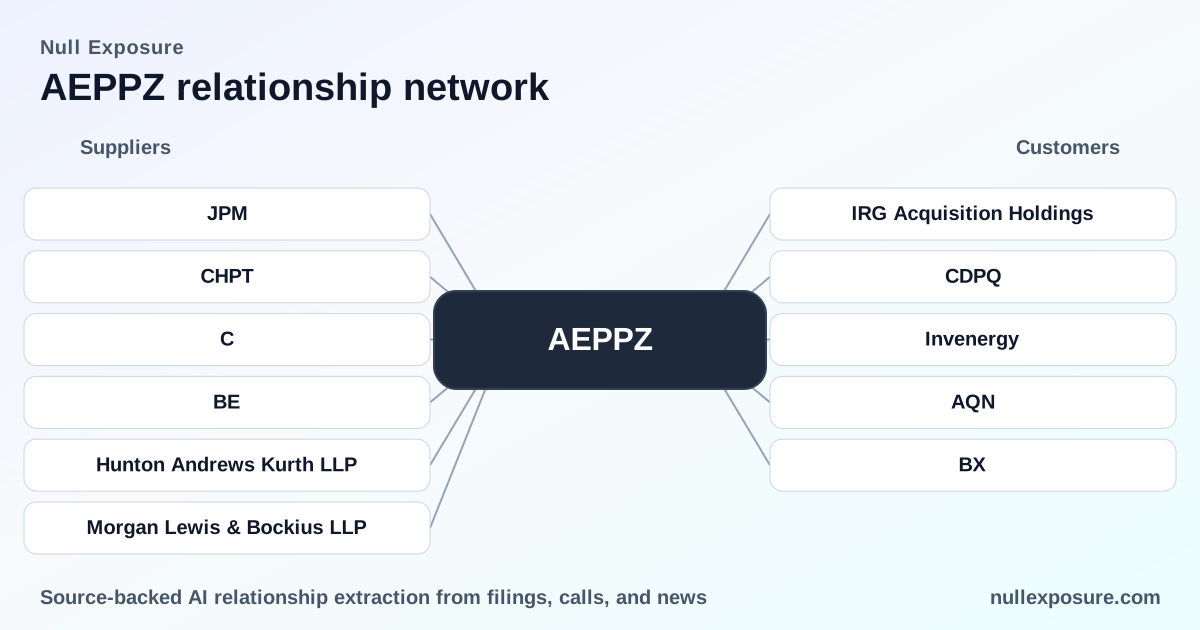
AEPPZ (AEP customer relationships) — Asset monetization and regulated cashflow drive valuation
American Electric Power monetizes a vertically integrated utility and grid portfolio through regulated retail and transmission revenues while actively extracting value via strategic asset sales, minority-stake disposals and carve-outs to infrastructure investors. Revenue comes from regulated distribution and transmission tariffs, merchant renewables proceeds when assets are sold, and one‑time cash from strategic divestitures—a hybrid model that reduces capital intensity on the corporate balance sheet while preserving core regulated earnings.
Learn more about this coverage at https://nullexposure.com/.
Why counterparties matter: capital recycling and counterparty mix drive credit dynamics
AEP’s counterparty map in recent filings and press coverage shows a consistent pattern: large institutional and corporate counterparties (private equity, pension investors, global renewables sponsors, and hyperscalers) are used to monetize non-core assets and fund capital spending without diluting rate-base returns. That contracting posture signals a deliberate shift toward liquidity through asset sales and minority-stake transactions while keeping regulated, mission‑critical infrastructure in rate base.
Below I catalogue every customer/partner relationship surfaced in the curated results, with a concise plain‑English takeaway and source pointer for each.
Amazon Data Services
AEP filed at the Ohio Public Utilities Commission for permission to supply about 100 MW of fuel cells to data centers owned by Amazon, signaling direct infrastructure service to a hyperscaler and a pathway to non‑rate revenue from large commercial loads. Source: Utility Dive (May 2026) — https://www.utilitydive.com/news/aep-data-center-earnings-load-fehrman/740182/
Cologix Johnstown
Ohio AEP requested authorization to supply roughly 100 MW of fuel cells to Cologix Johnstown, indicating AEP’s willingness to treat data center campuses as bespoke customers for on‑site generation. Source: Utility Dive (May 2026) — https://www.utilitydive.com/news/aep-data-center-earnings-load-fehrman/740182/
Liberty Utilities
AEP agreed to reduce and delay the sale of its Kentucky operations to Liberty Utilities, reflecting negotiation dynamics in large regulated divestitures and the use of proceeds for renewables and grid investment. Source: Utility Dive (May 2026) — https://www.utilitydive.com/news/aep-sale-retail-business-pjm-investor-kentucky/633372/
Liberty (ticker LBBB)
A corporate update noted AEP expected to complete the sale of its Kentucky operations to a Liberty entity, reinforcing that transactions with Liberty variants are material to AEP’s portfolio reshaping. Source: PR Newswire (reported in feed May 2026) — https://www.prnewswire.com/news-releases/aep-shares-updates-on-strategic-initiatives-highlights-planned-capital-investments-in-renewables-and-energy-grid-301639920.html
Alqonquin Power & Utilities Corp. / AQN
A prior agreement identified Alqonquin (AQN) as the indirect parent of Liberty Utilities in a planned purchase of Kentucky operations, a deal AEP used to reposition capital. Source: Utility Dive (May 2026) — https://www.utilitydive.com/news/aep-to-sell-kentucky-operations-to-liberty-for-285b-use-proceeds-for-ren/608973/
Algonquin / AQN (renewed mention)
A later item records Algonquin dropping the plan to acquire AEP’s Kentucky assets, which illustrates transaction risk in large utility asset sales and third‑party execution risk. Source: Renewables Now (March 2026) — https://renewablesnow.com/news/algonquin-drops-plan-to-buy-aeps-kentucky-ops-820404/
Public Service Company of Oklahoma
The Traverse wind project will supply 3.8 million MWh annually to Public Service Company of Oklahoma customers, underlining AEP’s use of large renewables projects to lower long‑run customer costs and to reconfigure generation economics. Source: The Hill (May 2026) — https://thehill.com/changing-america/sustainability/energy/600044-massive-new-wind-farm-goes-online-in-oklahoma/
Southwestern Electric Power Company
Southwestern Electric Power Company is a named beneficiary of the Traverse wind farm’s output, reinforcing regional portfolio optimization across AEP’s operating companies. Source: The Hill (May 2026) — https://thehill.com/changing-america/sustainability/energy/600044-massive-new-wind-farm-goes-online-in-oklahoma/
IRG Acquisition Holdings
AEP agreed to sell 1,365 MW of renewable projects to IRG Acquisition Holdings (an ownership vehicle), demonstrating AEP’s strategy of divesting merchant renewable assets to infrastructure consortia at scale. Source: Power Engineering (March 2026) — https://www.power-eng.com/business/aep-sells-its-wind-and-solar-renewable-energy-portfolio-for-1-5b/
Invenergy
Invenergy is an owner within the IRG consortium that bought AEP renewables, showing strategic alignment between asset operators and infrastructure buyers. Source: Power Engineering (March 2026) — https://www.power-eng.com/business/aep-sells-its-wind-and-solar-renewable-energy-portfolio-for-1-5b/
CDPQ
CDPQ participated in the IRG Acquisition Holdings vehicle acquiring AEP’s renewables portfolio, bringing institutional pension capital into assets AEP exited. Source: Power Engineering (March 2026) — https://www.power-eng.com/business/aep-sells-its-wind-and-solar-renewable-energy-portfolio-for-1-5b/
Blackstone Infrastructure / BX
Funds managed by Blackstone Infrastructure were also part of the IRG consortium buying AEP’s renewables, confirming the transaction’s appeal to global infrastructure investors. Source: Power Engineering (March 2026) — https://www.power-eng.com/business/aep-sells-its-wind-and-solar-renewable-energy-portfolio-for-1-5b/
KKR
AEP sold a 19.9% equity interest in its Ohio and Indiana/Michigan transmission companies to KKR, deploying a minority sale to monetize long‑lived transmission assets while retaining control. Source: Utility Dive (May 2026) — https://www.utilitydive.com/news/aep-transmission-kkr-psp-investments-ohio-michigan/737005/
Public Sector Pension Investment Board
Canada’s Public Sector Pension Investment Board co‑invested alongside KKR in the 19.9% transmission stakes, signaling pension appetite for regulated cashflows. Source: Utility Dive (May 2026) — https://www.utilitydive.com/news/aep-transmission-kkr-psp-investments-ohio-michigan/737005/
Basalt Infrastructure Partners
Basalt’s funds bought AEP OnSite Partners — AEP’s distributed resources business — in a transaction that freed an immediate cash inflow while outsourcing DER commercialization. Source: Utility Dive (May 2026) — https://www.utilitydive.com/news/aep-transmission-kkr-psp-investments-ohio-michigan/737005/
Operating model signals and constraints investors should factor
- Contracting posture: AEP is executing long‑term regulated operations while selectively engaging in market transactions (minority stake sales, renewables carve‑outs, and business divestitures). This mixed posture reduces capital intensity on corporate balance sheets while preserving regulated earnings.
- Concentration and counterparty mix: Transactions with hyperscalers (Amazon), global infrastructure funds (KKR, Blackstone), pension capital (CDPQ, PSP Investments), and renewables sponsors (Invenergy) reflect diverse counterparty exposure that transfers development and merchant risk off AEP.
- Criticality: Transmission assets sold to minority investors remain operationally critical and are structured as concession‑style stakes, preserving network reliability and regulatory relationships.
- Maturity profile: The pattern of sales — renewables, distributed resources, and transmission minority stakes — is indicative of a late‑cycle portfolio optimization that prioritizes free cash and lower operational risk at the corporate level.
These are company‑level signals derived from public transaction activity and filings; they are not assigned to any single counterparty unless the transaction reference explicitly names that party.
Investment implications — what investors should watch
- Positive: AEP’s capital recycling generates near‑term cash and reduces execution risk on merchant renewables; minority sales to institutional partners improve financial flexibility without ceding operational control.
- Negative: Deal execution and regulatory approvals (as seen in the Liberty/Algonquin saga) introduce timing and counterparty risk that can affect near‑term cashflow expectations.
- Operational risk: Supplying bespoke solutions (fuel cells to data centers) expands customer concentration risk toward large commercial loads, requiring careful monitoring of contract terms and cost recovery in regulated rates.
For a deeper look at how these counterparty moves alter credit and valuation dynamics, visit https://nullexposure.com/.
Bottom line
AEP is monetizing non‑core generation and enabling balance‑sheet light growth through infrastructure partnerships and targeted sales, while preserving regulated transmission and distribution cashflows. That model supports predictable utility earnings with episodic boosts from asset sales, but investors must track regulatory outcomes and counterparty execution to assess realized value.