Aeroméxico (AERO): Customer relationships that move revenue and risk
Grupo Aeroméxico operates as Mexico’s largest full-service airline, monetizing through scheduled passenger and cargo services, ancillary fees, and strategic commercial alliances and capital-market transactions that finance fleet and network expansion. Revenue is driven by seat sales and codeshare partnerships, while balance-sheet flexibility is supported by periodic equity offerings and private placements. For a concise view of commercial counterparties and recent capital-market customers, see https://nullexposure.com/.
Quick read: thesis for investors and operators
Aeroméxico’s business model combines operating leverage from high fixed-cost aviation assets with revenue amplification through strategic partnerships (notably with Delta) and episodic equity transactions that dilute or shore up liquidity. Institutional ownership is high and the company uses capital markets to manage fleet and cash needs; understanding counterparties that take equity or enable network scale is critical to assessing both upside and downside.
Customer relationships: what the record shows
Below I cover every relationship item surfaced in the results, with a plain-English summary and source for each record.
-
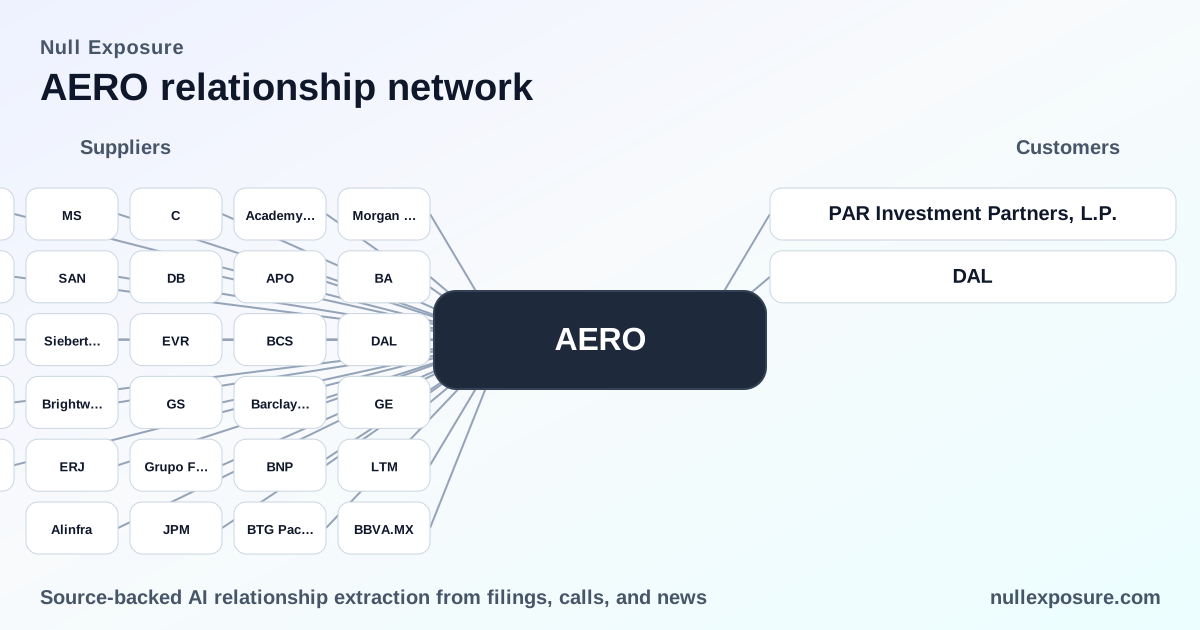
PAR Investment Partners, L.P. — GlobeNewswire (Nov 6, 2025): Aeroméxico priced a global offering and announced a concurrent private placement of approximately US$25 million in common shares sold to PAR Investment Partners at US$1.805 per share, a direct capital-market transaction that provides immediate liquidity to the company. A GlobeNewswire press release documented the placement as part of the broader global offering process.
Source: GlobeNewswire press release, Nov 6, 2025. -
PAR Investment Partners, L.P. — Aviator.aero (Nov 2025 press coverage): Aviation trade coverage repeated that the company executed a concurrent private placement of roughly US$25 million to PAR Investment Partners at US$1.805 per share alongside its global offering, emphasizing the placement’s role in the overall financing package.
Source: Aviator.aero press note reporting on Aeroméxico’s global offering, Nov 2025. -
Delta / DAL — Expansion.mx (Feb 23, 2024): The Delta–Aeroméxico agreement grants immunity for joint commercial activities and enables code-share sales, resulting in more than 90 daily flights between the two countries under the alliance; this relationship underpins a material share of Aeroméxico’s network and inventory distribution.
Source: Expansion.mx business report, Feb 23, 2024.
What these relationships say about operating posture and business model
Aeroméxico’s counterparty mix combines commercial airline partners that expand distribution and demand with financial counterparties that supply balance-sheet capital. From that mix we can draw several operational characteristics relevant to investors and operators:
-
Contracting posture — strategic and transactional. The Delta relationship is strategic and evergreen in commercial importance (codeshare and joint coordination), while the PAR placement is transactional and capital-market driven; Aeroméxico uses both partnership contracts and equity placements to manage demand and liquidity.
-
Concentration and criticality. Commercial concentration toward major alliance partners is high: the Delta codeshare drives network feed and passenger bookings (90+ daily flights cited), making that counterparty critical to Aeroméxico’s revenue throughput. By contrast, the PAR placement is a single-event financing and not an operating-critical counterparty by itself.
-
Maturity and tenor. The Delta alliance is a mature, entrenched commercial relationship that materially affects route economics and yield management; the private placement to PAR is a short-term capital solution tied to a specific global offering event.
-
Counterparty type mix. Aeroméxico balances institutional-owned financing (noted institutional ownership at about 73% of float) with bilateral commercial alliances, creating a hybrid risk profile where network exposure and capital-market cycles both influence operating outcomes.
No explicit constraints were provided in the dataset for customer relationships; that absence is itself a company-level signal: at present, there are no disclosed constraint excerpts to alter the above operating-read assessment.
Financial context that frames the customer relationships
Use these figures to weigh relationship impact:
- Revenue TTM: US$5.52 billion, Gross profit TTM US$2.07 billion, EBITDA US$1.128 billion — Aeroméxico operates at a scale where alliance-driven passenger volumes materially affect top-line performance.
- Valuation multiples: EV/EBITDA ~3.44 and a trailing P/E of 0.66 reflect market valuation that incorporates both operating leverage and capital-market actions.
- Shareholder structure: institutional holders account for roughly 73.35% of ownership, an ownership profile that enables sizable equity placements like the PAR deal to clear efficiently with institutional uptake.
These metrics demonstrate that commercial partnerships that drive passenger volumes (Delta) and opportunistic equity deals (PAR) are both credible levers Aeroméxico uses to manage cash flow and growth.
Investment implications and risk checklist
- Positive implication — demand expansion via Delta: The codeshare and immunized JV structure with Delta materially expands Aeroméxico’s effective network and booking flows, improving load factors and pricing power on key Mexico–U.S. routes. This alliance is a core revenue driver.
- Balance-sheet lever — private placements and global offerings: The recent ~US$25m private placement to PAR illustrates management’s willingness to use equity issuance alongside public offerings to raise liquidity; investors must monitor dilution and timing of such transactions. Equity financings change capital structure quickly.
- Concentration risk: Heavy reliance on a single commercial partner for cross-border flows increases susceptibility to regulatory, competitive, or partner-specific shocks. Network dependency is a material operational risk.
- Governance and investor base: High institutional ownership facilitates large placements but also means market reactions to liquidity events and alliance news will be amplified by sophisticated investor behavior.
Closing action for research teams
For a deeper, model-ready view of counterparties and to track incremental relationship disclosures, visit https://nullexposure.com/ for ongoing coverage and structured alerts. The two relationship types—strategic commercial alliances and episodic capital-market customers—should be modeled separately when forecasting cash flow volatility and dilution scenarios.