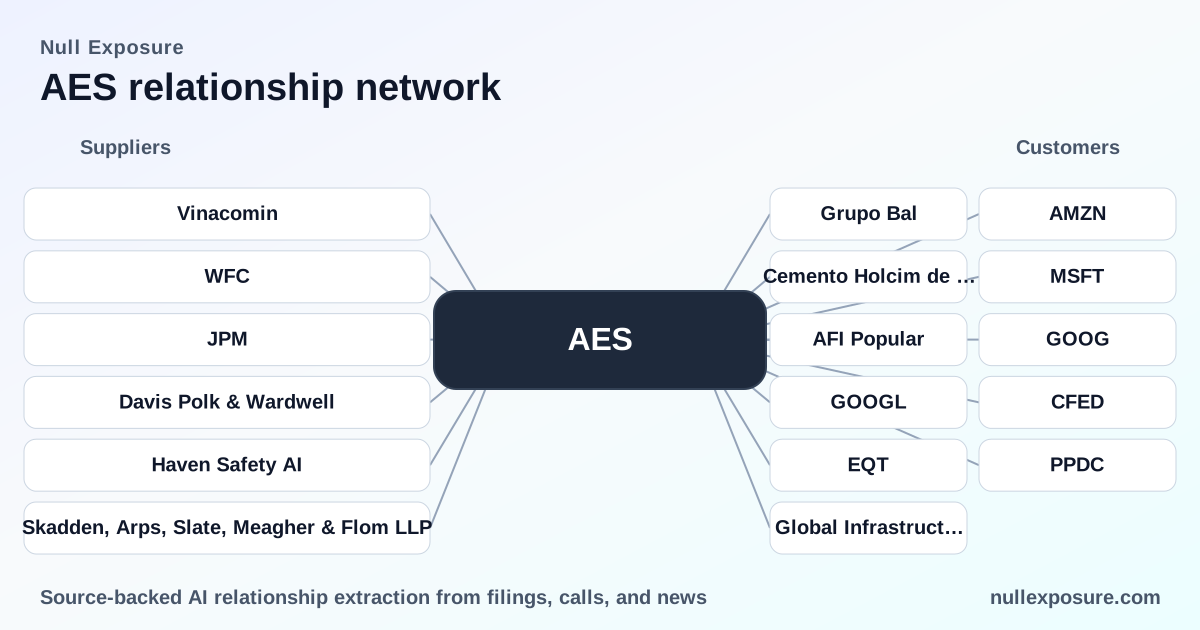
AES customer map: who pays for the renewables build‑out and what it means for investors
The AES Corporation generates and distributes electricity across a globally diversified portfolio that combines regulated utilities, merchant generation and a large renewables development platform. AES monetizes through long‑term power purchase agreements (PPAs), regulated retail tariffs, energy‑management services, and development/asset ownership of co‑located renewable projects — a business mix that converts capital deployment into contracted cashflows while preserving upside from merchant and corporate sales.
Visit https://nullexposure.com/ for a data‑driven view of counterparty relationships and disclosures.
Why AES’s customer footprint determines valuation more than margin moves
AES’s revenue profile is dominated by contract structures. Long‑term PPAs are the central revenue engine: AES Clean Energy’s backlog and signed PPAs lock future output and heavily reduce volatility in project returns. At the same time, AES runs a mix of shorter‑term merchant exposure and spot sales in select geographies that create earnings cadence variability. The company reports that no single customer generated 10% or more of 2024 revenue, which reduces concentration risk at the parent level even while individual businesses can be highly dependent on one or a few counterparties.
Regulatory and government counterparties are strategically important — for example, AES’s Puerto Rico operations are materially contracted to the public utility PREPA — and AES’s growth strategy is focused on large enterprise buyers (data centers, miners, hyperscalers) in North America and internationally. These facts shape capital allocation: AES funds large upfront construction through balance‑sheet capital or project finance and monetizes via long‑dated contracts.
Detailed customer relationships you should know (documented sources and plain English)
Below are every customer relationship referenced in AES’s customer‑scope results, each with a concise, sourced description.
-
Grupo Bal — AES operates Mesa La Paz, a 306 MW wind project in Llera, Tamaulipas developed in a joint venture with Grupo Bal, demonstrating AES’s use of local partnerships for renewable project development. According to AES’s FY2024 Form 10‑K disclosure, Mesa La Paz is a JV project with Grupo Bal. (AES 2024 10‑K)
-
Cemento Holcim de El Salvador — The Metapán solar plant in El Salvador (15 MW) is fully owned by AES and 100% contracted with customers that include CLESA and Cemento Holcim de El Salvador under agreements running into the 2043–2048 window. This is described in AES’s FY2024 plant listing. (AES 2024 10‑K)
-
AFI Popular — AES sold a 20% ownership interest in AES Dominicana in December 2023, including a 10% stake to AFI Popular, reflecting AES’s strategy to monetize assets via local partners while retaining operating exposure. The transaction is disclosed in AES’s FY2024 filings. (AES 2024 10‑K)
-
Amazon.com Inc. (AMZN) — AES has a contractual relationship to provide energy from Bellefield Solar + Storage in California to Amazon, underscoring AES’s client focus on large cloud customers for clean energy supply. This engagement is reported in a FinancialContent MarketMinute article (April 14, 2026). (FinancialContent, MarketMinute, Apr 2026)
-
Google — AES has announced multiple agreements with Google (Alphabet) to develop co‑located generation for a new data center in Wilbarger County, Texas, including 20‑year PPAs and long‑term energy management services; AES will own and operate the co‑located assets. Multiple news outlets reported the deal and its scale in early 2026. (Reuters coverage summarized on Finviz and StockTitan, Feb–Mar 2026 / Morgan Stanley note coverage)
-
StockTitan reported AES highlighting a major power deal with Google alongside other corporate announcements in Jan–Feb 2026. (StockTitan, Jan–Feb 2026)
-
A Polish market news site noted Google inked new supply deals with AES and Xcel Energy in March 2026. (bez‑kabli.pl, Mar 2026)
-
MarketBeat cited a near‑term AES–Google partnership expected to deliver roughly $770 million in customer savings and referenced AES’s quarterly dividend (Apr 2026). (MarketBeat, Apr 2026)
-
Daily Energy Insider covered AES’s expanded partnership with Google and quoted AES’s CEO on delivering powered land and energy at scale (Mar 2026). (Daily Energy Insider, Mar 2026)
-
Finviz aggregated reporting that AES signed 20‑year power supply agreements with Google and will provide retail supply, cost optimization, and related services under a long‑term arrangement (Feb 24, 2026 filing discussions). (Finviz / Reuters summary, Feb 2026)
-
StockstoTrade and other outlets reiterated the long‑term nature of AES’s agreements with Google and the strategic market implications in late Feb–Mar 2026. (StockstoTrade, Feb–Mar 2026)
-
-
Microsoft Corp. (MSFT) — AES is referenced in press coverage as a supplier positioned to serve data center customers including Microsoft, highlighting AES’s strategic focus on cloud and AI infrastructure clients in industry commentary about a 2026 takeover discussion. (FinancialContent MarketMinute, Apr 2026)
-
Amazon / Microsoft / Google (industry grouping) — PE‑Insights and other commentary note AES’s strategy of supplying renewable power to major technology firms including Amazon, Microsoft and Google, which underpins AES’s corporate PPA pipeline and development economics. (PE‑Insights, Mar 2026)
-
EQT / EQT AB — Media reports in March 2026 identified EQT (EQT AB) as a key private equity bidder alongside Global Infrastructure Partners and BlackRock’s GIP in advanced talks to acquire AES, signaling investor appetite for AES’s contracted cashflows and corporate PPA franchise. (Global Banking & Finance / Bloomberg reporting, Mar 2026)
-
Global Infrastructure Partners (GIP) — GIP was reported as part of a consortium led by BlackRock that entered advanced talks for AES, illustrating strategic buyer interest in infrastructure cashflows and corporately contracted renewables. (Global Banking & Finance / Bloomberg reporting, Mar 2026)
-
CFED / CFE — AES’s Merida combined‑cycle gas turbine (CCGT) sells power under a capacity and energy long‑term PPA to Mexico’s state counterpart (CFE) with contracts noted through 2025, reflecting AES’s exposure to government counterparties in Mexico. The asset and counterparty are disclosed in AES’s FY2024 10‑K. (AES 2024 10‑K)
-
PPDC / PREPA — AES Puerto Rico’s Ilumina 24 MW solar facility is fully contracted through a long‑term PPA with PREPA that expires in 2037; AES’s Puerto Rico exposure to PREPA is explicitly noted as an operational and payment‑risk factor in the FY2024 filing. (AES 2024 10‑K)
Operating constraints and what they signal for investors
-
Contracting posture: long‑term, dominant — Company disclosures show AES Clean Energy’s backlog and project economics are driven by long‑term PPAs and REC contracts; AES reported signing long‑term contracts for 4.4 GW in 2024 and a renewables backlog with 7.3 GW of PPA‑backed projects as of year‑end 2024. This is a company‑level signal that AES prioritizes contracted cashflows that de‑risk project returns. (AES 2024 10‑K)
-
Spot and short‑term exposure exists in specific geographies — AES operates with spot exposure in markets like Colombia and retains some short‑term sales or unhedged positions in certain generation businesses, which creates localized earnings volatility. This is a company‑level signal from the 2024 filing. (AES 2024 10‑K)
-
Counterparty mix: government and hyperscalers — AES sells to governments (notably PREPA and CFE) and large enterprises (data centers, miners, hyperscalers). PREPA is explicitly named as a government counterparty with long‑term PPAs that carry payment performance risk; this is a relationship‑specific constraint tied to AES Puerto Rico. (AES 2024 10‑K)
-
Concentration: parent‑level diversification vs. asset‑level dependency — No single customer accounted for >10% of consolidated revenue in 2024, reducing top‑line concentration risk, but individual projects or SBUs can rely on one or few PPAs, which concentrates operational risk at the asset level. (AES 2024 10‑K)
-
Stage and maturity — AES’s portfolio includes fully contracted, operational assets and a large backlog (11.9 GW of signed contracts not yet in operation), which implies a multi‑year ramping profile as projects move from contracted backlog to revenue‑generating assets. (AES 2024 10‑K)
Investment implication and next steps
AES’s business is financed for scale: the firm converts development expertise into long‑dated contracted cashflows sold to corporations and utilities, making the company attractive to strategic infrastructure buyers and private equity. The mix of long‑term PPAs and selective merchant exposure creates a defensive core with episodic growth upside as backlog projects come online.
If you need a compact, counterparty‑level dossier for diligence, explore the full relationship extraction at https://nullexposure.com/ — or contact us to build a bespoke report focused on AES’s corporate PPA counterparties and government exposures.