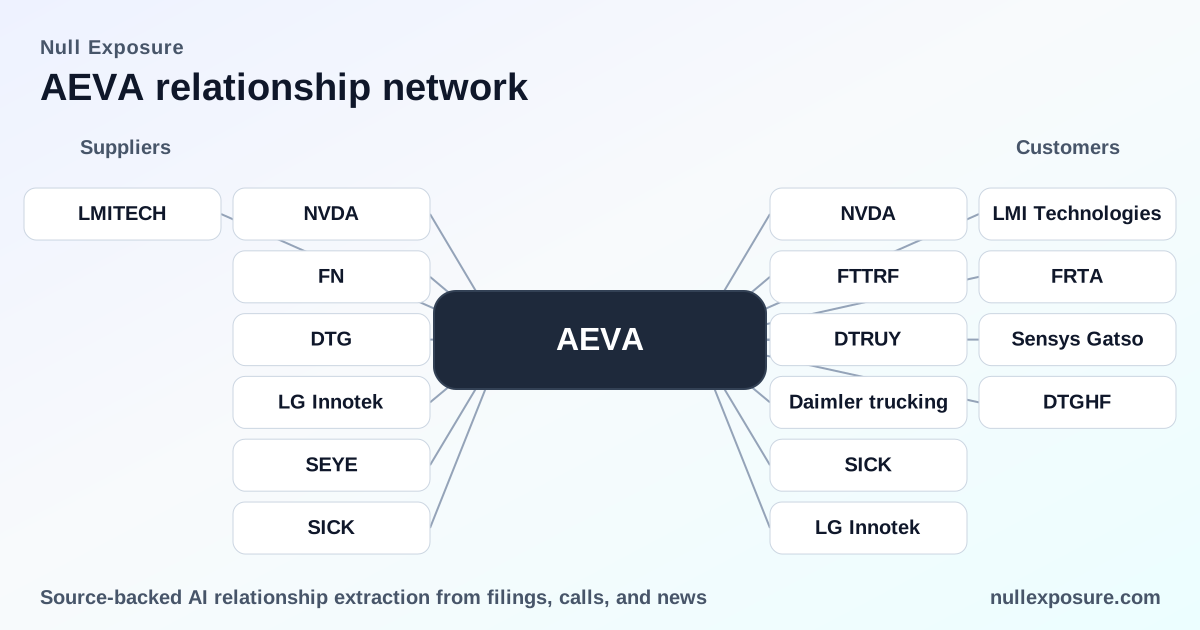
AEVA’s customer map: from pilot pipelines to production contracts
Aeva Technologies designs and sells FMCW-based 4D LiDAR hardware and embedded perception software, monetizing through a mix of unit sales for series-production programs, non-recurring engineering (NRE) services, and embedded software for automotive, industrial and defense customers. Revenue today is concentrated and lumpy—driven by prototype and early production shipments—while the company transitions toward recurring per-unit economics as production programs ramp. For investors, the core thesis is simple: value unlocks as pilot engagements convert into repeatable OEM/Tier‑1 production volumes; downside centers on concentration and the timing of those ramps.
If you want a consolidated view of AEVA’s customer relationships and what they imply for revenue scale and risk, visit https://nullexposure.com/.
Customer map: named partners and the evidence trail
Below are every customer relationship captured in the underlying reporting, each summarized in plain language with the supporting source noted.
NVIDIA (NVDA)
AEVA is the reference LiDAR sensor provider for NVIDIA’s DRIVE Hyperion development platform, positioning Aeva’s sensors as a standard component adopted by OEMs pursuing Level‑3+ automation. This relationship was disclosed on AEVA’s Q4 2025 earnings call and reiterated in media transcripts in March–May 2026. (AEVA Q4 2025 earnings call transcript; Investing.com / InsiderMonkey, March–May 2026)
Plus (PLUS)
AEVA collaborated with Plus to showcase an integrated LiDAR design for the PlusDrive automated trucking solution using Aeva’s Aeries II 4D LiDAR, signaling commercial engagement with a trucking autonomy provider. (SimplyWall.St coverage of AEVA’s product showcase, Jan 4, 2026)
Georgia Department of Transportation
AEVA has an active deployment with the Georgia Department of Transportation, demonstrating municipal/state-level adoption of its sensing technology in infrastructure or traffic-monitoring applications. (TradingView summary citing Zacks analysis, 2026)
SICK AG
SICK AG is listed among AEVA’s initial manufacturing and factory-automation customers that began receiving shipments in late 2025, representing industrial automation adoption outside of automotive. (AEVA Q4 2025 earnings call transcript; Investing.com transcript, March–May 2026)
LMI Technologies
LMI Technologies is cited as a manufacturing and factory automation customer receiving early shipments, reflecting AEVA’s traction in non‑automotive industrial use cases. (AEVA Q4 2025 earnings call transcript; InsiderMonkey summary, March 2026)
Sensys Gatso
Sensys Gatso appears as a customer engaged for smart infrastructure applications, indicating AEVA’s sensors are being evaluated or deployed in traffic enforcement and infrastructure monitoring. (AEVA Q4 2025 earnings call transcript; Investing.com / InsiderMonkey, March–May 2026)
Smart Infrastructure
AEVA references “Smart Infrastructure” alongside other industrial customers, pointing to a channel of system integrators or infrastructure operators targeting automated monitoring and control applications. (AEVA Q4 2025 earnings call transcript; Investing.com, March–May 2026)
Forterra (FTTRF / FRTA)
Forterra selected AEVA’s 4D LiDAR and perception stack for its AutoDrive autonomous vehicle system in defense and complex operational environments; AEVA announced the win via a BusinessWire-style press release in January 2026 and reiterated it on the Q4 call. (AEVA press release distributed via BusinessWire / Markets FinancialContent, Jan 20, 2026; AEVA Q4 2025 earnings call transcript, March 2026)
Daimler Truck (various tickers reported)
AEVA secured an exclusive long-range LiDAR series‑production program with Daimler Truck and is supplying pre-production samples with support toward a planned 2027 launch cadence—an OEM‑level production commitment that underpins future per-unit revenue. Multiple press reports and the earnings call reference this program and related sample deliveries in 2026. (StockTitan and The Globe and Mail reporting; AEVA Q4 2025 earnings call transcript, Dec 2025–Mar 2026)
Wideye by AGC
AEVA and Wideye by AGC showcased an in‑cabin FMCW 4D LiDAR integration at CES 2025, demonstrating product diversification into occupant sensing and in‑vehicle applications. (SimplyWall.St coverage of AEVA’s CES showcase, Jan 6, 2025)
LG Innotek
AEVA formed a strategic collaboration with LG Innotek to commercialize 4D LiDAR across broad physical AI applications, leveraging LG Innotek’s global scale to accelerate non‑automotive deployments. (AEVA Q4 2025 earnings call transcript, March 2026)
Visit https://nullexposure.com/ for further analysis and a consolidated view of AEVA’s customer evidence and risk map.
What the relationship set implies for AEVA’s operating model
The customer roster and AEVA’s public statements create a clear operational profile:
-
Contracting posture: mixed pilot-to-production — AEVA operates with both short‑term, NRE and prototype engagements and longer-term per‑unit production contracts. The company explicitly sells prototypes and engineering services while pursuing design‑ins for lifecycle production pricing, and it has started production shipments in late 2025. The combination creates lumpy near-term revenue but a path to recurring unit sales once programs scale.
-
Concentration and criticality are material company-level risks — AEVA reported that in a recent year two customers accounted for 56% and 16% of revenue, signaling high revenue concentration that increases sensitivity to single-program delays or cancellations. This is a company-level signal of high customer concentration and financial exposure.
-
Counterparties are large enterprises and OEM/Tier‑1s — AEVA’s go‑to customers are automotive OEMs, Tier‑1 suppliers and global industrial players; this implies long validation cycles, stringent quality controls and multi-year procurement processes that favor eventual scale but slow near-term monetization.
-
Relationship maturity skews early stage — The majority of relationships reported are in pilot or development stages (high confidence), with a transitional set of initial production shipments beginning in late 2025; investors should value AEVA as a company moving from R&D revenue toward production economics, not yet at steady-state recurring revenue.
-
Product mix emphasizes hardware with embedded software and services — AEVA’s core offering is hardware (Aeries II 4D LiDAR) plus embedded perception software and NRE services, meaning margins and capital intensity will evolve as manufacturing scales and software monetization improves.
Investment implications: catalysts and risks
-
Key upside catalyst is conversion of strategic wins into high-volume OEM production (Daimler Truck and NVIDIA‑DRIVE platform exposures are examples noted by management). These conversions shift revenue from one‑time prototype payments to recurring per‑unit sales and tighten valuation multiples as predictability improves.
-
Primary risk is timing and concentration: with a small number of material customers, a single delay can compress revenue and hurt margin leverage; likewise, industrial and defense wins diversify end markets but are not yet large enough to offset potential automotive slippage.
-
Operational execution matters: manufacturing scale-up, quality assurance and supply-chain stability are the levers that convert design wins into profitable volume sales.
Bottom line
AEVA sits at the intersection of advanced sensing hardware and embedded perception software with clear early commercial traction across automotive, industrial and defense customers. The company’s value proposition hinges on converting pilot engagements into repeatable, high‑volume production contracts while managing concentration risk. Investors should track production sample deliveries, confirmed OEM program timelines, and quarter-to-quarter revenue composition for signs of durable, per‑unit economics.
If you want a focused customer evidence package and risk map tailored for institutional diligence, explore the research at https://nullexposure.com/.