American Financial Group (AFG): Customer Relationships and Strategic Implications
American Financial Group operates as an insurance holding company that underwrites specialized property & casualty products through its Great American Insurance Group subsidiaries and collects fees for underwriting and policy services; it monetizes via insurance premiums, investment income on float, and transactional dispositions of non-core businesses. Recent transactions — notably the $3.5 billion sale of its annuity business — materially reshape AFG’s capital allocation and reduce exposure to life/annuity obligations while concentrating the firm on P&C underwriting economics. For a concise package of relationship intelligence, visit https://nullexposure.com/.
Executive thesis for investors
AFG is a P&C-focused holding company that generates cash through underwriting margins and investment returns on reserves, with ancillary revenue from administrative services and selective divestitures. The company’s business model is concentrated on short-duration commercial lines sold to small and mid-market customers across North America, producing predictable premium cadence but persistent exposure to underwriting cycles and loss volatility. Strategic asset sales, like the annuity divestiture closed in 2026, accelerate capital redeployment to underwriting and buybacks.
Operating-model constraints that drive diligence priorities
Investors should evaluate AFG with these company-level operational signals in mind:
- Contracting posture: short-duration underwriting dominates. AFG prepares detailed claims development tables for short-duration insurance contracts, which underpins a business model reliant on near-term premium recognition and reserve adequacy rather than long-tail guaranteed annuity liabilities.
- Customer concentration profile: small and mid-market commercial buyers. The firm’s specialty casualty and customized programs target small to mid-sized businesses, a segment that produces product-oriented claims dominated by regional policyholders. This reduces exposure to large national defendants but concentrates underwriting risk in regional economic cycles.
- Geographic footprint: primarily North American. Statutory reporting covers U.S.-based subsidiaries that generated roughly 98% of direct written premiums in 2024, making AFG’s revenue and reserving dynamics closely tied to U.S. regulatory and economic conditions; a modest international presence exists for selective operations.
- Relationship roles: both seller and service provider. AFG acts as a seller of insurance products and, in some instances, as a service provider (for example, claims and policy admin functions), while corporate strategy includes selective asset sales that alter the composition of earnings.
- Maturity and strategic posture: active portfolio management. The company executes disposals of non-core businesses and selectively acquires specialty platforms, signaling a mature holding company allocating capital between underwriting operations, investments, and strategic transactions.
These constraints imply investors should focus diligence on reserve adequacy, exposure to regional economic cycles, and the capital impact of disposals and buybacks.
Documented relationships — plain-English takeaways (each entry)
-
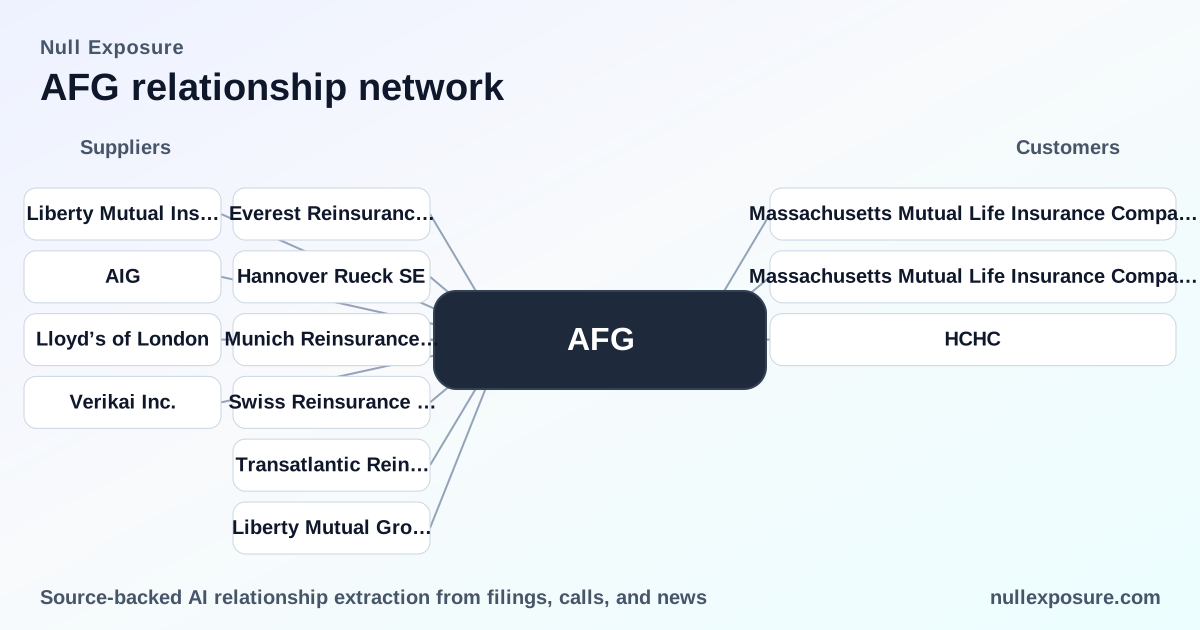
American Financial Group closed the sale of its annuity businesses to Massachusetts Mutual Life Insurance Company for $3.5 billion in cash, removing a large block of life/annuity liabilities from AFG’s balance sheet. According to Insurance Business (March 9, 2026), this transaction reduced AFG’s exposure to guaranteed annuity risk and provided immediate liquidity for capital redeployment.
Source: Insurance Business (news report, March 9, 2026). -
A separate news report confirmed the same transaction: AFG agreed to sell its annuity business to Massachusetts Mutual Life Insurance Company for $3.5 billion in cash, a transaction that converts illiquid policy blocks into liquid capital. RTTNews reported this corporate sale on March 9, 2026.
Source: RTTNews (press/news report, March 9, 2026). -
AFG’s historical footprint at Lloyd’s was tied to its acquisition of Neon Underwriting Ltd. (formerly Marketform) in 2008 for $75 million; AFG’s presence at Lloyd’s lasted about 12 years, illustrating past strategic experimentation with specialty underwriting platforms. CarrierManagement documented this legacy in a 2020 piece summarizing AFG’s Lloyd’s involvement and acquisitions.
Source: CarrierManagement (industry article, September 28, 2020). -
In 2015 AFG sold its long-term care insurance business to HC2 Holdings Inc. for an initial payment of $7 million, reflecting prior efforts to divest non-core long-duration liabilities. The Cincinnati Enquirer reported the transaction in April 2015, a move consistent with AFG’s later decision to exit annuity blocks as well.
Source: Cincinnati.com (local business report, April 14, 2015). -
The same Cincinnati.com piece is recorded under the HCHC ticker notation, capturing identical facts: AFG’s long-term care arm was transferred to HC2 (HCHC) in 2015 for a modest upfront payment and risk transfer, evidencing a history of shedding long-duration lines.
Source: Cincinnati.com (local business report, April 14, 2015). -
Local reporting noted that Great American Life — AFG’s annuities subsidiary — was sold to Massachusetts Mutual Life Insurance Co. for $3.5 billion, a change that created new operational arrangements (including hiring and relocation) for the divested business. WCPO covered the post-transaction local implications on May 2, 2026.
Source: WCPO (local news, May 2, 2026).
What these relationships imply for AFG’s risk/reward profile
The pattern across these documented relationships is deliberate: AFG is exiting long-duration life and annuity liabilities while double-downing on P&C specialty underwriting. That pivot improves capital flexibility and reduces interest-rate and longevity risks associated with annuities, but it also reduces recurring fee and spread income that previously diversified earnings.
Key investor considerations:
- Capital redeployment: The $3.5 billion cash inflow from the annuity sale strengthens the balance sheet and funds share repurchases or increases reinsurance capacity in underwriting lines with higher return on capital.
- Underwriting leverage: Concentrating on short-duration P&C increases sensitivity to casualty loss volatility and regional economic cycles; reserve adequacy and loss trends will be the primary drivers of near-term earnings.
- Customer credit and concentration: Selling into small and mid-market commercial segments keeps customer credit risk diffuse, but geographic concentration in the U.S. amplifies domestic regulatory and economic exposures.
- Operational profile: Continued use of service relationships (policy administration and claims processing) fits a model where AFG earns fees and retains underwriting economics — a structure that supports margin enhancement if scale and claims management remain disciplined.
Final read for the investor
AFG’s recent relationship activity is consistent with a strategic simplification toward core P&C underwriting and away from long-duration guarantees. For investors, the primary monitoring points are underwriting results, reserve development, and how management deploys divestiture proceeds. For ongoing relationship intelligence and concise transaction tracking on companies like AFG, visit https://nullexposure.com/.
Key takeaway: AFG’s disposals materially change its capital and risk profile—enhancing flexibility while concentrating the firm on short-duration underwriting performance and North American P&C dynamics.