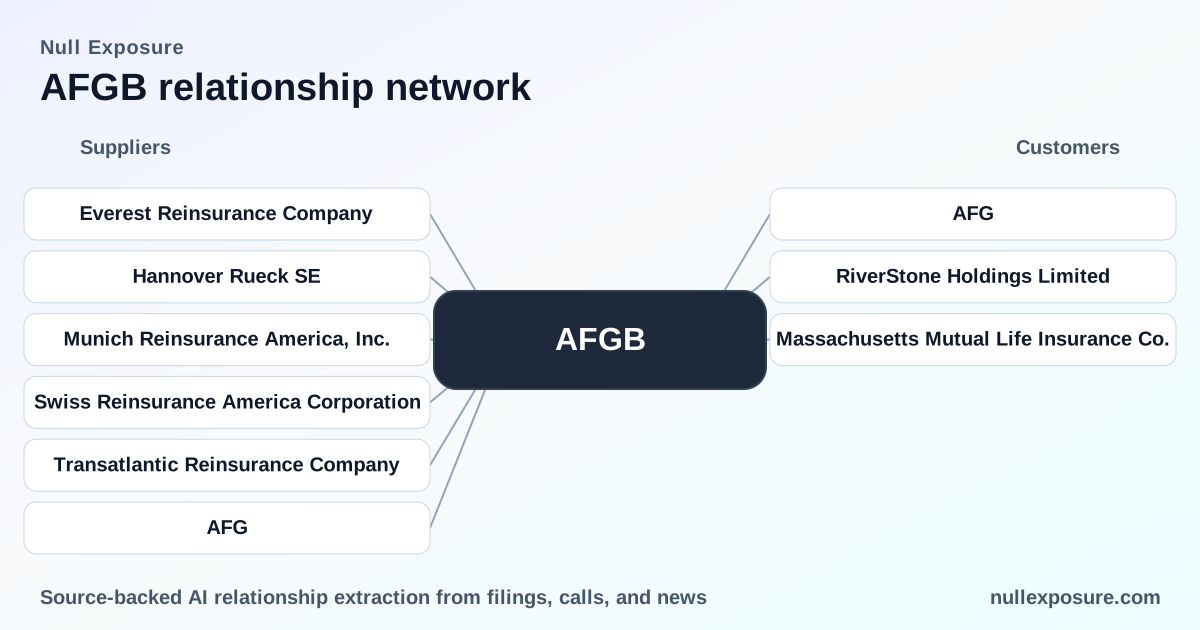
AFGB (American Financial Group) — customer relationships, strategic exits, and operational signals
American Financial Group (AFG), represented here by the AFGB preferred, is an insurance holding company that earns revenue through underwriting property & casualty risks, selling fixed and indexed annuities, and capturing investment income on float. The company monetizes via premiums written by its Great American insurance businesses, distribution through independent agents and brokers, and periodic corporate portfolio management decisions (including asset sales and Lloyd’s market exits) that reshape capital allocation and recurring earnings.
For an investor or operator evaluating AFGB customer relationships, the transactional history in the public record shows deliberate portfolio pruning—selling Lloyd’s-stage units and carving out life/annuity franchises—while the core commercial specialty P&C portfolio remains concentrated in North America and distributed through a broad agent base. Learn more at https://nullexposure.com/.
Quick take: strategy revealed through customer and counterparty moves
AFG’s public transactions over 2020–2021 reveal two strategic threads: exit non-core, lower-margin or capital-intensive platforms (e.g., Lloyd’s/Neon), and monetize annuity life franchises when valuation matches strategic priorities (Great American Life sale to MassMutual). These dispositions both free capital and reduce exposure to internationally complex reinsurance markets while preserving domestic specialty underwriting scale.
Read more about how these moves inform counterparty risk and distribution strategy at https://nullexposure.com/.
Relationship entries in the record — what each connection means
AFG (American Financial Group) — the seller in the Neon transaction
AFG executed a sale of GAI Holding Bermuda and its subsidiaries—the legal entities behind its Neon Lloyd’s operations—as part of a move to exit the Lloyd’s re/insurance marketplace. According to CarrierManagement (September 28, 2020), RiverStone was identified as the buyer in that transaction, reflecting AFG’s strategic pullback from Lloyd’s operations in FY2020. (Source: CarrierManagement, 2020)
RiverStone Holdings Lt. — buyer of Neon (as reported)
RiverStone Holdings Lt. is reported as the purchaser of the legal entities that own Neon, effectively acquiring AFG’s Lloyd’s-market platform in the FY2020 transaction. CarrierManagement described RiverStone as the acquirer in the September 2020 coverage of the deal, signaling a transfer of Lloyd’s-market exposure away from AFG to a specialized private equity-backed reinsurer. (Source: CarrierManagement, 2020)
RiverStone Holdings Limited — confirmation from reinsurance press
ReinsuranceNews provided a complementary report that AFG completed its exit from the Lloyd’s of London re/insurance marketplace through the sale of GAI Holding Bermuda and its subsidiaries to RiverStone Holdings Limited, corroborating the transaction and its strategic intent to leave Lloyd’s exposure. This external confirmation underscores that the Neon asset sale closed the loop on AFG’s Lloyd’s exit in FY2020. (Source: ReinsuranceNews, 2020)
Massachusetts Mutual Life Insurance Co. (MassMutual) — purchaser of Great American Life
Massachusetts Mutual Life Insurance Co. agreed to acquire Great American Life Insurance Company from AFG for $3.5 billion, transferring a substantial fixed-annuity franchise. InvestmentNews reported the FY2021 announcement, highlighting that Great American was a top fixed annuities seller (about $2.4 billion through the first three quarters of 2020) and that the transaction consolidated annuity market share under MassMutual while providing AFG with proceeds and strategic refocus. (Source: InvestmentNews, 2020/2021)
What the constraints say about AFGB’s operating model and what that means for counterparties
The relationship-level evidence is limited to a handful of strategic transactions, but company-level constraints provide a fuller operating picture. These are firm-level signals, not isolated to any single counterparty.
-
Distribution and contracting posture: AFG directs most P&C sales through several thousand independent agents and brokers, with agents typically paid commission. This structure implies low single-channel lock-in but high exposure to distribution economics (commissions, retention rates, and broker relationships). The company also writes a small portion through employee agents. (Company disclosures)
-
Concentration and customer mix: Management indicates that in AFG’s Specialty P&C group, a meaningful portion of gross written premiums is produced by top-tier businesses (management believes over 55% of 2024 GWP in Specialty P&C is produced by businesses ranking in the “top 10”), while other lines are dominated by small-to-mid sized commercial and regional policyholders. This mix yields concentration of premium with large accounts alongside scale in the mid-market, balancing counterparty credit and exposure profiles. (Company disclosure excerpt)
-
Geographic footprint and criticality: Statutory reporting focuses on U.S. subsidiaries that generated approximately 98% of direct written premiums in 2024, signaling a predominantly North American revenue base with limited but present international operations. For customers and partners, this implies regulatory and market risk largely tied to U.S. insurance markets rather than global Lloyd’s intricacies. (Company disclosure excerpt)
-
Materiality and commercial posture: The constraints flag relationships and revenue lines as material—AFG’s P&C platform and annuity businesses drive the company’s commercial profile and capital allocation decisions. Dispositions such as the Neon and Great American Life sales are therefore material strategic moves rather than incidental divestitures. (Company disclosure excerpt)
-
Customer types and maturity: The client base spans large enterprises, mid-market, small businesses, and not-for-profits, with government/public sector exposure noted at lower confidence. This breadth indicates mature underwriting capabilities across multiple customer segments and a need for tailored product and claims management across differing legal and risk environments. (Company disclosure excerpts)
Operational implication: AFG’s contracting model (agent-distributed P&C, commission economics) and concentrated premium production among top accounts create both scalability and vulnerability—scale in underwriting expertise and distribution gives competitive pricing power, while reliance on top-producing accounts concentrates underwriting and credit risk. The company’s recent sales demonstrate active capital management to reduce complexity and shore up balance-sheet flexibility.
Key takeaways and investor considerations
- Strategic de-risking: AFG sold its Lloyd’s platform (Neon) to RiverStone and its large annuity franchise (Great American Life) to MassMutual, signaling a deliberate reduction of capital-intensive or non-core exposures (CarrierManagement; ReinsuranceNews; InvestmentNews, 2020–2021).
- Domestic focus: ~98% of direct written premiums originate in the U.S., concentrating regulatory, pricing, and catastrophe exposure domestically.
- Diversified account base with concentrated premium production: The Specialty P&C book combines large enterprise accounts that drive a disproportionate share of premiums with a broad mid-market and small-business base.
- Distribution risk profile: Heavy use of independent agents reduces distribution concentration risk but transfers exposure to broker economics and commission sensitivity.
Final read for investors and operators
For investors evaluating AFGB, the record shows a company actively reallocating capital away from international Lloyd’s exposures and large annuity holdings while maintaining a North American specialty P&C franchise distributed through independent channels. For operators or counterparties, AFG represents a mature underwriter with a mixed counterparty base—material, domestically concentrated, and strategically decisive.
Explore further analysis and relationship maps at https://nullexposure.com/.