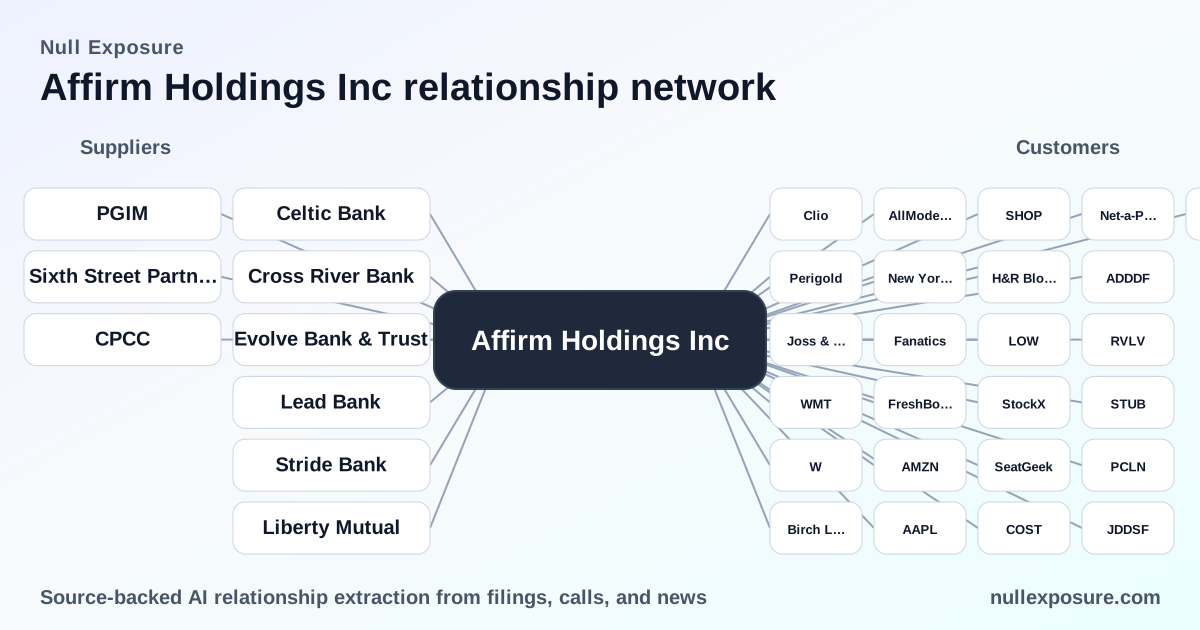
Affirm (AFRM) customer relationships: who pays, who partners, and what it means for revenue
Affirm operates a two‑sided commerce platform that underwrites and distributes consumer installment loans while charging merchants transaction fees and earning interest on interest‑bearing loans. The company monetizes through merchant fees, interest income on originated or purchased loans, and capital partnerships that fund loan inventory, with scale driven by merchant integrations across retail, travel, services and embedded payments.
Explore more merchant and capital signals at the Null Exposure homepage: https://nullexposure.com/
How Affirm’s commercial posture shapes risk and growth
Affirm’s relationships reflect a merchant‑led distribution strategy rather than reliance on a single anchor customer. Public filings show roughly 377,000 active merchants and $36.7 billion in GMV for FY2025, indicating broad distribution across small business and large enterprise customers. The company’s product mix includes short‑term Pay‑in‑X plans and longer interest‑bearing installment loans; that mix produces both transactional merchant fees and consumer interest income. Evidence in filings identifies the platform as active in the United States, Canada and the U.K., with the U.S. dominating revenue.
Key operating signals to consider:
- Contracting posture: predominantly merchant integrations and embedded checkout relationships; contracts are typically commercial integrations rather than long‑dated exclusives (company disclosures list Pay‑in‑X as short‑term installment product).
- Concentration: merchant revenue is immaterial at the individual level—no single merchant exceeded 10% of revenue for FY2025—so counterparty concentration risk is low but aggregate sector exposures matter.
- Criticality: for large retail partners, Affirm is a checkout feature that can be critical for conversion and average ticket; for small merchants Affirm is a growth tool but not a single‑source revenue dependency.
- Maturity: relationships range from years‑old marquee deals (Amazon, Shopify) to newer vertical expansions (tax services, healthcare), showing both foundational and growth‑phase integrations.
- Geography: revenue is heavily North America‑centric, with expanding but smaller presence in EMEA (U.K.) and Canada.
If you want a concise feed of merchant signals and relationship analytics, visit Null Exposure: https://nullexposure.com/
Merchant and capital relationships investors should track
Below is a compact, source‑tagged rundown of every relationship reported in the results feed.
- Walmart / WMT — Klarna replaced Affirm as Walmart’s exclusive BNPL provider in a March 2025 development, showing market competition for anchor retail relationships (TradingView / Reuters, March 2025).
- Wayfair / W — Affirm expanded its partnership to integrate BNPL across Wayfair’s checkout online and in‑store, positioning Affirm inside a large home furnishings vertical (SahmCapital / press reports, Oct 2025).
- Perigold — As part of Wayfair’s brands, Perigold now accepts Affirm payments for online and in‑store purchases, extending Affirm’s access to higher‑end furniture buyers (SahmCapital, Oct 2025).
- AllModern — Affirm’s payment options were rolled out to AllModern, another Wayfair brand, broadening merchant coverage in the Wayfair estate (SahmCapital, Oct 2025).
- Birch Lane — Birch Lane joined Affirm’s in‑store and online payment availability as Wayfair integrated Affirm across brands (SahmCapital, Oct 2025).
- Joss & Main — Affirm’s checkout was added across Joss & Main as part of the Wayfair expansion (SahmCapital, Oct 2025).
- Clio — Clio introduced “Pay Later with Affirm” in its legal practice platform, integrating Affirm into professional services billing (Seeking Alpha press release, FY2025).
- H&R Block Canada / HRB — H&R Block Canada partnered with Affirm to offer installment payments for tax services, a customer‑financing play expected to raise service uptake and average ticket (MarketBeat / TradingView, FY2026).
- New York Life Insurance — New York Life agreed to purchase up to $750 million of Affirm installment loans through 2026, expanding Affirm’s loan distribution to institutional buyers (Yahoo Finance coverage of the Oct 31 announcement, FY2025).
- Amazon / Amazon.com Inc. / AMZN — Affirm expanded integrations with Amazon since 2021, including integration into Amazon Pay and marketplace checkout arrangements that materially raised Affirm’s merchant footprint (SiliconANGLE and Barchart historical reporting, FY2021–FY2024).
- Amazon Pay — Affirm has been integrated into Amazon Pay’s digital wallet in the U.S., providing another vector for checkout adoption (SiliconANGLE, FY2021).
- FreshBooks — Affirm partnered with FreshBooks to bring BNPL to small business customers, extending Affirm into B2B invoice financing channels (MarketScreener & Yahoo Finance, FY2025).
- Fanatics — Affirm announced a partnership with Fanatics to offer BNPL to sports fans, joining a broader merchant network (MarketScreener and Yahoo Finance, FY2025).
- StockX — StockX is listed among large merchant partners in Affirm’s network expansion commentary tied to Fanatics (MarketScreener, FY2025).
- REVOLVE — REVOLVE appears on Affirm partner lists connected to merchant announcements in FY2025.
- Net‑a‑Porter — Included among large apparel and luxury merchant partners in Fanatics‑era disclosures (MarketScreener, FY2025).
- adidas — adidas listed as part of the merchant network mentioned in partnership press materials (MarketScreener, FY2025).
- StubHub / STUB — StubHub is cited in the partner list included in Fanatics and merchant network announcements (MarketScreener, FY2025).
- SeatGeek — SeatGeek appears in the merchant roll‑up for Affirm’s sports and ticketing partnerships (MarketScreener, FY2025).
- Costco — Costco is referenced in partner lists that underline Affirm’s scale among major retailers (MarketScreener, FY2025).
- Shopify / SHOP — Shopify’s Shop Pay Installments has an expanded agreement with Affirm that materially increased active merchant adoption on the Shopify platform (SahmCapital commentary and Affirm disclosures, FY2022–FY2026).
- Priceline / PCLN (Booking Holdings) — Affirm added Priceline to its integrator list, increasing coverage in travel bookings (Barchart reporting, FY2024).
- JD Sports — JD Sports was cited as a recent merchant integration, supporting Affirm’s European and specialist retail reach (Barchart, FY2024).
- Worldpay — Affirm integrated with Worldpay’s embedded payments to reach software platforms and partners, broadening distribution beyond direct merchant integrations (AskTraders, FY2025).
- Lowe’s / LOW — Affirm and Lowe’s teamed up to offer BNPL in the home improvement channel, an expansion into big‑box in‑store financing (StockTitan / press summaries, FY2026).
- DKS (Dick’s Sporting Goods) — Affirm extended its checkout partnership renewal with Dick’s to offer flexible payments online (StockTitan reporting, FY2026).
- Google — Affirm integrated with Google’s Agent Payments Protocol (AP2) to embed BNPL options into AI‑driven shopping experiences (AskTraders analysis, FY2025).
- Apple / AAPL — Affirm is integrated as an Apple Wallet BNPL provider, adding embedded wallet distribution to its merchant channels (Investing.com coverage of filing notes, FY2025).
- Stone Ridge — Stone Ridge holds Affirm consumer loans and limited redemptions to a fraction of requests, a capital stress indicator tied to loan warehousing exposure (Investing.com and Investing coverage, FY2026).
- Sixth Street / TSLX — Sixth Street entered a long‑term capital partnership to invest up to $4 billion by purchasing Affirm loans via a forward‑flow AssetCo structure, materially strengthening Affirm’s funding capacity (Sixth Street press release and StockTwits, FY2024–FY2025).
- FuturHealth — FuturHealth is cited as a sector partner providing payment plans for healthcare services, including GLP‑1 medication financing (AskTraders analysis, FY2025).
- CostCo entry is covered earlier (Costco).
- All merchant roll‑ups and partner lists referenced in multiple press releases indicate Affirm’s merchant network now exceeds 375,000 partners in public commentary tied to FY2025 announcements (MarketScreener & company disclosures, FY2025).
What the relationship map implies for investors
- Diversified merchant base but concentrated product exposure. Public filings and press coverage show broad merchant adoption and transactional scale, but Affirm’s revenue model still depends on consumer loan performance and the appetite of institutional buyers to purchase or warehouse originations.
- Capital partnerships are critical to balance‑sheet capacity. The Sixth Street and New York Life announcements are explicit examples of capital providers underwriting loan inventory, which directly affects originations and growth runway (Sixth Street press release; Yahoo Finance, FY2024–FY2025).
- Competition for anchor retail deals matters. Walmart’s switch to Klarna highlights the fragility of exclusive retail relationships and the importance of continually defending integrations (TradingView / Reuters, March 2025).
- Expansion into services and non‑retail verticals diversifies demand generation. Partnerships with H&R Block Canada, Clio, FreshBooks and FuturHealth show Affirm moving beyond pure retail into professional and healthcare payments, which supports revenue diversification but raises integration risk (MarketBeat, Seeking Alpha, Marketscreener, AskTraders, FY2025–FY2026).
Bottom line for operators and allocators
Affirm is a platform business that monetizes through merchant conversion fees, interest income, and third‑party capital flows; its growth is a function of merchant integrations and loan funding. Investors should monitor merchant churn at large partners, the health of loan buyers and warehouse funds, and geographic expansion metrics in Canada and the U.K. for signs that diversification is translating into durable revenue.
For systematic relationship monitoring and timely signals on partner changes, see Null Exposure’s customer intelligence coverage: https://nullexposure.com/