Allied Gaming & Entertainment (AGAE): Customer Relationships, Commercial Footprint, and Investment Implications
Allied Gaming & Entertainment operates as a global experiential entertainment company that monetizes through three core streams: venue management and branded esports arenas, casual mobile gaming with advertising and in‑app monetization, and live event promotion and sponsorships. Revenue is driven by long‑term sponsorship contracts, advertising agreements tied to in‑game impressions and clicks, venue operation & management agreements in international markets, and recurring subscription-style offers for premium experiences. For investors, the company’s scale is modest — Revenue TTM approximately $7.9M and Market Cap roughly $20M — but its commercial relationships concentrate revenue and expose the business to both execution risk in venue rollouts and counterparty concentration. For a deeper assessment of counterparties and contract posture, visit the company profile at Null Exposure.
How Allied makes money and where counterparty risk shows up
Allied runs a three‑pillar model: Allied Esports (in‑person events and arenas), Z‑Tech (casual mobile games and advertising), and Skyline (live concert promotion). Each pillar carries different counterparty dynamics:
- Venue operations and management agreements generate multi‑year cash flows when executed, but they are execution‑intensive and capital‑light only if Allied positions itself as a licensor/operator rather than an owner.
- Casual mobile gaming revenues are driven by advertising service providers that are effectively customers; Allied recognizes revenue on display/click events, creating high dependency on ad demand and platform distribution.
- Sponsorship contracts provide forward revenue visibility; documented sponsorships carry unsatisfied performance obligations that will be recognized over remaining terms.
Key commercial scale signals: Allied reported consolidated revenue breakdowns showing substantial activity in both the United States and China; during the year ended December 31, 2024 the company disclosed U.S. and China revenue lines that together comprise the bulk of consolidated sales, underpinning a genuinely global footprint rather than a single‑market play.
Contracting posture, concentration and maturity — what matters for investors
Allied’s customer relationships are characterized by longer contract tenors and recurring monetization mechanics, with supporting evidence in public filings and company disclosures:
- Long‑term contractual exposure: The company has sponsors and warrants that extend multiple years; one sponsorship runs through April 2, 2026 and the firm recognizes remaining revenue over the term. This gives near‑term revenue visibility but concentrates recognition risk into defined windows.
- Subscription elements: Allied explicitly designs VIP/subscription access as a revenue stream, indicating recurring revenue potential alongside one‑off ticketing and event sales.
- Geographic concentration and global reach: Allied reports meaningful revenues both in North America and APAC (notably China) and states it sells worldwide; this drives geographic diversification but also regulatory and execution complexity in APAC projects.
- Customer concentration: The company disclosed that its two largest customers accounted for approximately 48% and 20% of consolidated revenues in a recent year, creating pronounced counterparty concentration risk.
- Operational criticality: Advertising service providers are treated as customers with a single performance obligation tied to ad delivery, making ad demand a critical operational input.
These are company‑level signals rather than relationship‑specific assignments; they shape how investors should model downside scenarios for covenant, cash flow and growth assumptions.
Customer relationships disclosed in the record
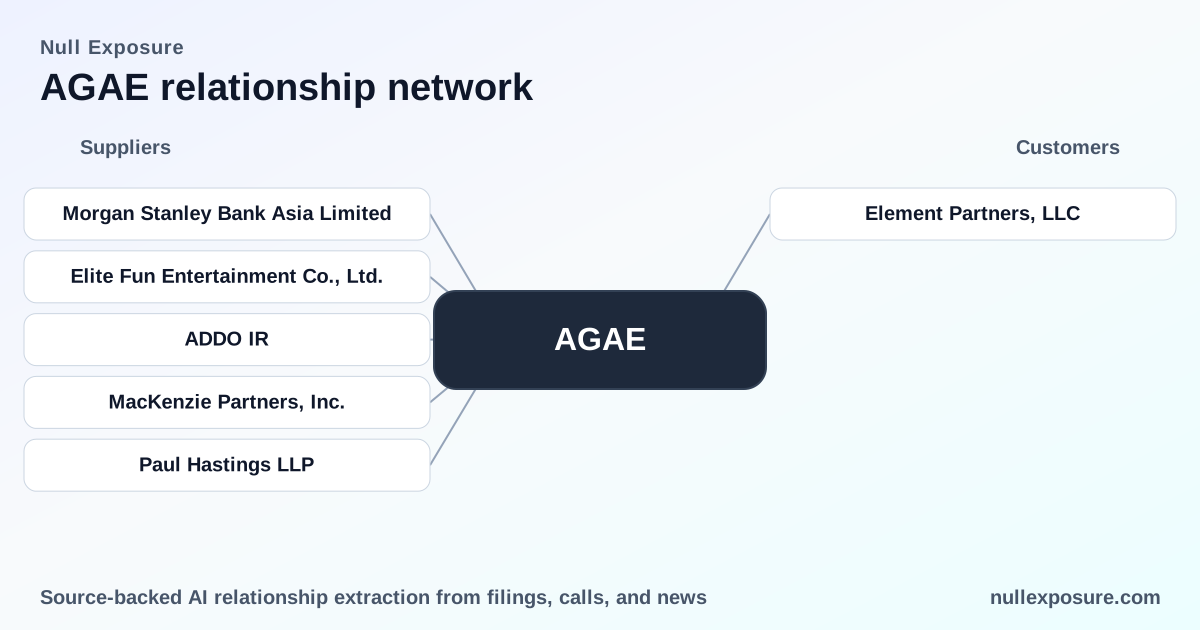
Element Partners, LLC — transaction and asset sale activity
A Gaming America report covering corporate actions noted that a stockholder meeting was scheduled to consider AESE’s sale of 100% of the outstanding capital stock of Club Services, Inc. to Element Partners, LLC; the process was reported in the context of transaction deliberations that trace back to FY2021. This reference signals past M&A activity involving AESE assets and an external private buyer. Source: Gaming America news coverage of the sale process (reported March 2026).
COFCO Yalong Bay International Conference Center — Asia venue project
According to TradingView’s summary of Allied’s SEC 10‑Q disclosures for FY2025, Allied Esports (Allied Esports International) agreed in principle on August 25, 2025 to negotiate a Project and Venue Operation & Management Agreement to convert the COFCO Yalong Bay International Conference Center in Sanya, Hainan, China into an Allied Esports Arena Asia. This is a direct example of Allied pursuing an operator/licensor role in APAC venue expansion. Source: TradingView coverage of Allied’s SEC 10‑Q (FY2025).
What these relationships imply for the business model
- Execution risk on venue rollouts: The COFCO negotiation illustrates Allied’s strategy to scale via venue operation & management agreements in APAC — a high‑leverage growth vector that requires strong local partnerships and reliable project governance. Successful negotiations convert into multi‑year revenue streams but failed or delayed projects materially impact near‑term growth.
- Concentration amplifies counterparty credit risk: With two customers representing nearly 70% of revenue historically, the failure or payment issues at a single counterparty would have outsized impact on cash flow and margins.
- Recurring and long‑dated revenue mix provides visibility, not immunity: Long‑term sponsorships and subscription mechanics give predictability, but the company still recognizes significant revenue from ad impressions and event execution, which are volatile and demand‑sensitive.
- APAC presence increases opportunity and geopolitical/regulatory complexity: China revenue lines are material to consolidated results, supporting growth but requiring active management of local operating models and revenue repatriation.
Practical takeaways for investors and operators
- Monitor the outcome of the COFCO negotiation as a milestone: a signed venue operation & management agreement would validate Allied’s ability to scale in APAC and de‑risk growth assumptions.
- Stress test concentration scenarios: model a 30–50% reduction in revenue from the top counterparties to understand liquidity and covenant resilience given the current revenue base.
- Track sponsorship recognition schedules and unsatisfied performance obligations: the company disclosed remaining contract revenue that will be recognized through contract maturities; these line items are the short‑term buffer against volatility.
- Evaluate advertising demand sensitivity: Z‑Tech’s ad revenue is tied to impressions and click events; macro ad market weakness would compress revenue quickly relative to fixed cost commitments.
For a concise dossier on counterparties and mapped relationship risk, see the company profile hub at Null Exposure — it centralizes filings, reported counterparties and material contract excerpts useful for valuation models.
Final read
Allied’s commercial model is clear: scale through venue operations, monetize via advertising and sponsorships, and extend reach with licensor/operator relationships in APAC. The business combines recurring elements with event‑driven volatility and is materially sensitive to a small number of counterparties and to execution on international venue projects. Investors should value Allied with a premium on execution and counterparty risk, and operators should prioritize contract certainty and local delivery capability as they pursue arena conversions and management agreements.