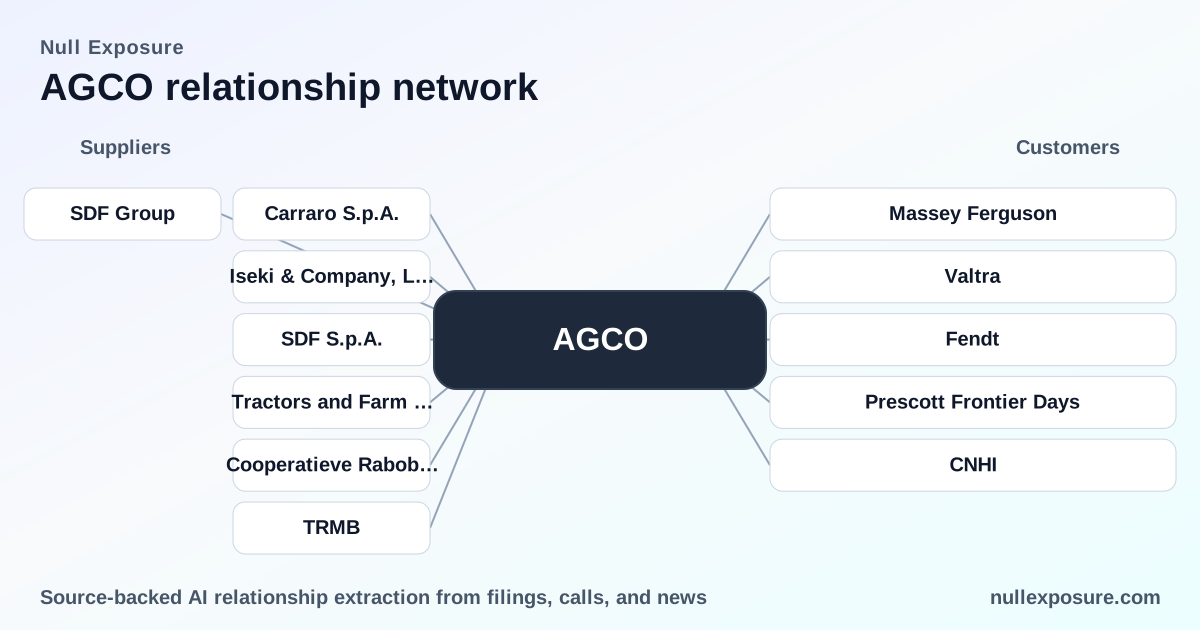
AGCO’s customer map: distribution-heavy, dealer-financed, globally diversified
Thesis — AGCO manufactures tractors, engines, and precision-agriculture hardware and software and monetizes through direct equipment sales, spare-parts aftermarket, and services delivered primarily via an independent dealer network; wholesale dealer finance and short-term payment schedules accelerate revenue recognition and broaden market reach while concentrating commercial risk in the dealer/distributor channel. For investor research: AGCO is a hardware-first industrial OEM with recurring aftermarket economics, distributed through ~2,700 independent dealers across ~140 countries, which makes dealer relationships the primary commercial lever and the chief operational dependency. Learn more about how we extract and contextualize customer signals at https://nullexposure.com/.
Market context and operating model signals
- AGCO’s commercial model is distribution-centric: the company funnels most production through independent dealers and distributors who conduct retail sales and after-sales service, creating a large but dispersed revenue base and leaving AGCO’s top-line exposure tied to dealer inventory and retail demand.
- Contracting posture is short-term dealer finance: AGCO operates wholesale finance arrangements with dealers that typically have fixed payment schedules running from one to 12 months, which accelerates cash conversion but requires continual dealer turnover to sustain sales velocity.
- Geographic footprint is global and segmented: reportable segments (EMEA, North America, South America, Asia/Pacific/Africa) show meaningful revenue concentration in Europe and the U.S., with material sales also in Latin America and APAC — this drives multi-currency, multi-market execution risk and diversified demand cycles.
- Role mix and product maturity: the company acts principally as a manufacturer and licensor (uses licensees and associates in some countries), reseller/distributor via dealers, and buyer/provider of precision-agriculture solutions to OEMs; product set is hardware-led with growing digital/precision services that lift lifetime aftermarket margins.
- Materiality: a large majority of sales are to independent dealers, making dealer performance and franchise economics central to AGCO’s operational stability.
Customer relationships (concise, source-linked)
- Ritchie Implement — AGCO added Ritchie Implement as an authorized full‑line production dealer serving southwest Wisconsin effective April 1, 2026, expanding local access to Fendt, Massey Ferguson and PTx product lines; the move was announced in AGCO PR material and syndicated by Finviz/Intellectia in early May 2026. (AGCO press release / Finviz, reported Mar–May 2026)
- Massey Ferguson — AGCO Power supplies engines to Massey Ferguson as part of its powertrain offerings; the Core80 engine program was publicly recognized in March 2026 as Diesel Engine of the Year, highlighting AGCO’s vertical integration across engines and brand portfolios. (AGCO Power/Core80 press coverage, Mar 9, 2026)
- Valtra — Valtra is one of the tractor brands powered by AGCO Power engines; public descriptions of the Core80 program list Valtra among brands receiving AGCO’s engines, underscoring intra‑group product flows across AGCO’s brand matrix. (AGCO Power/Core80 press coverage, Mar 9, 2026)
- Fendt — AGCO developed the Core80 engines together with Fendt, with product development explicitly integrating farmer needs from concept to production, signaling close product‑level collaboration between the engine division and the Fendt brand. (AGCO Power/Core80 press coverage, Mar 9, 2026)
- Prescott Frontier Days — A local consumer/brand engagement: Prescott Frontier Days received a Massey Ferguson 4700 Series tractor as an award or donation, illustrating AGCO brands’ community and promotional footprint at events. (StockTitan article reporting AGCO/Massey Ferguson activity, Mar 2026)
- TITN (Titan International) — Titan’s 2025 10‑K references AGCO as one of several equipment manufacturer competitors (alongside Deere, Caterpillar, Komatsu, Volvo Group), framing AGCO as a market peer whose product, pricing or dealer support could affect competitors’ market positions. (Titan International 2025 10‑K filing, Jan 2025)
- CNHI (CNH Industrial) — Coverage of AGCO’s Q4 2025 earnings notes PTX Elite dealer support across hundreds of dealers and calls out sales to OEM customers and competitors; documents reference CNH dealers and OEM sales when discussing dealer networks and aftermarket reach, situating CNHI as both a competitor and a neighboring distribution dynamic to track. (Earnings transcript coverage summarized in InsiderMonkey, Mar 2026)
- CNH (duplicate entry for CNHI) — Independent reporting of AGCO’s dealer and OEM footprint cites approximately 200 CNH dealers alongside hundreds of Fendt, Massey Ferguson and Valtra dealers; this reinforces the competitive set and shows cross‑industry dealer sizing used by management in earnings commentary. (Earnings transcript coverage summarized in InsiderMonkey, Mar 2026)
How these relationships change the investment lens
- Distribution scale is a competitive advantage and a concentration risk. A network of ~2,700 dealers across ~140 countries drives market reach and aftermarket sales but concentrates credit, inventory, and reputational exposure in those dealer franchises.
- Short-term wholesale finance lowers working capital but increases throughput dependence. Fixed payment schedules of one to 12 months accelerate cash collection, but sustaining revenue requires constant dealer replenishment and healthy end-user demand.
- Vertical integration in engines and brands supports margin capture. AGCO Power’s development of the Core80 engine with Fendt and supply to brands like Massey Ferguson and Valtra shows product-level integration that supports differentiated OEM pricing and aftermarket parts revenue.
- Local dealer additions remain the primary growth mechanism. The Ritchie Implement appointment in Wisconsin is emblematic of an expansion strategy that grows footprint through authorized dealers rather than direct retail — this is operationally cheap but commercially dependent on partner execution.
Investor takeaways and risks
- Positive: diversified geography, strong aftermarket potential, and integrated engine/brand programs that lift lifetime value per machine.
- Negative: dealer-channel concentration, short-term dealer finance reliance, and exposure to cyclical capital spending in key markets (EMEA/NA/LATAM/APAC) that can create lumpy sales and inventory risk.
- Watch: dealer credit metrics, inventory days at independent dealers, AGCO Power product adoption, and dealer appointment cadence for signs of sustainable demand or stress.
For analysts and operators wanting a systematic view of AGCO’s dealer and customer footprint, our platform aggregates these signals into actionable customer maps and contract‑posture indicators — explore the approach at https://nullexposure.com/.