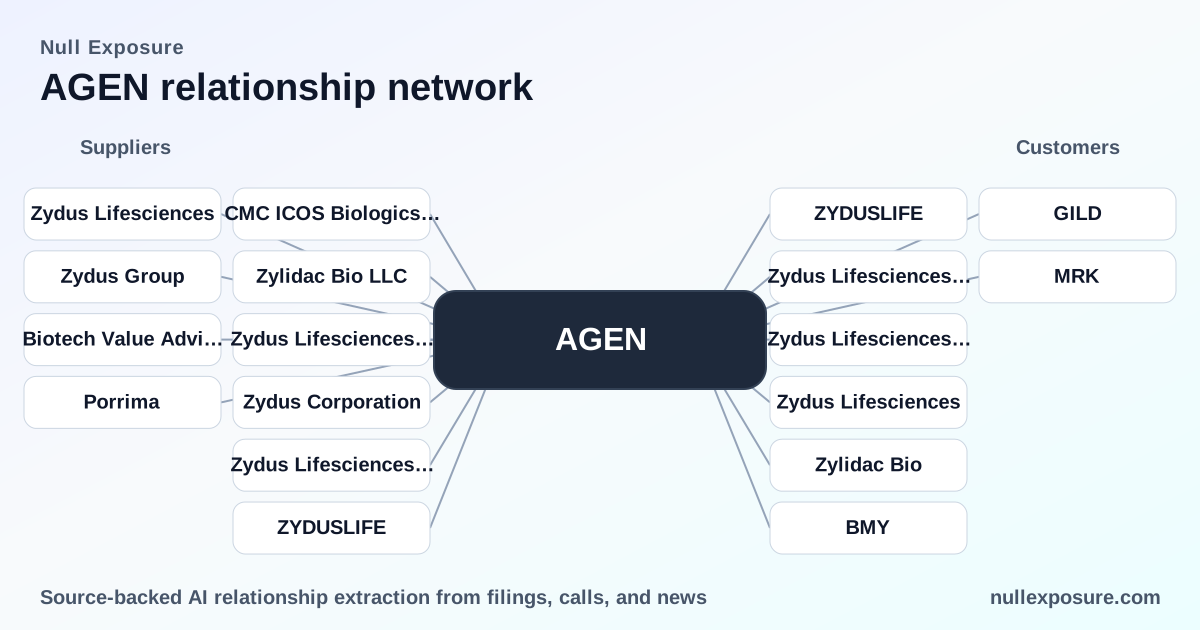
Agenus (AGEN) customer relationships: a commercial map for investors
Agenus is a clinical-stage immuno-oncology company that monetizes primarily through licensing, partnerships, milestone/royalty streams and selective asset sales rather than product sales today. Revenue over the last two fiscal years has been driven by upfront and milestone payments, non-cash royalty recognition and targeted divestitures of manufacturing assets, while the company continues to pursue partner-funded development programs for its lead assets (botensilimab and balstilimab). For investors, the thesis is straightforward: value realization at Agenus depends on licensing economics and partner execution rather than internal commercial scale. Learn more at https://nullexposure.com/.
Why the relationship map matters now
Agenus’s cash generation profile is dominated by partner deals, royalties and strategic asset transfers, so the quality, term structure and lifecycle stage of each relationship determines near-term revenue and longer-term upside. The company shows a pattern of licensing out programs, selling manufacturing capabilities, and monetizing royalty streams — an operating model that reduces commercial execution risk while concentrating counterparty exposure.
Operating model signals you should register
- Licensing-first commercial posture. Agenus regularly grants exclusive licenses and option agreements to third parties, keeping developmental upside while transferring commercial and regulatory costs to partners. This is a company-level strategic choice supported by multiple license agreements disclosed in filings.
- Counterparty mix includes large pharmas and strategic acquirers. Relationships with established pharma names and financial counterparties create material milestone and royalty optionality.
- Contract lifecycle heterogeneity. The record shows active collaborations, terminated options and winding-down partner agreements — which creates both recurring and one-time cash inflection points.
- Government and global exposure. Public contracts and global commercialization rights play a role in the company’s go-to-market and reimbursement risk posture.
- Deal size scale. There are multiple deal references in the $10–$100 million band, which is meaningful for a company of Agenus’s market capitalization and cash needs.
Visit https://nullexposure.com/ for further research tools and partner mapping.
Counterparty map: every relationship in the public results
Below are plain-English summaries of every relationship captured in the provided results, each with a direct source reference.
MiNK Therapeutics (INKT)
Agenus provides intercompany financial and operational services to MiNK Therapeutics through an amended intercompany services agreement, with a senior Agenus finance executive supporting MiNK’s operations. — Investing.com (SEC filing, May 2026): https://m.investing.com/news/sec-filings/mink-therapeutics-appoints-new-principal-financial-and-accounting-officers-93CH-4571980?ampMode=1
Zydus Lifesciences (ZYDUSLIFE / Zydus Lifesciences Limited)
Agenus completed a multi-component deal with Zydus that includes a $141 million strategic collaboration to accelerate development of botensilimab and balstilimab (BOT/BAL) and the sale of biologics manufacturing facilities, with Agenus eligible for a 5% royalty on net sales in India and Sri Lanka. — Pharmaceutical-Technology (Mar 9, 2026): https://www.pharmaceutical-technology.com/news/agenus-zydus-complete-141m-deal/
Zydus acquisition of Agenus manufacturing assets / Zylidac Bio
Zydus completed acquisition of Agenus’s Emeryville and Berkeley biologics manufacturing facilities and launched the Zylidac Bio subsidiary to operate them; the transaction transferred facilities and related operations to Zydus. — PR Newswire (Mar 2026): https://www.prnewswire.com/news-releases/zydus-lifesciences-limited-completes-the-acquisition-of-agenus-incs-biologics-manufacturing-facilities-launches-zylidac-bio-llc-in-the-us-302662438.html
Zylidac Bio (post‑transaction)
Following the Zydus transaction, the newly formed Zylidac Bio will operate the acquired manufacturing footprint in Emeryville and Berkeley, which had been part of Agenus’s CMC capability. — Pharmaceutical-Technology (Mar 9, 2026): https://www.pharmaceutical-technology.com/news/agenus-zydus-complete-141m-deal/
GSK
Agenus recognized non-cash royalty revenue tied to GSK in 2025 that materially affected top-line composition, illustrating the company’s reliance on partner-derived royalty flows. — TradingView summary of AGEN SEC filings (2025/2026): https://www.tradingview.com/news/tradingview:0b1736dabe4b7:0-agenus-2025-10-k-114-2m-revenue-0-00-eps/
Ligand Pharmaceuticals (LGND)
Ligand purchased a portion of Agenus’s royalty and milestone streams and paid $75 million to acquire economic interests tied to certain oncology products, including a royalty on botensilimab/balstilimab. That transaction provided immediate cash and repriced future royalty economics. — Pharmaphorum reporting (Mar 2026): https://pharmaphorum.com/news/ligand-grows-cancer-again-100m-apeiron-takeover
Bristol-Myers Squibb (BMY)
Agenus has historically entered into collaboration and license agreements with Bristol‑Myers Squibb, including an exclusive license for the AGEN1777 program; recent filings list BMS among major collaborators involved in Agenus’s pipeline development. — TradingView summary of AGEN SEC filings (2025/2026): https://www.tradingview.com/news/tradingview:76e3d95280f1f:0-agenus-inc-sec-10-q-report/
Gilead Sciences (GILD)
Agenus granted Gilead option-and-license programs for certain antibody assets (AGEN1223 and AGEN2373); Gilead formally chose not to exercise one option, leading to termination of that agreement in 2024 and return of rights. — Evidence summarized in Agenus filings cited in trading coverage (FY2024–FY2026): https://www.tradingview.com/news/tradingview:76e3d95280f1f:0-agenus-inc-sec-10-q-report/
Merck (MRK)
Merck is listed among Agenus’s collaborative partners in public filings and forms part of the counterparty set that shares in development and royalty economics across Agenus programs. — TradingView summary of AGEN SEC filings (2025/2026): https://www.tradingview.com/news/tradingview:76e3d95280f1f:0-agenus-inc-sec-10-q-report/
What these relationships imply for revenue and risk
Agenus’s commercial model is transaction-driven: upfront payments, milestone receipts, royalty recognition and occasional asset sales drive earnings rather than recurring product revenue. That structure produces a few concrete investment implications:
- Concentration of value realization: Large one-off deals (e.g., Zydus transaction, Ligand purchase) deliver sizable near-term cash but transfer future upside to counterparties, compressing Agenus’s share of long-term product economics.
- License and partner execution criticality: Development and commercialization depend on partner decisions; terminations or option non-exercise (Gilead, BMS winding‑down) create return-to-company scenarios but also timing uncertainty.
- Contract lifecycle diversity: Active partnerships coexist with terminated or winding-down deals; this creates a mix of recurring royalty recognition and episodic cash events.
- Government and global exposure: Government contracting and global commercialization rights introduce reimbursement and regulatory complexity that affect realized pricing in multiple markets.
- Deal size relevance: Multiple references point to the $10–$100 million band, which is material relative to Agenus’s market cap and liquidity profile.
Key risks and levers for valuation: partner clinical execution, milestone timing, royalty percentage retention after secondary sales (e.g., Ligand), and successful monetization of returned assets.
Bottom line for investors
Agenus is a licensing-centric biotech whose valuation hinges on partner agreements and selective asset monetization rather than internal commercial capabilities. Investors should track partner milestones, royalty recognition schedules, and any further asset sales that will materially alter future cash flow shares.
For a deeper counterparty map and scenario modeling, visit https://nullexposure.com/ — our analysis tools break down partner cashflow timelines and downside scenarios.
Bold takeaways: Agenus generates value through contracts, not product sales; partner decisions and deal structures are the primary drivers of near-term cash and long-term upside.