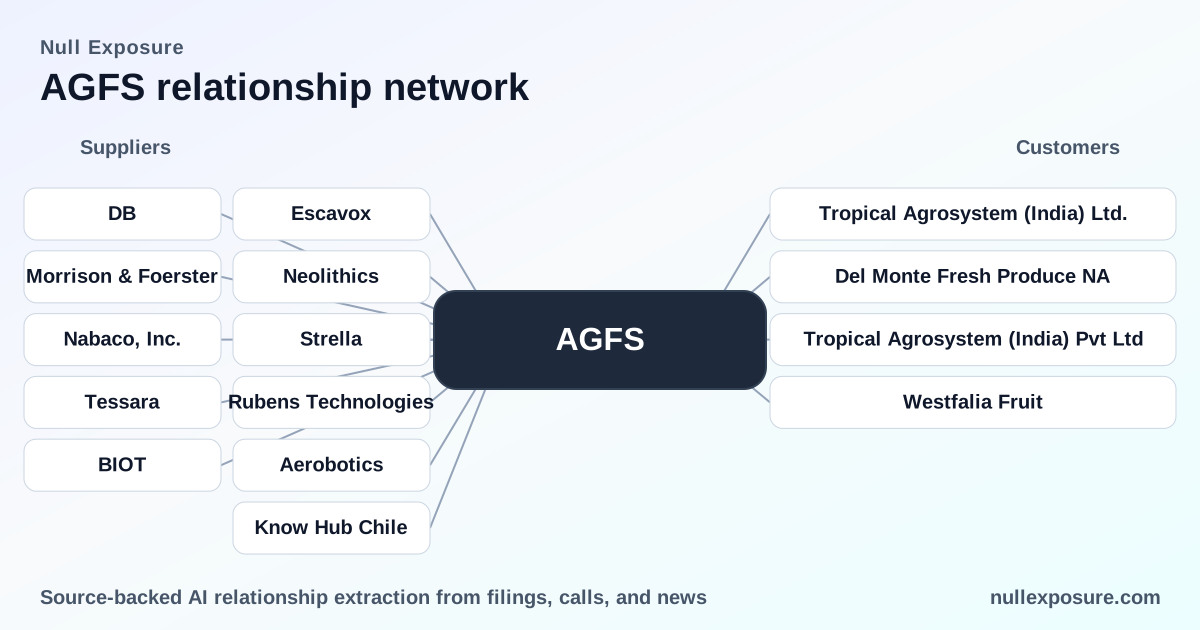
AgroFresh (AGFS) customer map: who pays for freshness and why it matters
AgroFresh Solutions, Inc. monetizes a mix of chemical treatments, hardware and cloud software sold to growers, packers and retailers to extend shelf life and reduce waste; revenue comes from product sales, recurring software/inspection services and channel partnerships that drive geographic scale. Investors should view AGFS as a platform company selling operationally critical post‑harvest technology to large, branded supply‑chain players — business is driven by product stickiness, recurring software economics and partner-led distribution. For a deeper look at the company’s customer relationships and what they imply for revenue durability, see the company intelligence home page: https://nullexposure.com/
How AgroFresh makes money
- Product sales: SmartFresh™, SmartFresh™ InBox and RipeLock treatments are sold to packers and retailers; these are consumable, repeat‑purchase products.
- Software & services: FreshCloud™ Quality Inspection is a recurring, analytics/service product sold to large growers and packers.
- Channel/licensing & partnerships: local distributors and strategic partners expand reach into markets like India, Australia and Latin America.
Investor‑oriented constraints and operating model signals
- Contracting posture: Commercial relationships are predominantly B2B contracts with multi‑month to multi‑year buying patterns (product replenishment and subscription-like software), supporting predictable repeat revenue.
- Concentration and distribution: Customers are large, geographically distributed growers and packers; this reduces single‑customer concentration risk but increases dependence on a set of large partners to drive scale in each region.
- Criticality and stickiness: Freshness and shelf‑life are operationally critical for produce supply chains; customers have clear incentives to retain treatments and inspection services that demonstrably reduce waste, increasing switching costs.
- Maturity of offerings: SmartFresh™ and RipeLock have legacy adoption in produce supply chains, while FreshCloud™ Quality Inspection is a faster‑growing, higher‑margin recurring component that supports strategic expansion into digital services.
Customer relationships — direct, regional and repeated mentions Below are every customer or partner mention in the available results; each entry is presented in plain English with its cited source.
Tropical Agrosystem (India) Ltd.
Tropical Agrosystem is working with AgroFresh to introduce Strella and Rubens into the Indian market following earlier launches of SmartFresh™ and SmartFresh™ InBox, indicating a formal strategic partnership to distribute both hardware and treatment solutions. According to IndiaTechnologyNews (March 2026), the move extends AgroFresh’s product suite into India via a local partner.
Del Monte Fresh Produce NA
Del Monte is using AgroFresh’s RipeLock system to extend banana shelf life at retail, reflecting direct adoption by a large branded produce retailer/packer and demonstrating product relevance in fresh produce retail operations. A report in The Packer (FY2022) highlighted Del Monte’s deployment of RipeLock to improve in‑store shelf life.
Montague
Montague, one of Australia’s largest fruit growers, will deploy FreshCloud™ Quality Inspection across its quality systems to drive decision‑making and reduce waste, signaling enterprise adoption of AgroFresh’s software/inspection offering at scale in Australia. Global‑Agriculture reported this rollout on May 2, 2026.
Tropical Agrosystem (India) Pvt Ltd
Tropical Agrosystem (India) Pvt Ltd is expanding the SmartFresh InBox rollout in India, underscoring repeated and expanding distribution of AgroFresh’s post‑harvest solution through the same regional partner. The Hindu BusinessLine covered this expansion (March 2026).
Tropical Agrosystem (India) Pvt. Ltd.
A second mention in industry coverage notes Tropical Agrosystem’s expanded footprint for SmartFresh™ InBox in India, reinforcing that AgroFresh’s Indian distribution is both broadening and being publicized across trade outlets. Global‑Agriculture carried this note on May 2, 2026.
Westfalia Fruit (Perishable News citation, FY2023)
Westfalia Fruit implemented FreshCloud Quality Inspection to fight food waste, showing adoption among large export‑oriented fruit companies in Latin America and the global avocado supply chain. PerishableNews reported this implementation (first seen in 2026, referencing activity in FY2023).
Starr Ranch Growers
Starr Ranch Growers adopted FreshCloud™ Quality Inspection to help reduce waste, indicating direct uptake among large domestic U.S. growers who operate packing house and supply‑chain infrastructure. Global‑Agriculture covered Starr Ranch’s implementation on May 2, 2026.
Bagú
AgroFresh worked with Bagú, a leading clementine producer, to improve quality through data, illustrating targeted use of FreshCloud analytics to optimize fruit grading and packing decisions. Global‑Agriculture reported Bagú’s engagement on May 2, 2026.
Westfalia Fruit (Global‑Agriculture citation)
A separate item in Global‑Agriculture reiterates implementation of FreshCloud™ Quality Inspection by Westfalia Fruit, emphasizing that Westfalia’s adoption is noted across multiple trade publications and by year‑end reporting. Global‑Agriculture published this account on May 2, 2026.
What this customer map means for revenue and risk
- Recurring‑revenue growth vector: Adoption of FreshCloud™ by Montague, Westfalia, Starr Ranch and Bagú signals an acceleration in recurring services revenue that is higher margin and stickier than one‑off chemical sales. This transition supports upward margin trends if installations scale.
- Channel expansion as growth multiplier: The repeated Tropical Agrosystem references confirm that AgroFresh leverages local partners to enter high‑growth markets like India; partner distribution reduces go‑to‑market cost but increases reliance on channel execution.
- Diversification across crop types and geographies: Customers include banana exporters, clementine producers, avocado/fruit groups and large Australian growers, which spreads commercialization risk across commodities and regions.
- Concentration caveat: While the roster is diversified, large named customers drive visibility and volume; loss of a handful of major partners would be noticeable to revenue, so monitor contract renewals and expansion metrics.
Actionable investor signals
- Track FreshCloud installation counts and subscription ARR disclosures as the clearest leading indicator of margin expansion.
- Monitor partner distribution agreements (e.g., Tropical Agrosystem) for territory exclusivity and revenue share terms that affect scale economics.
- Watch renewals with large packers (Del Monte, Westfalia, Montague); these contracts determine the durability of product and service revenue.
For a consolidated view of AGFS commercial exposure and to access more customer intelligence, visit the company research hub: https://nullexposure.com/
Conclusion AgroFresh’s customer footprint shows a deliberate push from chemical treatments into cloud‑enabled quality inspection sold to large growers and packers; this hybrid product + software model increases revenue resilience and margin upside but remains sensitive to execution by regional partners and renewal dynamics with major accounts. Investors should prioritize observable SaaS‑style metrics and partner roll‑out cadence when modeling revenue growth and profitability.