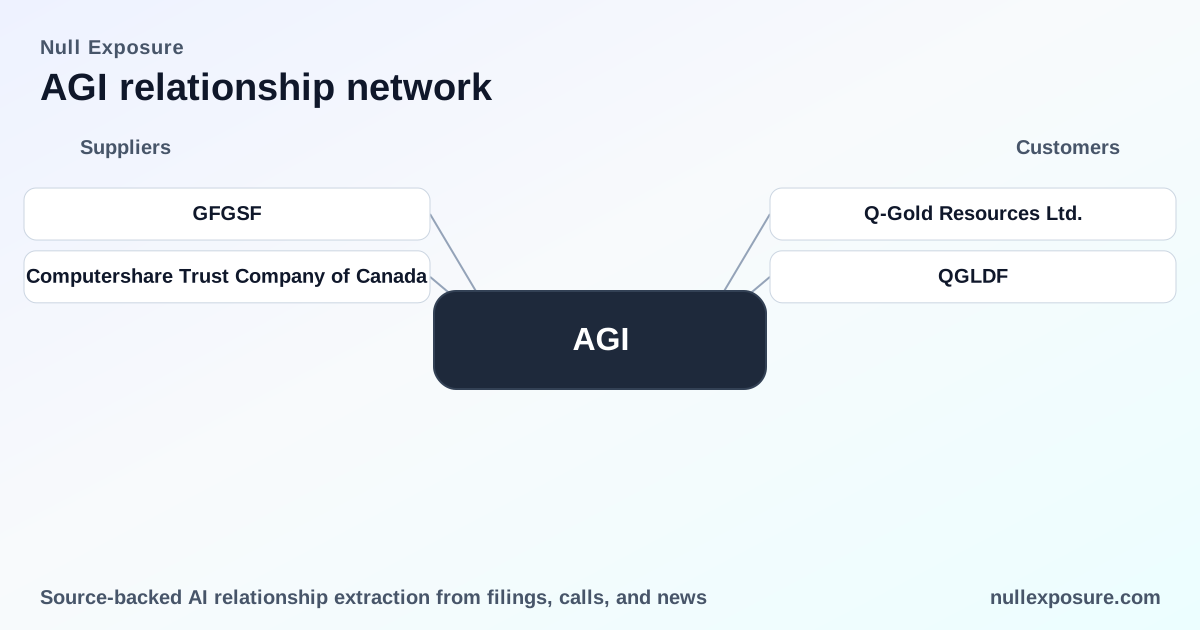
Alamos Gold (AGI): Customer relationships that matter for value and operational risk
Alamos Gold operates as a North American gold producer, monetizing through mine production, concentrate and doré sales, and selective asset disposals and royalties that convert future geology into near-term cash and equity stakes. Revenue derives from physical gold production and strategic monetizations of non-core projects, while third‑party royalties and processing relationships create recurring cash flow vectors and operational dependencies. For investors, the mix of asset sales, royalties and facility interactions across partners defines both upside and operational risk exposure.
Explore a focused view of these customer and partner links at https://nullexposure.com/ for ongoing monitoring and deeper intelligence.
Why these relationships matter for an investor thesis
Alamos’s external ties in the record set reveal three actionable themes for underwriting risk and upside: (1) asset monetization and portfolio pruning that accelerates cash and ownership stakes; (2) royalty arrangements that convert mines into low‑cost, predictable cash flows; and (3) operational interdependencies where facility availability and processing capacity affect third‑party throughput and Alamos’s own optionality. Together these signals shape contracting posture (selective deals rather than long-term processing commitments), concentration (industry‑typical handful of royalty and sale partners), criticality (processing outages can ripple to customers), and maturity (divestments and royalties consistent with a mid‑life producer managing capital).
No contractual constraints are flagged in the relationship records; as a company‑level signal, this absence indicates the available reporting does not highlight formal contract restrictions or encumbrances tied to the disclosed customer links.
Customer and partner links — itemized, source-by-source
BATL — Battalion Oil (news coverage)
An Ad‑Hoc News report described the shutdown of the AGI processing facility beginning August 2025, which forced Battalion to rely on third‑party processors and cut its average daily output in Q4 2025 by roughly 4,300 barrels of oil equivalent, illustrating that Alamos’s processing infrastructure functioned as a material throughput node for at least one counterparty. According to Ad‑Hoc News (May 2, 2026), the facility outage had direct operational consequences for customers tied to that plant. (Source: Ad‑Hoc News, May 2026 — https://www.ad-hoc-news.de/boerse/ueberblick/battalion-oil-under-investigation-as-operational-woes-deepen/69118909)
GDEN — Golden Entertainment (Ainsworth content deal, FY2020 reporting)
A historical item in the records references an Ainsworth agreement to supply exclusive gaming content across Golden Entertainment’s Montana route; the excerpt records a content‑supply deal from October 2020 and contains no explicit operational link to Alamos Gold’s core mining operations. The underlying citation is an Infoplay news item from October 23, 2020. (Source: Infoplay, Oct 23, 2020 — https://www.infoplay.info/en/2020-10-23/-160ainsworth-announces-agreement-to-provide-exclusive-montana-gold-multigame-content-for-golden-entertainment/14088/new/)
Q‑Gold Resources Ltd. (StockTitan entry, FY2026)
StockTitan reports that Alamos closed the sale of its option to earn an interest in the Quartz Mountain Gold Project in Oregon to Q‑Gold Resources Ltd., receiving cash and an equity interest in Q‑Gold, a transaction that converts a prospective asset into liquidity and an ownership position in the buyer. The StockTitan overview (March 2026) records the cash and equity consideration for the Quartz Mountain option sale. (Source: StockTitan, Mar 2026 — https://www.stocktitan.net/overview/AGI/)
MTA — Metalla Royalty (press release, FY2025)
A Metalla press release highlights that regional drilling at the Edwards Mine (operated by Alamos) intersected high‑grade mineralization and notes that Metalla holds a 1.25% NSR royalty on the Edwards Mine, establishing a recurring royalty payment channel tied to Alamos’s extraction success. The Metalla update (June 24, 2025) ties downstream royalty economics to Alamos’s mining progress. (Source: PR Newswire / Metalla, reported Mar 2026 — https://www.prnewswire.com/news-releases/metalla-reports-financial-results-for-the-third-quarter-of-2025-and-provides-asset-updates-302614961.html)
QGLDF / Q‑Gold Resources (MarketScreener entries, FY2025 — duplicate coverage)
MarketScreener carried multiple notices in April 2025 that Alamos sold the Quartz Mountain Gold Project to Q‑Gold Resources and structured consideration to maintain an equity stake (reported around 10.8% in related filings), signaling a deliberate monetization strategy that preserves upside through retained equity. MarketScreener coverage of April 28, 2025 documents the divestiture and the ongoing ownership linkage. (Sources: MarketScreener, Apr 28, 2025 — https://www.marketscreener.com/news/alamos-gold-to-acquire-gfg-resources-securities-to-maintain-10-8-stake-ce7d5adcdb8cf120 and https://www.marketscreener.com/news/alamos-gold-announces-renewal-of-normal-course-issuer-bid-ce7d50d2de8cf427)
Q‑Gold Resources (MarketScreener repeated reference — FY2025)
A second MarketScreener item reiterates the Quartz Mountain sale and Alamos’s retained interest, offering corroborating market reporting on the same transaction and reinforcing that the Quartz Mountain disposition is a deliberate capital‑allocation action rather than an operational write‑off. (Source: MarketScreener, Apr 28, 2025 — https://www.marketscreener.com/news/alamos-gold-to-acquire-gfg-resources-securities-to-maintain-10-8-stake-ce7d5adcdb8cf120)
What to take away for valuation and portfolio construction
- Asset‑level monetization is an active lever for Alamos: the Quartz Mountain transactions and equity receipt compress development risk on non‑core projects while preserving upside exposure through ownership stakes. These actions support free cash flow generation without diluting operational focus.
- Royalties provide recurring, low‑cost cash flow and reduce capital intensity; the Metalla 1.25% NSR on Edwards is a direct example where Alamos’s operational success translates into partner income that is economically tied to production.
- Operational interdependence is a clear risk vector: the documented shutdown of an AGI processing facility (Aug 2025) had tangible effects on customer throughput, which underlines that facility availability is a counterparty risk that can transmit to third‑party production and reputation.
- Coverage noise exists: not all matches in the relationship records are operationally meaningful to Alamos’s core mining business (for example, the Ainsworth/Golden Entertainment item), so active curation is necessary to isolate commercial counterparties that affect cash flow.
If you evaluate counterparty exposure and operational risk across precious‑metals producers, track these links and transaction histories for evolving concentration and criticality signals. Learn more about structured monitoring and relationship intelligence at https://nullexposure.com/.
Bottom line
Alamos is executing a mixed strategy of producing cash from established mines while using disposals and equity stakes to derisk exploration assets and employing royalty structures that create predictable partner income. Investors should underwrite upside to the extent Alamos converts optionality into liquid value, and discount for operational dependency on key processing assets whose outages have demonstrable downstream effects.