Agios (AGIO): customer map, concentration risk, and what the commercial footprint means for investors
Agios Pharmaceuticals monetizes by commercializing small-molecule therapeutics (notably PYRUKYND and the recently launched AQVESME) through a narrow network of specialty distributors and specialty pharmacies, and by monetizing intellectual property through asset sales and royalty transactions. Revenue is driven primarily by product sales routed through a few large channel partners, while corporate liquidity has been materially augmented by strategic asset sales and royalty monetizations. For a concise analytical brief on customer concentration and partner commitments, visit https://nullexposure.com/.
How Agios actually sells and gets paid
Agios sells PYRUKYND and now AQVESME into the market primarily through a limited set of specialty distributors and specialty pharmacy providers that resell or dispense to patients. The company also extends its commercial reach internationally through regional distribution agreements, and it has recently executed transformational transactions—selling oncology assets to Servier and monetizing royalty rights—to improve cash position. According to the company’s 2025 Form 10‑K, Agios’s commercial model is distributor/reseller-centric, with downstream pharmacies or specialty pharmacies dispensing directly to patients after purchase by those Customers.
- The company’s own 2025 Form 10‑K describes sales to a limited number of specialty distributors and specialty pharmacy providers and notes distribution arrangements outside the U.S. with Avanzanite and NewBridge (FY2025).
- A March 2026 market report summarized Agios’s sale of its oncology business to Servier and the sale of Vorasidenib royalty rights to Royalty Pharma, events that materially improved liquidity (news reporting, March 2026).
Concentration is the defining financial constraint
Agios exhibits extreme customer concentration. The 10‑K reports that one Customer accounted for 89% of consolidated revenues in 2025 and even higher shares in prior years (95% in 2024 and 96% in 2023); accounts receivable are similarly concentrated. This is a primary financial and commercial risk vector for investors evaluating Agios’s customer relationships and earnings durability. The 10‑K also explicitly frames the channel partners as distributors/resellers who subsequently resell or dispense product to pharmacies or patients (FY2025).
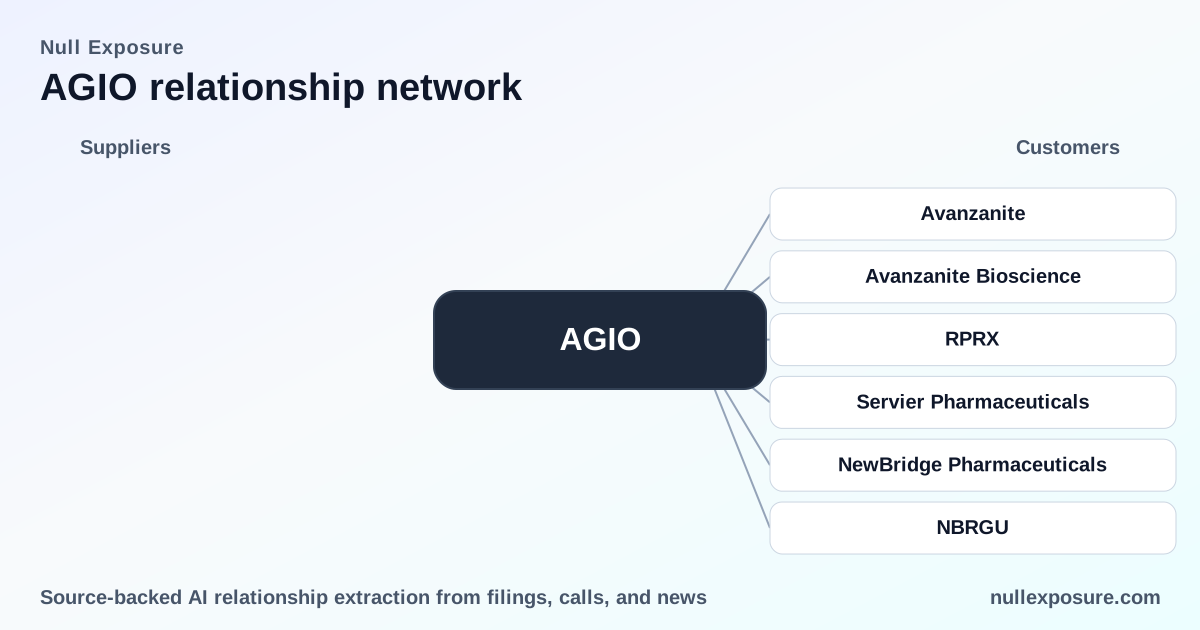
Customer map — every relationship pulled from Agios’s public references
Below are concise plain‑English descriptions of every relationship flagged in the public record, with source context.
Avanzanite
Avanzanite is named as a purchaser of PYRUKYND for territories outside the United States, part of Agios’s limited set of international Customers that take product for resale in the EEA, Switzerland, and the U.K. — this is documented in Agios’s 2025 Form 10‑K (FY2025).
Avanzanite Bioscience
Avanzanite Bioscience is cited in press reporting as the named distribution partner in the European Economic Area, Switzerland, and the U.K., helping Agios expand commercial reach in those markets (TradingView coverage of Agios filings, March 2026).
NewBridge Pharmaceuticals
NewBridge Pharmaceuticals is identified as Agios’s distribution partner for the Gulf Cooperation Council region (GCC), supporting launches and approvals in Gulf markets for rare blood disorder indications (regional news coverage, SahmCapital; also referenced in TradingView summarizing Agios filings, March 2026).
NewBridge (NBRGU)
NewBridge appears in the company’s 2025 Form 10‑K as a Customer that buys PYRUKYND outside the United States; NewBridge is also mapped to the market symbol NBRGU in Agios’s disclosure (10‑K, FY2025).
NBRGU
NBRGU is represented twice in Agios’s relationship list; the duplicate entries reflect the same contractual purchaser identity for international product sales as recorded in the FY2025 filing (10‑K, FY2025).
Servier Pharmaceuticals
Servier Pharmaceuticals is the counterparty that acquired Agios’s oncology business in a transaction that generated a large upfront cash payment plus contingent milestone payments, improving Agios’s capital position and refocusing the company toward its commercial and metabolic programs (news reporting summarizing the 10‑K and related disclosures, March 2026).
Royalty Pharma (RPRX)
Royalty Pharma purchased Vorasidenib royalty rights from Agios for $905 million, a material non‑operating liquidity event that the company reported and that materially reduced financing pressure while crystallizing value from an asset that would otherwise have been subject to development risk (TradingView report summarizing Agios’s filings, March 2026).
RPRX
The entity RPRX is listed again in the relationship output mirroring the Royalty Pharma entry; both records reference the same $905 million royalty rights sale and should be read as the same monetization event (TradingView coverage, March 2026).
What these relationships imply for contract posture, criticality and maturity
- Contracting posture: Agios operates with a concentrated, channel-focused commercial posture. The 10‑K explicitly describes sales to a limited number of specialty distributors and specialty pharmacies and states that those Customers resell or dispense product to pharmacies and patients (10‑K, FY2025). That structure creates single‑counterparty leverage on pricing, billing terms and collection.
- Concentration and criticality: The company‑level disclosure that one Customer supplied 89% of revenues in 2025 is a corporate signal of extreme counterparty risk and receivables concentration; this should be treated as a near‑term liquidity and operational dependency rather than a residual diversification issue.
- Maturity and product cycle: Agios is transitioning from development to commercial maturity in key indications: AQVESME launched in the U.S. in January 2026 under a REMS program, and PYRUKYND is already commercial in multiple territories through distribution partners (company disclosures and FY2025/early‑2026 public coverage).
- Balance‑sheet impact: Strategic asset sales (Servier) and royalty monetization (Royalty Pharma) materially strengthened cash reserves, converting development‑stage optionality into near‑term liquidity (news coverage, March 2026).
Investment implications for operators and allocators
- Revenue durability is concentrated: With a single Customer accounting for the bulk of revenue historically, investors should price in meaningful downside to top‑line forecasts if any major distributor relationship softens or if contracting terms are renegotiated.
- Distribution partnerships define market access: International expansion into the EEA, U.K. and GCC relies on partners such as Avanzanite and NewBridge; those relationships accelerate market entry but transfer execution and reimbursement risk to local partners.
- Non‑operating monetizations reshape optionality: The Servier sale and the $905 million Royalty Pharma transaction materially lower near‑term financing risk but reduce upside tied to those assets; investors must balance improved liquidity against lost future revenue streams from sold assets.
For more structured intelligence and ongoing tracking of Agios’s partner footprint and concentration metrics, see our research portal at https://nullexposure.com/.
Bold takeaways
- Extreme customer concentration is the single largest commercial risk for Agios.
- Distribution and reseller partners (Avanzanite, NewBridge) are the primary channels for international growth but also central points of execution risk.
- Asset sales and royalty monetization significantly improved liquidity but removed upside tied to those assets.
This combination — narrow distribution channels, high revenue concentration, and recent monetizations — establishes Agios as a commercially active biotech with material single‑counterparty exposure that investors must model explicitly into revenue and credit scenarios.