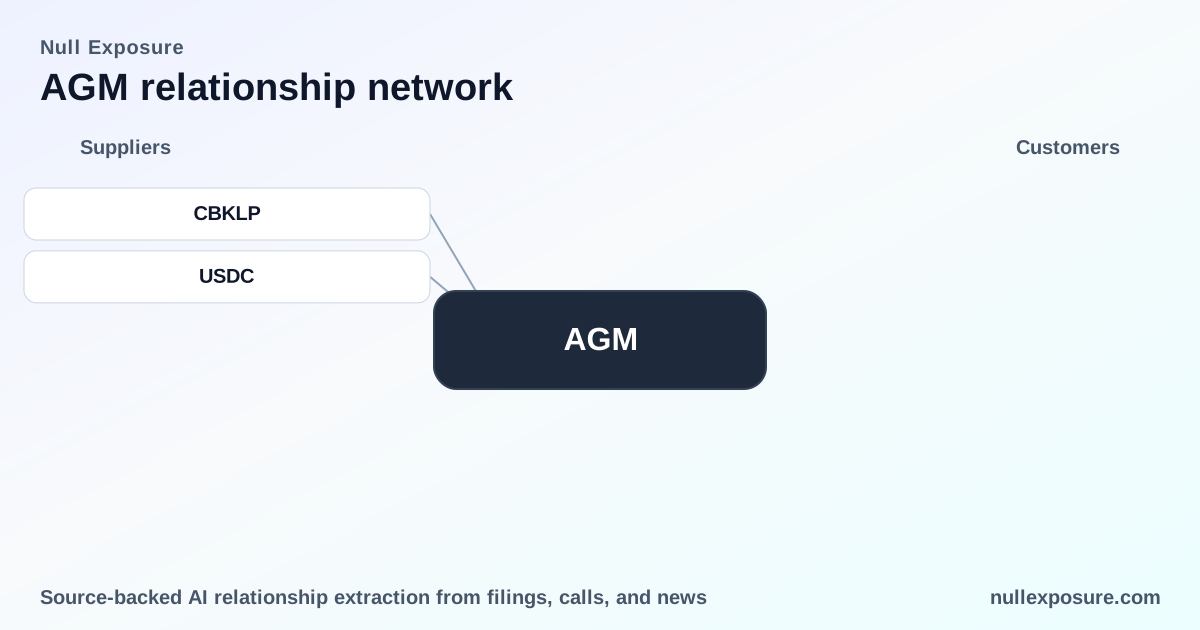
Farmer Mac (AGM) — customer relationships that underpin a niche secondary market
Farmer Mac operates a government-chartered secondary market for agricultural and rural infrastructure lending, monetizing through guarantee and commitment fees, net interest spread on purchased loans, and proceeds from debt issuance and securities programs. The company provides liquidity and capital relief to banks, Farm Credit institutions, and other large lenders by buying loans, guaranteeing securities (AgVantage and Farmer Mac Guaranteed Securities), servicing portfolios, and issuing long‑term standby purchase commitments (LTSPCs). For investors evaluating customer-level risk and concentration, Farmer Mac’s commercial model is driven by long-dated commitments, a U.S.-centric loan book, and sizable counterparty exposures across infrastructure and agricultural finance. For a centralized view of counterparties and signals, see https://nullexposure.com/.
A concise operating snapshot investors need to know
Farmer Mac’s revenue mechanics are straightforward: fees for guarantees and commitments plus net spread on held securities form the primary cash generation engine. The firm combines both short-term funding instruments (discount notes, medium-term notes) and very long contractual exposures (LTSPCs extending up to 30 years). This dual tenor profile creates both funding risk and long-duration credit exposure, and the balance between them is central to underwriting Farmer Mac’s credit and liquidity risk.
Key structural characteristics:
- Long-term contracts coexist with short-term funding: Farmer Mac writes LTSPCs and guarantees with maturities up to 30 years while maintaining discount notes and medium-term notes that roll within one year.
- U.S.-only geographic footprint: Eligible collateral must be U.S. agricultural real estate or rural infrastructure, and balance sheet exposures are spread across states.
- Institutional and government counterparties dominate: Primary customers are banks, Farm Credit institutions, and large non-bank lenders as well as public and quasi‑public investors.
- Concentration risk is present: A material share of AgVantage securities outstanding were issued by a small number of counterparties, creating single‑counterparty stress scenarios that investors must model explicitly.
Notable customer relationships observed in the record
Below are the customer relationships surfaced in the compiled signals, each with a plain-English summary and source citation.
Farmland Partners (FPI) — facility amendment expanding Farmer Mac exposure (FY2026)
Farmland Partners reported that it amended its Farmer Mac facility in December, increasing the facility size from $75.0 million to $89.6 million, indicating an active financing relationship and higher lender reliance on Farmer Mac-backed capacity. The amendment was disclosed in an earnings transcript referenced by The Globe and Mail (published March 9, 2026) and reiterates Farmer Mac’s role as a liquidity provider to farmland REITs. Source: The Globe and Mail earnings transcript, March 9, 2026 (https://www.theglobeandmail.com/investing/markets/stocks/MET/pressreleases/370841/farmland-partners-fpi-earnings-transcript/).
National Rural Utilities Cooperative Finance Corporation — expanded purchase capacity (FY2025)
A news report captured that Farmer Mac expanded its credit facility with the National Rural Utilities Cooperative Finance Corporation, increasing the maximum purchase amount to $6.5 billion and extending the borrowing period, reflecting sizable wholesale funding support tied to rural utilities and infrastructure finance. This relationship underscores Farmer Mac’s expanding footprint beyond pure agricultural mortgage exposure into rural power and utilities lending. Source: Investing.com report, May 2, 2026 (https://www.investing.com/news/insider-trading-news/federal-agricultural-mortgage-corp-director-robert-g-sexton-acquires-195616-in-shares-93CH-3928439).
Constraints and what they reveal about Farmer Mac’s business model
The corporate signals collected convey several operating constraints that shape Farmer Mac’s risk profile and capital dynamics. Present these as company‑level attributes that investors must price into models.
- Contract tenor is mixed but skewed to long-dated credit exposure. Farmer Mac issues LTSPCs and guarantees with contractual terms up to 30 years, while also relying on discount notes and medium-term notes to fund obligations. This mismatch demands active funding and interest-rate management. (Constraint evidence: LTSPCs and discount/medium-term notes).
- Counterparty mix emphasizes institutions and government-aligned investors. The charter and distribution channels favor banks, Farm Credit System entities, insurance companies, and public funds, creating deep institutional links but also sector concentration in financial institutions. (Constraint evidence: statutory charter limitations and marketing focus).
- Geographic concentration in the United States increases policy and regional agricultural-cycle sensitivity. Eligible collateral is U.S. agricultural real estate and rural infrastructure across 48 states, so portfolio performance tracks U.S. farm economics and regional stress events. (Constraint evidence: collateral eligibility and state spread).
- Material contingent exposures exist alongside historically stable niche portfolios. Farmer Mac reported $4.5 billion of contingent liabilities related to LTSPCs and guarantees, and $7.6 billion of AgVantage securities outstanding were issued by three counterparties, a concentration that could be materially adverse in default scenarios. Conversely, its Power & Utilities portfolio has historically shown immaterial delinquency. These are company‑level tradeoffs investors must balance. (Constraint evidence: LTSPC exposure and AgVantage concentration; Power & Utilities performance).
- Customer roles are both seller and service provider. Farmer Mac functions as purchaser/guarantor of loans and also provides servicing and master-servicing, which gives it multiple revenue touchpoints but also operational responsibilities and potential counterparty servicing risk. (Constraint evidence: product and servicing suite).
Investment implications and risk checklist
- Liquidity management is critical. The coexistence of short-term funding instruments with very long-dated guarantees creates rollover and spread risk; stress-testing funding pathways is essential.
- Concentration scenarios drive downside. The AgVantage concentration among three counterparties is a tangible single‑point failure risk; stress assumptions should include partial recovery and correlated defaults.
- Product diversification is real but not panacea. Infrastructure finance growth provides upside diversification, yet infrastructure exposure increases the company’s sensitivity to utility and broadband project cycles.
- Counterparty mix supports stable institutional demand. The charter‑driven investor base supports predictable sources of supply and demand for guaranteed securities, aiding liquidity in normal markets.
Quick take and suggested next steps for analysts
Farmer Mac operates a focused, fee-and-spread‑driven business that delivers liquidity to rural America and captures value through long-term commitments and servicing. The stock trades with notable yield and a modest P/E for a company with embedded duration and concentration risks; investors should underwrite LTSPC contingent liabilities and AgVantage issuer concentration before assuming a benign outcome.
For a deeper cross‑counterparty view and to track relationship-level developments, visit https://nullexposure.com/. If you are building exposure models or stress scenarios, prioritize funding-rollover analysis and counterparty concentration scenarios as immediate next steps.
Bold takeaways: Farmer Mac’s revenue is durable but duration‑heavy; concentration in AgVantage issuers is the top idiosyncratic risk; and expanding infrastructure finance relationships increase both diversification and new project‑level credit sensitivity.