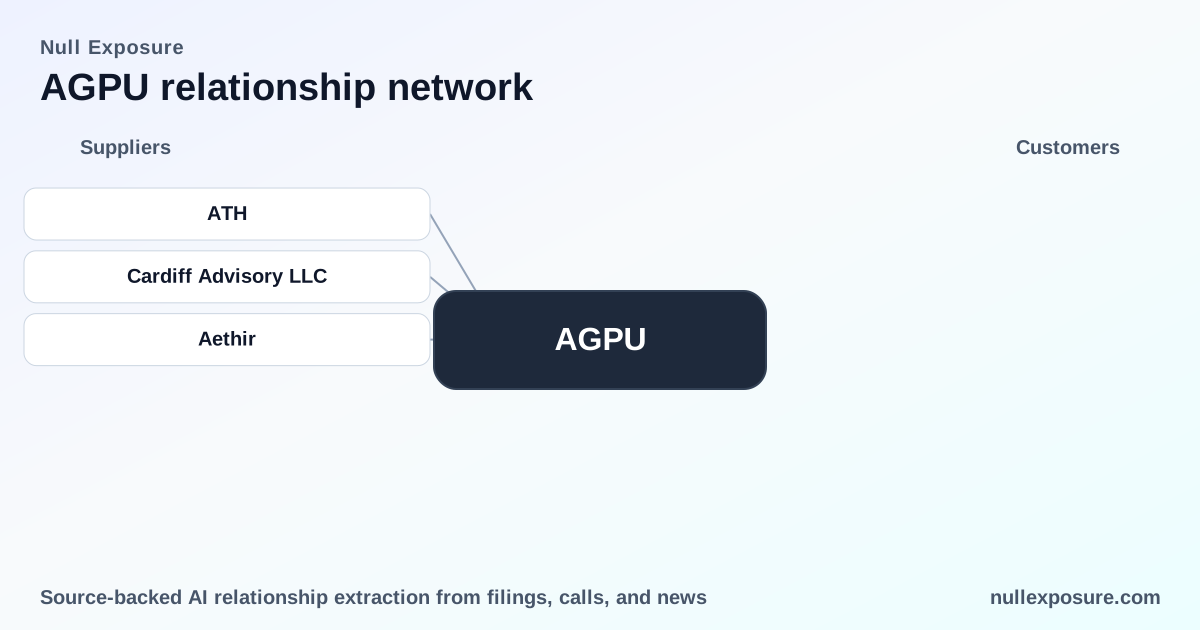
AGPU (Axe Compute Inc.): Customer relationships, concentration, and commercial posture
Axe Compute operates a two-pronged commercial model: medical-device hardware and consumables sold point-in-time to hospitals, and research services driven by AI and a proprietary tumor biobank used as a Contract Research Organization (CRO). The company monetizes through one-off hardware sales (STREAMWAY System), recurring maintenance subscriptions and disposables, and fee-for-service CRO engagements that sell predictions and 3D tumor models to drug developers. For investors, the combined mix creates lumpy, high-margin hardware sales offset by recurring but modest service revenue, and meaningful customer concentration that materially impacts near-term cash flow. Learn more at https://nullexposure.com/.
Recent public relationship signals and what they say
Two pieces of market news surfaced in early May 2026 that are captured in syndicated feeds and relate to counterparties in the medical and laboratory supply ecosystem.
-
Labcorp — A GlobeNewswire release aggregated on Finviz reported a development partnership where Predictive Oncology developed functional 3D organoid models exclusively for Labcorp, indicating commercial demand for outsourced 3D model services in the lab and diagnostics channel (reported May 2, 2026 via Finviz/GlobeNewswire).
Source: Finviz aggregation of GlobeNewswire, May 2, 2026 (https://finviz.com/quote.ashx?t=AGPU). -
DeRoyal Industries — A GlobeNewswire piece aggregated on Finviz reported that Predictive Oncology completed the sale of Skyline Medical assets to DeRoyal Industries, a transaction that transfers lines of business and related customer relationships for medical disposables and device assets (reported May 2, 2026 via Finviz/GlobeNewswire).
Source: Finviz aggregation of GlobeNewswire, May 2, 2026 (https://finviz.com/quote.ashx?t=AGPU).
These items were surfaced in third‑party news sentiment feeds and reference activity across adjacent players in the CRO / medical-device landscape; they are relevant to AGPU insofar as the company operates both a CRO-like services segment and a medical-device subsidiary (Skyline Medical) that historically sold STREAMWAY hardware and consumables.
How the public signals align with AGPU’s commercial model
AGPU’s disclosures and the constraint signals in its filings reveal a hybrid commercial posture:
-
Contracting posture: The company recognizes revenue from hardware sales at a point in time and maintenance/subscription revenue ratably over one year. This creates two cash- and margin-dynamics — spikes from hardware shipments and steadier, predictable maintenance cash flows. (Company FY2024 disclosures.)
-
Geography and go-to-market: Revenue is concentrated in North America / United States, with the STREAMWAY System being FDA-cleared, indicating regulatory maturity for the hardware product but limited geographic diversification. (Company FY2023–2024 disclosures.)
-
Product and service segmentation: AGPU reports two operating segments: Eagan (hardware and disposables: STREAMWAY System, cleaning fluid, filters) and Pittsburgh (AI-driven services and 3D tumor models using a proprietary biobank of 150,000+ tumor samples). These are structurally distinct businesses with different sales cycles and margin profiles. (Company FY2024 disclosures.)
-
Role and revenue mix: The company functions principally as a seller of hardware/consumables and a service provider (CRO) that sells drug-response predictions and 3D models to pharma and diagnostics customers. Company statements explicitly describe both roles. (Company FY2024 disclosures.)
Customer concentration, spend bands and working capital impact
AGPU has material customer concentration that is clearly described in its filings:
-
One customer accounted for 28% of total revenue for the year ended December 31, 2024, a level that is conventionally treated as a material concentration risk for small-cap operators. (Company FY2024 disclosures.)
-
Historical segment revenues tied to single customers were in the $100k–$1M range, consistent with mid‑market institutional lab or hospital procurement: the Pittsburgh segment recorded $489,921 attributable to a single customer in 2023 (AR $52,072), and the Eagan segment recorded $459,369 attributable to a single customer in 2024 (AR $144,880). These figures put typical customer spend at a scale that can materially swing quarterly results for a company with sub‑$1M revenue. (Company FY2023–2024 disclosures.)
-
Working capital sensitivity follows directly: a single large customer payment delay or relationship loss will pressure cash flow and receivables given AR balances are meaningful relative to segment revenue.
Commercial channels, pricing mechanics, and durability
AGPU’s sales motion and pricing mechanics give a clear picture of durability:
-
Direct sales to hospitals through employed sales representatives for the STREAMWAY System indicates a direct, relationship-driven go‑to-market on the hardware side; consumables (filters, cleaning fluids) generate recurring revenue tied to installed base activity. (Company FY2024 disclosures.)
-
Maintenance plans are sold as separate, one‑year subscriptions, recognized ratably, which converts some hardware purchasers into recurring revenue streams and elevates the lifetime value of each install. (Company FY2024 disclosures.)
-
On the services side, the Pittsburgh segment leverages AI and a proprietary biobank to sell CRO-style 3D models and predictive outputs to drug developers — a higher‑value, higher‑stickiness offering that supports recurring engagements but is project-based in nature. (Company FY2024 disclosures.)
What investors and operators should take away
- Concentration risk is real and measurable. A single customer represented 28% of revenue in 2024 and individual customer revenues in each segment are in the $100k–$1M band, so revenue volatility is elevated for a company at this scale.
- Revenue mix creates cash‑timing volatility. Point‑in‑time hardware sales produce lumps; maintenance subscriptions and CRO contracts produce smoothing — the net cash profile depends on the cadence of device placements and CRO engagements.
- Regulated hardware provides a defensible product line but limited scale so far. STREAMWAY is FDA‑cleared, which supports commercialization, but hardware sales remain a relatively small contributor to consolidated revenue.
- Services are strategically valuable. The proprietary biobank and 3D modeling capabilities are high‑value assets for partnering with labs and drug developers, and they align with market demand reflected in recent industry transactions.
- Operational focus should be on customer diversification and receivables management. Given the concentration and AR magnitudes, credit control and expansion of recurring revenue are primary levers to reduce risk.
For deeper coverage of aggregated customer signals and what they imply for small‑cap medical‑device and CRO operators, visit https://nullexposure.com/.
Bottom line
Axe Compute runs two distinct, complementary businesses: regulated hardware with recurring consumables and maintenance, and AI-driven CRO services that leverage a large tumor biobank. The combination offers differentiated revenue levers but also concentrates risk in a small number of mid‑sized customers and creates cash‑flow sensitivity to order timing. Investors should price AGPU as a company with strategic assets and product-level defensibility, but with execution and customer‑diversification as the key near‑term catalysts for stabilizing revenue and cash flow.
(News references: Finviz aggregation of GlobeNewswire items, May 2, 2026; company disclosures covering fiscal years ended December 31, 2023 and 2024 as cited in the company’s filings.)