Adecoagro (AGRO): When farmland becomes an energy and capital platform
Adecoagro operates as a vertically integrated South American agro-industrial group that monetizes through crop and livestock production, commodity sales, land and water assets, and an emerging energy business. Recent public disclosures and press coverage show the company is actively commercializing its renewable energy capacity and engaging with large, non-traditional counterparties—moves that change the profile of how Adecoagro converts fixed agricultural assets into recurring cash flows.
Quick financial context every investor needs
Adecoagro is a mid-cap listed on the NYSE with a market capitalization around $2.19 billion and trailing revenue of about $1.43 billion. The company generated EBITDA of $249 million on that revenue base, while trailing EPS was negative at - $0.09, reflecting margin compression in a cyclical agricultural cycle. Insider ownership is unusually high at 73%, and institutional ownership is low by developed-market standards at roughly 12%—a governance and liquidity dynamic that investors must price into any valuation or capital raise scenario.
Strategic relationships and capital moves worth watching
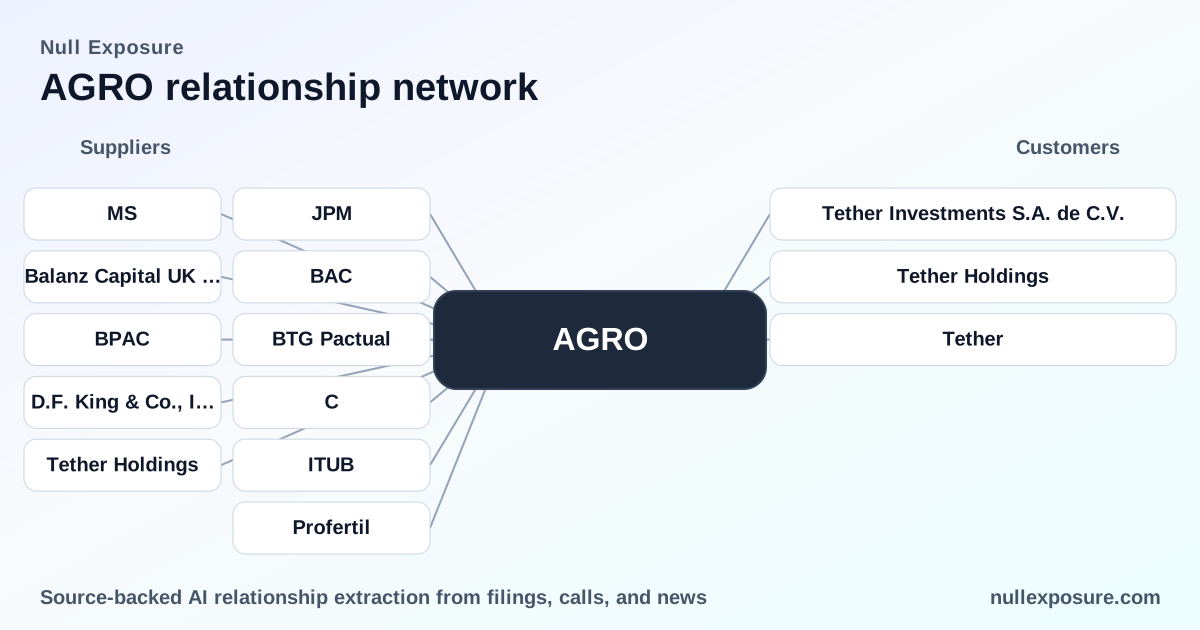
Adecoagro is converting energy and balance-sheet optionality into commercial relationships. Below are the relationships captured in public reporting; each is summarized with a concise, source-linked note.
Tether Investments S.A. de C.V. indicated interest in a sizeable equity allocation
A March 2026 StockTitan release reported that Tether Investments S.A. de C.V. indicated an interest in purchasing approximately $200 million of Adecoagro common shares in connection with a share offering tied to FY2025 activity. This signals potential external capital inflow and an investor that could meaningfully shift the company’s shareholder base. (StockTitan news, March 2026)
Tether Holdings signed an MoU to explore Bitcoin mining using Adecoagro’s renewable capacity
A CoinGeek story described a Memorandum of Understanding under which Tether Holdings would explore Bitcoin mining operations powered by Adecoagro’s roughly 230 MW of clean-energy capacity across Brazil, Argentina and Uruguay, leveraging solar, wind and hydropower assets. That agreement reframes Adecoagro’s energy portfolio as an active monetization channel rather than just an internal cost hedge. (CoinGeek, reporting on a July 3 MoU; reported March 2026)
Major crypto firm coverage amplified the energy-mining angle in Brazil
Market aggregation on FinViz referenced a CoinDesk piece noting plans for Bitcoin mining in Brazil using Adecoagro’s surplus renewable energy, reinforcing press coverage that positions the company as an energy provider to large-scale computing clients. This coverage converts a niche energy strategy into a market-visible development. (FinViz reference to CoinDesk, April 2026)
What these relationships imply about Adecoagro’s operating model
With no formal constraints data supplied, the following are company-level signals drawn from public filings and the relationship coverage:
- Contracting posture: opportunistic and asset-driven. Adecoagro is contracting to monetize spare energy capacity and to accept non-traditional counterparties, indicating commercial flexibility beyond classical commodity contracts.
- Concentration and shareholder dynamics: elevated potential concentration risk. High insider ownership combined with interest from a single large external investor implies that discrete capital transactions can quickly change ownership and governance dynamics.
- Criticality of energy assets: rising. The company’s 230 MW of renewable capacity now functions as a strategic asset that can generate non-agricultural revenue streams, increasing the systemic importance of those assets to Adecoagro’s overall cash generation.
- Maturity and diversification: transition phase. Adecoagro retains a traditional agricultural revenue base while actively diversifying into energy and capital markets relationships, a transition that increases optionality but also execution complexity.
Key investment implications and risks
- Balance-sheet and governance impact: A genuine $200 million external purchase would be significant relative to market cap and shares outstanding; investors must monitor dilution, governance concessions, and any preferential terms tied to such placements.
- Regulatory and reputational risk: Commercial ties to major crypto firms introduce regulatory scrutiny and reputational vectoring not typical for agribusinesses in South America.
- Execution risk on novel monetization: Turning surplus renewable energy into reliably contracted revenue (for mining or other industrial customers) requires grid-interconnection, power management, and long-term offtakes—capabilities that are operationally different from core farming operations.
- Cyclicality remains a constraint: Agricultural commodity cycles and weather exposures continue to drive core revenue volatility even as energy monetization smooths some cash flow.
Relationship-by-relationship recap (single-sentence summaries)
- Tether Investments S.A. de C.V. indicated interest in acquiring roughly $200 million of Adecoagro common shares in connection with an offering tied to FY2025, a potential source of large external capital. (StockTitan, March 2026)
- Tether Holdings signed an MoU to explore Bitcoin mining powered by Adecoagro’s 230 MW of renewable energy across Brazil, Argentina and Uruguay, positioning the energy fleet as a revenue-generating asset. (CoinGeek, MoU reported in March 2026 with July 3 reference)
- Market aggregation noted a CoinDesk report that Tether would mine Bitcoin in Brazil using surplus renewable energy from Adecoagro, amplifying public awareness of the company’s energy commercialization strategy. (FinViz reference to CoinDesk, April 2026)
Bottom line and investor action points
Adecoagro is no longer a pure-play agricultural operator; its renewable energy assets and the company’s openness to non-traditional counterparties create new revenue channels and new governance dynamics. Investors should watch three items closely: (1) any confirmation and terms of the reported $200 million equity interest, (2) concrete offtake or service agreements that convert the MoU into contracted revenue, and (3) regulatory developments around crypto-related energy uses in the jurisdictions where Adecoagro operates.
For deeper signal intelligence and ongoing monitoring of Adecoagro’s partner engagements, visit the company overview and customer relationship tracking at https://nullexposure.com/. If you are assessing counterparty concentration or looking to model the valuation impact of energy monetization, detailed updates live on our platform at https://nullexposure.com/.