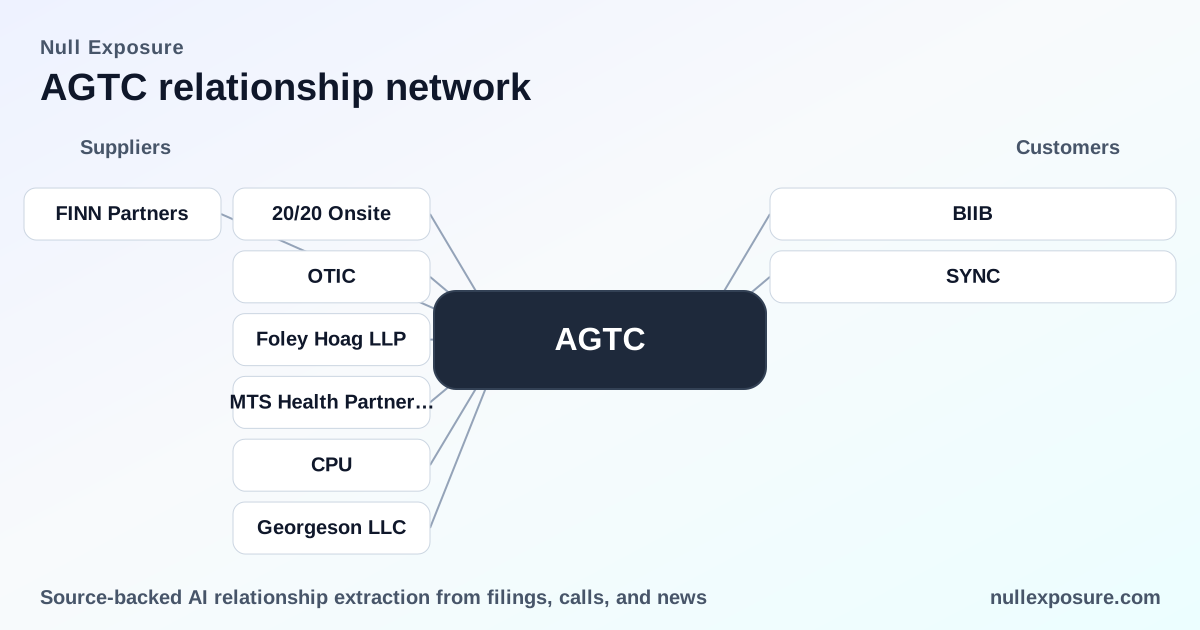
AGTC customer relationships: what partners tell investors about monetization and risk
Applied Genetic Technologies Corporation (AGTC operates by developing AAV-based gene therapies and monetizing through partner licensing, upfront payments, program-level exits, and ultimately a strategic sale. The company historically transacted large upfront license fees with major biopharma, licensed programs to smaller developers, and completed a full-company sale to a healthcare investor — a clear trajectory from partnership-led financing toward acquisition value realization. For investors, the business model is therefore partnership-centric, asset-driven, and dependent on milestone de‑risking of late preclinical/early clinical programs.
If you want a concise vantage into AGTC’s partner set and implications, visit the Null Exposure homepage for our broader coverage: https://nullexposure.com/
How the partner map frames AGTC’s commercial DNA
AGTC’s relationships fall into two strategic buckets: (1) big‑pharma licensing and collaboration that provided upfront capital and validation, and (2) asset licensing / spinouts that transferred programs to specialist developers, followed by a portfolio-level exit to an investor group. These relationships show a company that sells program rights to manage development risk and liquidity rather than pursuing fully integrated commercialization on its own.
Key investor takeaways: AGTC monetized intellectual property through large upfront payments and later sale of remaining equity; partnerships reduced balance-sheet capital needs but concentrated value in a small set of program outcomes. The company’s contracting posture favors out-licensing and strategic sale as liquidity events.
Source-by-source relationship notes (each result represented)
Biogen — BioPharma Dive (FY2018)
AGTC licensed programs targeting XLRS and XLRP to Biogen in 2015 and received a $124 million upfront payment as part of that deal. According to BioPharma Dive’s historical coverage, the partnership was a material financing and validation event for AGTC’s ophthalmic pipeline.
Biogen — BioPharma Dive (FY2022)
Following a failed early‑stage trial in 2018 for a related program, Biogen cut ties with AGTC’s XLRP work, illustrating how single trial failures can terminate large collaborations and reverse near‑term revenue prospects. BioPharma Dive reported the termination in its analysis of the program’s clinical history.
Syncona Limited — GlobeNewswire (FY2022)
In October 2022, AGTC entered into a definitive agreement under which a portfolio company of Syncona Limited commenced a tender offer to acquire all outstanding AGTC shares, a formal acquisition step reported in AGTC’s press release on GlobeNewswire. That tender offer represented the culmination of a partner‑led exit strategy.
Biogen — The Wall Street Transcript / TWST (FY2018, BIIB)
AGTC’s CEO led negotiations that produced the $124 million upfront deal with Biogen, according to an interview published by TWST, underscoring management’s active role in closing large licensing transactions that funded further development.
Biogen — The Wall Street Transcript / TWST (FY2018, Biogen label)
TWST’s coverage reiterates the same negotiation and upfront payment detail, confirming Biogen’s role as a marquee development partner that provided meaningful non‑dilutive capital to AGTC’s program development.
TeamedON International — GlobeNewswire (FY2021)
AGTC signed a licensing agreement with TeamedON in April 2021 to advance a gene therapy for XLRS, indicating active program out‑licensing to specialist biotechnology companies as a core monetization route, per AGTC’s FY2021 financial release.
Beacon Therapeutics Holdings — GEN Eng News (FY2023)
Beacon Therapeutics’ XLPR candidate, AGTC‑501, is publicly described as having been developed and advanced through an early clinical study by AGTC, which Beacon is now advancing, demonstrating asset handoffs from AGTC to follow‑on developers as part of product lifecycle management.
Syncona Limited — Foley Hoag (FY2022)
Foley Hoag’s press release notes the law firm represented AGTC in the sale to a Syncona portfolio company, confirming the legal and transactional advisory infrastructure supporting AGTC’s acquisition and the buyer’s role in the deal process.
Syncona — BioPharma Dive (FY2022)
BioPharma Dive reported that Syncona agreed to pay $0.34 per share (about $23.5 million) for rights to AGTC, providing a concrete valuation reference for the exit and encapsulating investor realization from the acquisition.
SYNC (Foley Hoag duplicate) — Foley Hoag (FY2022)
A Foley Hoag announcement repeated that the firm represented AGTC in the sale to a Syncona portfolio company, reinforcing that the transaction was a formal sale process rather than an unsolicited takeover.
Syncona Investment Management — GEN Eng News (FY2023)
GEN Eng News reported that AGTC agreed to be acquired by Syncona Investment Management, confirming the completion of the strategic exit and transition of assets into Syncona’s investment ecosystem.
What this partner set implies about AGTC’s operating model and constraints
- Contracting posture: AGTC consistently pursued licensing and collaboration over vertical integration, using partner upfronts and out‑licensing to fund R&D rather than build a commercial organization.
- Concentration risk: Value realization depended on a small number of program outcomes and a handful of counterparties, so trial failures had outsized financial effects (as the Biogen separation illustrates).
- Criticality of relationships: Strategic partners and eventual acquirers served both funding and validation functions; losing a single partner could materially reduce near‑term cash inflows.
- Maturity and exit orientation: The sequence of large upfront licensing, program handoffs to specialist developers, and a final acquisition indicates a lifecycle strategy oriented toward creating investable assets and enabling an exit rather than pursuing broad standalone commercialization.
These are company‑level signals derived from the relationship set and the corporate transactions recorded in public reporting.
Bottom line for investors and operators
AGTC’s commercial model generated liquidity through large licensing fees and strategic sale, rather than through internal commercialization. That model de‑risks capital burn but introduces binary program risk and counterparty concentration as the principal investor risks. The acquisition by Syncona crystallizes that strategy: AGTC’s intellectual property and clinical progress were monetized through partnerships and an eventual portfolio exit, delivering a clear but outcome‑dependent return path.
For a broader analytical view and coverage of similar partner‑centric biotech stories, explore Null Exposure’s research hub: https://nullexposure.com/
Bold takeaway: AGTC monetized science via partnerships and an acquisition; investors must therefore underwrite program outcomes and partner durability rather than downstream commercialization scale.