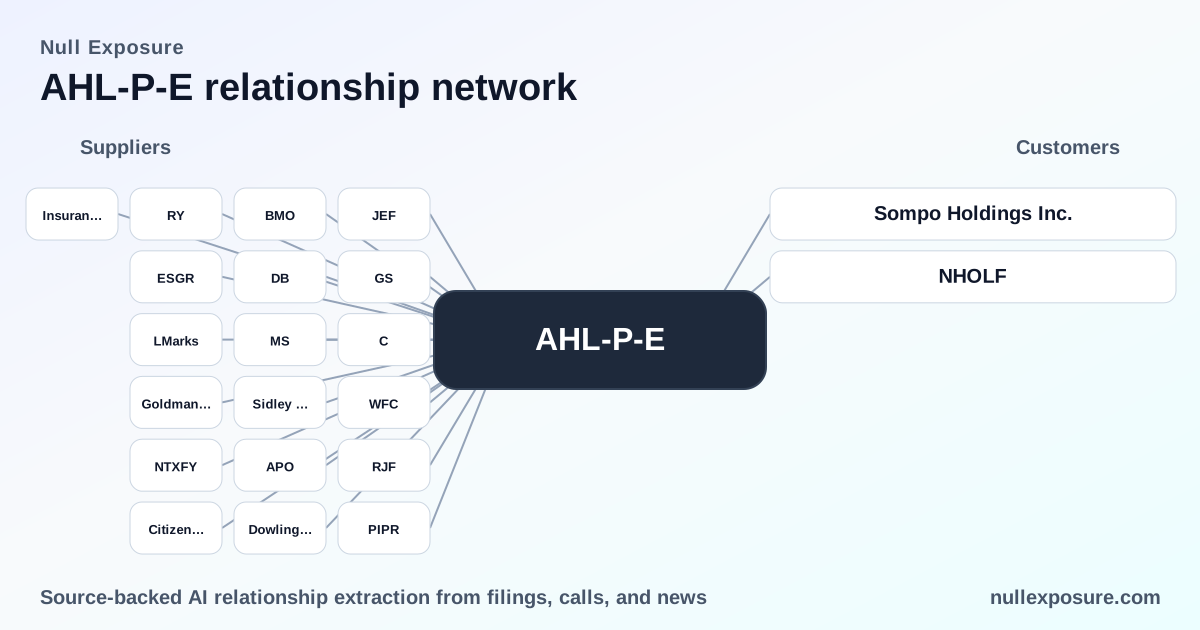
AHL-P-E customer relationships: what investors need to know
AHL-P-E is positioned as a reinsurance and specialty insurance provider that monetizes through underwriting premiums, portfolio renewals and strategic distribution partnerships that extend its Lloyd’s and wholesale capabilities into global risk corridors. Revenue generation depends on the durability of long-tail product relationships and the firm’s ability to redeploy or monetize portfolios when counterparties consolidate or buy capacity. For context and further company-level signals, visit https://nullexposure.com/ for the full research platform.
How to read these customer signals as an investor
The customer mentions collected for AHL-P-E form a narrative of concentration in counterparty relationships, exposure to sector consolidation, and functional criticality around Lloyd’s and complex-reinsurance capabilities. The dataset includes multiple references tied to the same strategic buyer (Sompo) and to established wholesale carriers and brokers—this pattern signals a business model that is commercially exposed to large reinsurer moves and portfolio transfers rather than to a broad retail base.
Operationally, AHL-P-E shows a contracting posture that is typical of specialty reinsurers: contracts and renewal rights are commercially valuable and transferable. The absence of explicit contract excerpts in the coverage is itself a company-level signal: there are no publicly surfaced contract terms in this set that would indicate guaranteed long-term revenue from specific counterparties. That means investors should price in revenue lability from portfolio transfers and M&A-driven customer reallocation alongside standard underwriting volatility.
Relationship run‑down: every customer mention in our coverage
-
Crum Forster — Crum Forster is cited as acquiring renewal rights for Aspen’s U.S. food and beverage product recall insurance portfolio, indicating a transfer of renewal economics away from Aspen-branded books in that specialty line. This is reported by Program Business in May 2026 and signals portfolio-level churn that reduces direct renewal flow for the original carrier. (Program Business, May 2026)
-
Sompo International Holdings — GlobalReinsurance reported that Sompo International announced a plan to buy Aspen Insurance Holdings for $3.5 billion. That transaction consolidates capacity and distribution and gives Sompo a larger role in underwriting complex risks that Aspen historically handled. (GlobalReinsurance, FY2025 coverage)
-
Sompo Holdings Inc. — Insurance Journal noted that Aspen’s top-tier Lloyd’s syndicate provides Sompo expanded access to support complex risks and reinsurance licensing across markets it had not fully penetrated, reinforcing that the acquisition is strategically aimed at diversifying Sompo’s global risk footprint. (Insurance Journal, FY2026)
-
NHOLF (ticker reference to Sompo-related disclosure) — Financial coverage on Yahoo Finance reported that Sompo Holdings agreed to acquire New York‑listed Aspen Insurance Holdings for about $3.5 billion, a market-facing account of the same consolidation that reshuffles customer and treaty relationships. This public-market disclosure confirms the transaction’s valuation and regulatory posture. (Yahoo Finance, March 2026)
-
Sompo Holdings (duplicate market mentions) — Additional reporting repeated Sompo’s acquisition terms and strategic intent; multiple outlets covering the March–August 2025/2026 timeframe consolidate the view that Sompo will reallocate Aspen-originated books under its broader reinsurance strategy. These repeated mentions underscore the transaction’s market impact on Aspen-origin customer flows. (Various press coverage, FY2025–FY2026)
-
Silverton (SLTN) — Historical renewal activity is noted: Aspen Reinsurance renewed Silverton for 2017, an example of legacy provider–client continuity in specialty reinsurance lines that contributes to long-term premium streams. This renewal was catalogued in an April 2024 report and illustrates the type of sustained, product‑level customer relationship that supports underwriting stability. (Bernews, April 2024)
What these relationships imply about AHL-P-E’s operating model
-
Contracting posture: The coverage points to a business that commercially treats renewal rights and portfolios as tradable assets. Portfolio-level transfers and M&A activity are central levers that change who captures renewal economics. That increases sensitivity to counterparties’ strategic decisions.
-
Concentration risk: Multiple entries tie back to a single strategic acquirer—Sompo—indicating concentrated counterparty exposure at the industry level. Concentration amplifies counterparty risk if a buyer elects to reassign or integrate capacity differently post-acquisition.
-
Criticality: The references to Lloyd’s-access and support for complex risks indicate high functional criticality: AHL-P-E’s books are valuable to large global reinsurers seeking regulatory licenses and specialized underwriting teams, which increases the strategic value of those customer relationships.
-
Maturity and stability: The Silverton renewal demonstrates pockets of mature, repeat business that provide underwriting continuity. However, the prevalence of M&A coverage suggests portions of the book are in transition and subject to re-pricing or re-allocation.
Investment implications and risk profile
-
Primary upside: Strategic buyers value the company’s Lloyd’s distribution and complex-risk underwriting, which lifts the replacement value of certain portfolio segments and supports accretive M&A outcomes.
-
Primary downside: Concentrated counterparty flows and active portfolio transfers create earnings volatility and complicate dividend and preferred coupon planning; the preferred security holder should underwrite the risk that renewal economics can shift rapidly in the wake of large acquisitions.
-
Portfolio-level action: Investors should track closing conditions and transitional service agreements tied to the Sompo acquisition and monitor whether renewal rights transfers (like the Crum Forster example) are replicating across other lines.
For deeper workflow on counterparty movement and to monitor incremental customer signals in real time, review our platform at https://nullexposure.com/.
Final read
The customer coverage for AHL-P-E tells a consistent story: this is a specialty re/insurance exposure whose economic outcomes are driven as much by M&A and portfolio transfers as by pure underwriting performance. Investors should value the firm’s Lloyd’s and complex-risk capabilities while pricing a higher-than-average execution and counterparty concentration risk into any preferred security position.