AHT-P-G: Advisory Revenues Underpinning a Preferred Yield — What investors need to know
Ashford Hospitality Trust issues the AHT‑P‑G 7.375% cumulative preferred as an income instrument backed by a combination of hotel ownership and fee‑generating advisory activities run by Ashford’s management platform. The company monetizes through operating cash flow from hotel assets and recurring advisory contracts that deliver significant, predictable fee income, a dynamic that directly supports preferred distributions and the credit profile of preferred holders.
For a deeper look at customer relationships that matter to Ashford and AHT‑P‑G holders, visit https://nullexposure.com/.
Why customer relationships matter for a preferred security
Preferred investors evaluate counterparty cash flows differently than equity holders: stable, contractually defined payouts are paramount. When a single client generates material advisory revenue for the issuer, that client’s payments become a quasi-fixed-income ingredient supporting preferred dividends. That structure creates two investment levers: reliable income when contracts perform and concentrated counterparty risk if a major client reduces or withdraws fees.
Below I unpack the operating posture this evidence implies — contracting style, revenue concentration, criticality to cash flow, and the maturity/recurrence of the arrangements — and then run through each customer relationship disclosed in the reporting.
Contracting posture: advisory agreements and recurring fees
The available disclosures show Ashford operates under formal advisory agreements that specify annual fees. This is a contracting posture aligned with repeatable revenue rather than one‑off project work — the kind of income profile that supports a fixed preferred coupon.
Concentration: a single client can drive material fee income
A disclosed advisory payment of $48.9 million in FY2024 from one client signals material concentration in advisory revenue. For preferred investors, concentrated fee payors reduce diversification of cashflow sources and increase reliance on counterparty stability and contract enforcement.
Criticality and maturity: recurring, visible cash flow
Annual advisory fees are contractual and observable through filings, which creates a predictable cashflow layer. Recurring fees that are large relative to the advisor’s business act as stabilizers for distributions, but they also elevate counterparty negotiation leverage and governance considerations when the counterparty is large.
Customer-by-customer run-down (complete)
-
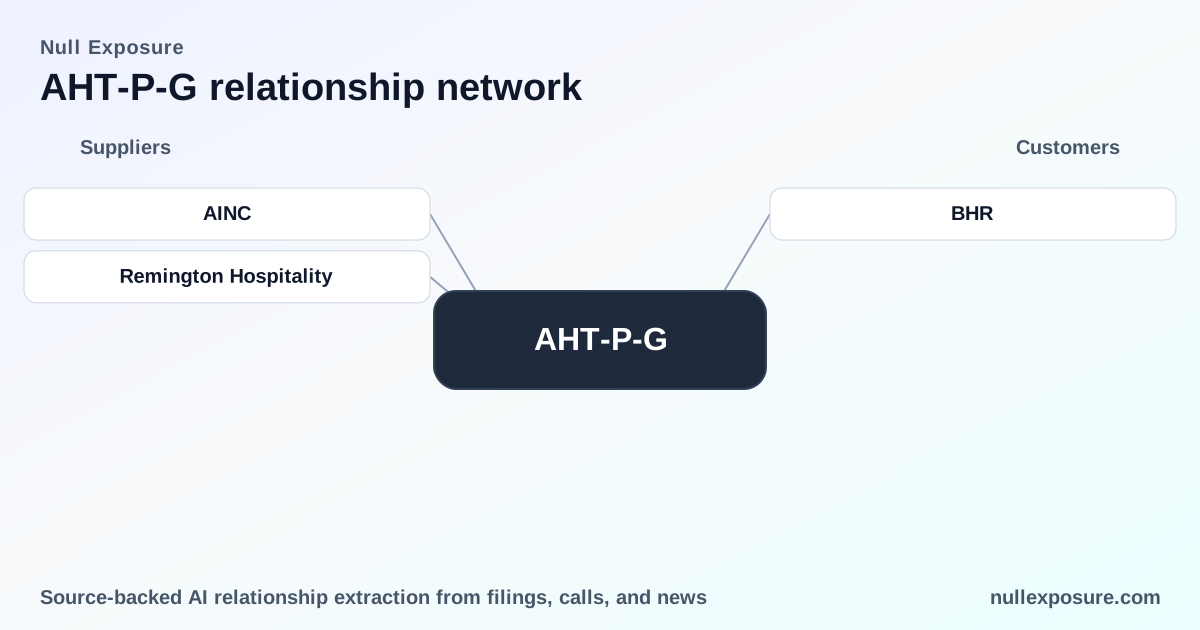
BHR — Under an advisory agreement, Ashford advises Braemar (BHR) and BHR paid Ashford $48.9 million for advisory services in FY2024, according to the trust’s most recent annual filing referenced in The Real Deal. This single‑client payment represents a large, recurring fee and therefore a meaningful contributor to Ashford’s fee income profile. Source: The Real Deal (May 16, 2024) — https://therealdeal.com/texas/dallas/2024/05/16/monty-bennett-survives-proxy-fight-for-now/
-
Braemar Hotels and Resorts — Reporting on the same advisory agreement notes that Braemar paid Ashford $48.9 million in FY2024 under that arrangement, underscoring that the Braemar relationship is a principal advisory revenue driver for Ashford. Source: The Real Deal (May 16, 2024) — https://therealdeal.com/texas/dallas/2024/05/16/monty-bennett-survives-proxy-fight-for-now/
(These two relationship records reference the same contractual counterparty and the same FY2024 payment disclosure; both entries from the news coverage were captured separately but reflect the identical advisory revenue fact.)
Constraints and company-level signals
No explicit contractual constraints, limitations, or counterparty caveats were reported in the relationship records reviewed. At the company level, the absence of reported constraints in the customer relationship records is itself a signal — the advisory arrangement is presented as a standard annual fee contract without publicly disclosed exceptional limitations.
Investment implications for AHT‑P‑G holders
- Income support: The existence of large, recurring advisory fees provides a strong cashflow element that supports the preferred coupon, improving near‑term distribution coverage compared with a pure hotel‑rental income model.
- Concentration risk: $48.9 million from a single client in FY2024 is material — preferred investors must view this as a concentration risk to the issuer’s fee stream. Any renegotiation, termination, or material dispute could compress distributable cashflow.
- Governance sensitivity: Public reporting that highlights large advisory fees often accompanies heightened governance scrutiny (the article that flagged the fee referenced a proxy context). Preferred holders should track governance developments because management disputes can affect fee realization and liquidity.
- Predictability vs. counterparty exposure: Advisory contracts that pay annual fees are predictable by design, but that predictability is conditional on the counterparty’s ongoing willingness and ability to pay.
Practical monitoring checklist for operators and investors
- Review Ashford’s next annual filing and proxy statements for explicit disclosure of the advisory fee schedule and any termination/change provisions.
- Monitor Braemar’s public filings for references to its advisory obligations with Ashford and any changes to fee terms.
- Track governance events and proxy outcomes that could affect the advisor–client relationship and the enforceability of fee arrangements.
For continued signals and relationship tracking, visit https://nullexposure.com/ to see how these dynamics are captured and updated.
Bottom line: balance steady income against concentrated counterparty exposure
AHT‑P‑G benefits from a significant, contractually structured advisory revenue stream that bolsters distribution coverage, but investors should weigh that strength against meaningful concentration risk from a single advisory client that contributed $48.9 million in FY2024. The preferred’s income profile is more resilient than a standalone operating‑asset model, yet it remains sensitive to the governance and contractual stability of the advisory relationship.