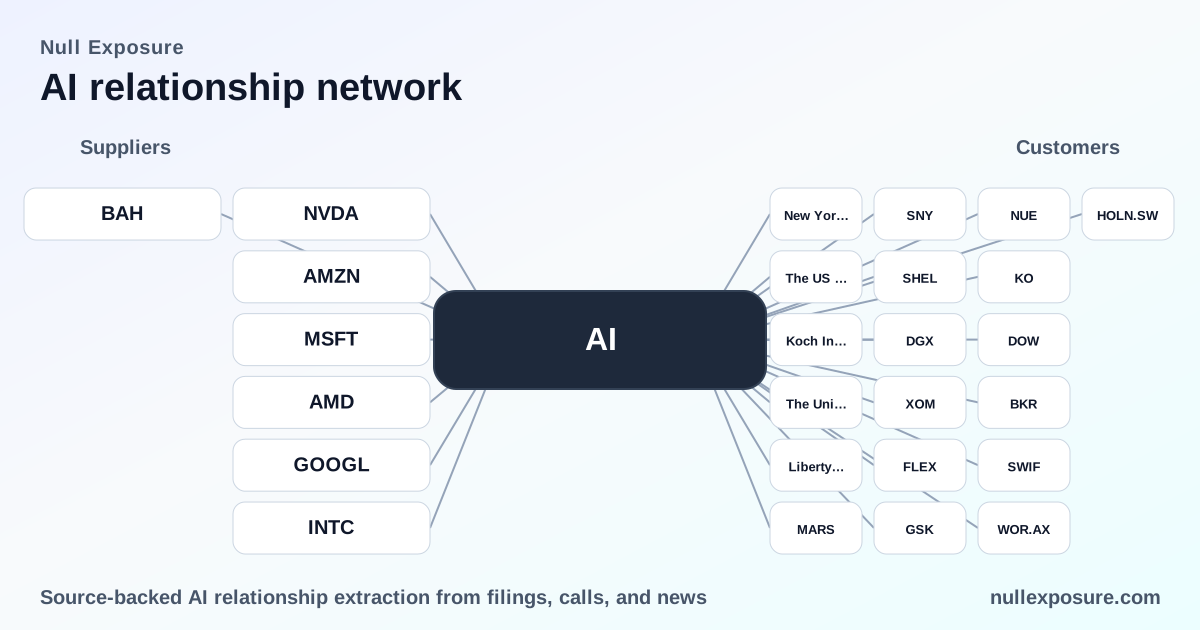
C3.ai (AI): How enterprise AI contracts and customer mix drive the next phase of revenue
C3.ai sells enterprise AI software and services to large corporations and government bodies, monetizing primarily through term subscriptions supplemented by usage-based runtime fees and professional services. Investors should evaluate growth through the lens of contract shape (subscription + consumption), customer concentration, and the strategic value of large, secure deployments. For a concise company overview and model primer, visit https://nullexposure.com/.
Quick read: the business model in an investor sentence
C3.ai generates recurring revenue from software subscriptions (roughly 84–90% of revenue), layers in consumption-based runtime fees, and supplements adoption with professional services and short-term initial production deployments that convert pilots into scaleable contracts.
Company-level constraints that determine upside and risk
C3.ai’s operating model is shaped by a handful of structural characteristics that matter to shareholders:
- Subscription-first revenue with meaningful consumption upside. The FY2025 10‑K states subscription revenue comprised 84–90% of revenue and the company explicitly sells runtime/consumption for its Agentic AI Platform. That creates high-margin recurring cash flows with upside from usage growth.
- Flexible contract mix. Contracts include multi-period fixed-fee subscriptions, consumption-billing based on vCPU/vGPU hours, short-term implementation engagements, and occasional perpetual licensing; this mix deepens monetization levers but complicates forecasting.
- Customer concentration and high materiality. A limited number of large customer-entities account for a disproportionate share of revenue—two accounted for 19% and 12% of FY2025 revenue—so renewals are binary contributors to near-term performance.
- Large-enterprise and government focus. The company targets multinational industrials and government agencies, which produce high average contract value but entail long procurement and budget cycles.
- North America-heavy geography with growing international nodes. The U.S. accounted for ~86% of revenue in FY2025, while EMEA and APAC remain targeted markets through lighthouse customers and hosted data centers.
These constraints produce high operating leverage if deployments scale, but renewal risk and concentration risk are principal downside scenarios. Learn more about how these signals translate to customer-level exposure at https://nullexposure.com/.
Client roster and why each name matters to investors
Below I walk through every relationship cited in the source material with one- to two-sentence summaries and a direct source note.
- New York Power Authority — C3.ai secured a new or expanded agreement referenced in the Q3 2025 earnings call, signaling traction in public-sector utilities and grid-scale energy optimization (Q3 2025 earnings call, cited Mar 8, 2026).
- The United States Air Force — Management highlighted Air Force deployments as testimonials to the economic benefits of C3.ai applications, indicating defense-grade adoption and potential multi-platform rollouts (Q4 2025 earnings call, Mar 7, 2026).
- Liberty Coca‑Cola Beverages — Listed among 20 closed Generative AI pilots in Q3 2025, showing C3.ai’s pilot-to-production motion in consumer goods and bottling operations (Q3 2025 earnings call, Mar 8, 2026).
- The US Intelligence Community — Cited as an installed environment for C3 Generative AI, demonstrating secure, high-assurance use cases for classified intelligence operations (Q4 2025 earnings call, Mar 7, 2026).
- Koch Industries — Management noted Koch as a secure installation for C3 Generative AI, reflecting engagement with complex industrial process optimization (Q3 2025 earnings call, Mar 8, 2026).
- Mars (MARS) — Named among clients that closed Generative AI pilots, indicating CPG use cases and willingness of major brands to test C3.ai’s next-gen offerings (Q3 2025 earnings call, Mar 8, 2026).
- Nucor Corporation (NUE) — Identified as part of new and expanded agreements and as a secure installation for Generative AI, signaling manufacturing and steel-sector adoption (Q3 2025 earnings call, Mar 8, 2026).
- Quest Diagnostics (DGX) — Included in Q3 2025 expansion commentary, pointing to healthcare and diagnostics workflows that C3.ai targets (Q3 2025 earnings call, Mar 8, 2026).
- Sanofi (SNY) — Listed among clients with new or expanded agreements in Q3 2025, underscoring pharmaceutical interest in AI-driven operations (Q3 2025 earnings call, Mar 8, 2026).
- Shell (SHEL) — Named repeatedly across Q3 and Q4 2025 commentary as a testimonial client delivering material economic benefit, underscoring energy-sector scale opportunities (Q3 & Q4 2025 earnings calls, Mar 7–8, 2026).
- ExxonMobil / Exxon (XOM) — Included among clients delivering testimonials of “hundreds of millions” in economic benefit, a strong signal of enterprise value capture in oil & gas (Q3 & Q4 2025 earnings calls, Mar 7–8, 2026).
- Flex (FLEX) — Cited in Q3 2025 as a new or expanded agreement, reflecting adoption among electronics/manufacturing supply-chain operators (Q3 2025 earnings call, Mar 8, 2026).
- Swift (SWIF) — Listed among new/expanded Q3 2025 agreements, indicating continued penetration into logistics and fleet operators (Q3 2025 earnings call, Mar 8, 2026).
- EBR‑B (Eletrobras) — A business-wire style news mention in FY2025 reported Eletrobras selected C3.ai to scale enterprise AI across Latin America’s largest power utility, a direct sales win in utilities (news item, May 2026).
- Baker Hughes (BKR) — The FY2025 10‑K discloses a June 2019 multi-agreement subscription relationship that included a three‑year software subscription, demonstrating multi-year strategic partnerships in O&G services (FY2025 10‑K).
- Coca‑Cola (KO) — Cited among testimonial clients in Q4 2025 commentary, further evidence of CPG and beverage industry references for economic impact (Q4 2025 earnings call, Mar 7, 2026).
- Dow / Dow Chemical (DOW) — Management referenced successful work with Dow and interest in broader Air Force deployment, showing cross-sector industrial relevance (Q4 2025 earnings call, Mar 7, 2026).
- GSK — Named in Q3 2025 new/expanded agreement commentary, marking pharmaceutical and life-sciences traction (Q3 2025 earnings call, Mar 8, 2026).
- Holcim — Included in Q3 2025 new/expanded agreements, indicating construction-materials and cement sector use cases (Q3 2025 earnings call, Mar 8, 2026).
- Worley (WOR.AX) — Listed among new and expanded Q3 2025 agreements, signaling partnerships with engineering and project-services companies (Q3 2025 earnings call, Mar 8, 2026).
- SSL (Air Liquide reference) — A news-sentiment entry (FY2026) references Air Liquide’s broader operations; included here as a contextual mention linking industrial gas operators to projects in which C3.ai is named (news item, FY2026).
- EBR‑B duplicate entry — The finviz/news mention again emphasizes Eletrobras’s selection of C3.ai for regional scaling of AI in utilities (news item, May 2026).
- BKR duplicate (earnings/10‑K) — The 10‑K and Q4 commentary reaffirm the Baker Hughes multi-year subscription and long-standing relationship (FY2025 10‑K; Q4 2025 earnings call).
Strategic read-through and investment implications
- Growth lever: converting Initial Production Deployments (pilots) into full subscriptions and generating runtime consumption revenue will determine incremental upside.
- Key risk: high customer concentration means a small number of renewals or expansions will materially move the top line. Monitor renewal cadence and contract length each quarter.
- Defensive signal: government and defense deployments provide credibility and potential long-duration contracts, but procurement timing creates lumpy bookings.
For ongoing coverage and to map customer-level exposure against public filings and conference commentary, visit https://nullexposure.com/.