AIDX (20/20 Biolabs): Customer relationships driving early commercial uptake of OneTest
20/20 Biolabs (ticker: AIDX) is an early-commercial molecular diagnostics lab that monetizes by selling its OneTest™ multi-cancer early detection (MCED) blood test and related laboratory services through direct institutional engagements, channel partnerships, and pilot retail arrangements. Revenue is generated on a per-test and services basis, while growth hinges on securing institutional contracts, marketplace distribution (third‑party ordering platforms), and proving clinical and operational value to repeat buyers. For a relationship‑level map and vendor due diligence visit https://nullexposure.com/.
Why customers define the company’s immediate value creation
The company’s commercial strategy is transactional and channel-driven: evidence in public releases shows targeted, project‑level awards (state-funded screening programs), marketplace listings that broaden ordering access, and retail pilot programs that test scaleability. Given the company’s small revenue base (Revenue TTM ~$2.0M) and negative operating margins, customer wins are the primary lever to convert R&D and lab capacity into sustainable top line. The current customer footprint signals early validation rather than entrenched, high‑value contracts, so investors should prioritize contract terms, renewal cadence, and distribution economics when modeling revenue trajectories.
Customer relationships — a concise ledger
Maryland Department of Health (MDH)
The Maryland Department of Health awarded funding to support cancer screenings using 20/20 BioLabs’ OneTest™, allocating $520,000 to cover procurement and administration for multiple public safety organizations, demonstrating state‑level program adoption of the test. This was reported in a GlobeNewswire press release on March 27, 2026 and reiterated in the company’s full‑year 2025 results on March 31, 2026.
18 groups of Maryland fire departments
Eighteen groups of Maryland fire departments were collectively notified that they would receive over $520,000 in state funding to procure OneTest™ for multi‑cancer screening, a direct channel into first‑responder health programs and an example of public‑sector buying. The award was announced via GlobeNewswire on March 27, 2026 and picked up by other outlets (Bitget and SahmCapital) in late March 2026.
Maryland fire departments
Multiple press releases and republished stories reference Maryland fire departments receiving state support to use OneTest™, confirming broader programmatic deployment across the state rather than a single isolated pilot. Coverage appeared across GlobeNewswire (March 27 and March 31, 2026) and syndicated outlets such as Bitget and SahmCapital in March 2026.
Salisbury MD Fire Department
The Salisbury MD Fire Department is a named beneficiary of the state program and provided a client testimonial, with leadership noting satisfaction with OneTest™; this is an explicit end‑user endorsement within the first‑responder group rollout. Deputy Chief Truitt’s remark and the funding notice were included in the GlobeNewswire release of March 27, 2026 and republished by SahmCapital and Bitget in late March 2026.
Evexia Diagnostics
20/20 BioLabs announced that OneTest™ for Cancer is now available through the Evexia Diagnostics platform, enabling integrative and functional medicine practitioners to order the test through a marketplace that centralizes advanced diagnostics. This distribution partnership was disclosed in a company press release on April 7, 2026 (GlobeNewswire) and referenced in the March 31, 2026 financial and operational update.
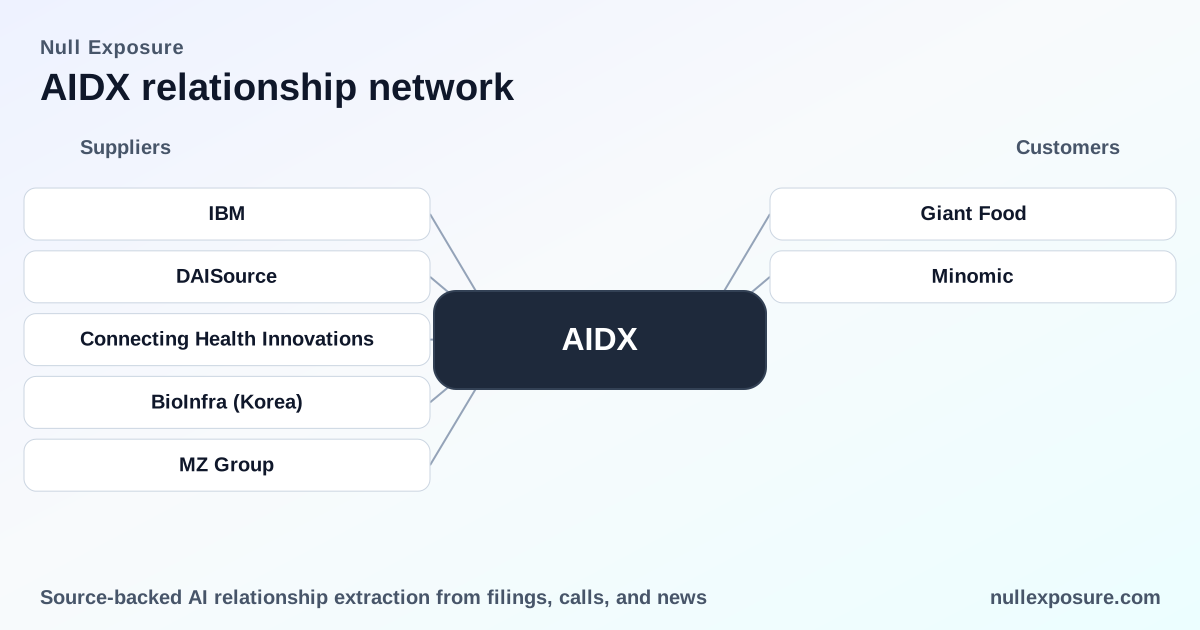
Giant Food
The company disclosed a pilot with Giant Food pharmacies in the Washington, D.C. area, indicating a retail channel test to reach walk‑in or pharmacy‑mediated patient populations and to validate consumer‑facing logistics. The pilot is documented in a TradingView report associated with the company’s March 2026 IPO filing materials (TradingView, March 9, 2026).
Minomic
Minomic is listed among stated partnerships—described in public filings and coverage as a connectivity and technology partner via CLIAx—signaling collaborations to integrate panels, algorithms or lab operations with external genomics and pathology providers. This partnership reference appeared in the TradingView IPO coverage on March 9, 2026.
What these relationships reveal about the operating model
- Contracting posture: The evidence indicates short‑term, project-based engagements (state awards and pilot programs) rather than long, exclusive contracts. Public‑sector awards and retail pilots suggest an opportunistic, go-to-market approach focused on early adoption cohorts.
- Concentration and scale: Customer wins are modest in absolute scale (the Maryland award totals $520k across 18 groups), so revenue concentration risk is material until the company secures larger or recurring contracts.
- Criticality: For institutional buyers such as fire departments and state health programs, OneTest™ is positioned as a preventive screening tool—important for occupational health but not an acute‑care essential, implying steady but not mission‑critical demand from these customers.
- Maturity: The relationship mix—marketplace listing (Evexia), retail pilot (Giant Food), and public grants—marks early commercial maturity: distribution proof points are present, but consistent repeat volumes and long‑term payer coverage remain outstanding.
- Company‑level signal: No explicit contractual constraints (exclusive distribution clauses or long-term indemnities) were found in the relationship extraction. As a company‑level signal, this absence implies freedom to expand channels but also the lack of disclosed durable lock‑in that would protect revenue visibility.
Financial and governance context that matters for relationship risk
Revenue TTM is small (~$2.0M), operating margins are negative, insider ownership is high (~35%) while institutional ownership is effectively negligible, and the company is thinly capitalized with early trading volatility (52‑week high/low wide range). These structural facts mean that every customer contract materially affects near‑term financials, and the company’s dependence on a handful of sales channels amplifies execution risk.
Investor takeaways and recommended next steps
- Validation is real but limited in scale. State funding and Evexia distribution establish commercial reach and clinical interest, but current contract values are modest relative to the capital required to scale lab operations.
- Monitor three signals closely: contract duration/renewal terms for state and institutional awards; uptake and ordering velocity through Evexia; conversion metrics from the Giant Food pilot to a repeat retail program.
- Model conservatively for concentration risk. Given small revenue and transactional contracts, model scenarios where public program demand and marketplace conversion drive break‑even timelines rather than assuming rapid consumer adoption.
- For structured relationship diligence and tracking of partnership developments, review the company’s filings and press releases and consider a subscription for continuous monitoring at https://nullexposure.com/.
Summary: 20/20 Biolabs has assembled a pragmatic early commercial playbook—state program awards, marketplace distribution via Evexia, and retail pilots with Giant Food—providing initial revenue channels and validation while the company converts that interest into repeatable, high‑volume demand. Investors should treat current customer wins as proof points and focus on contract economics, renewal mechanics, and distribution scale when assessing medium‑term upside.