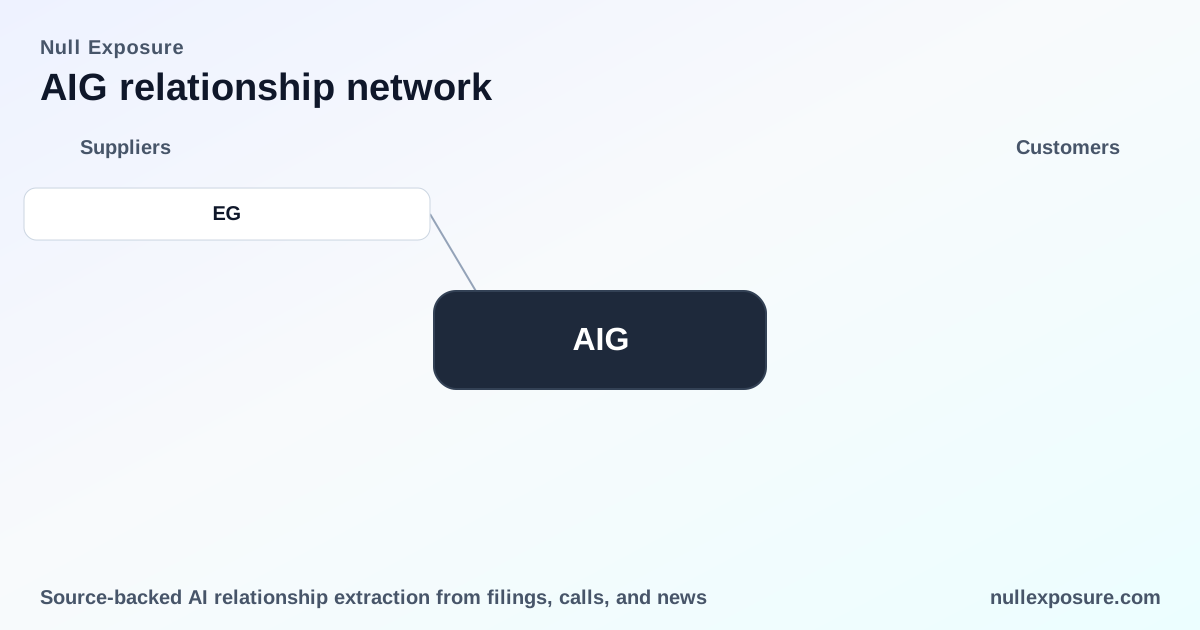
AIG’s customer footprint: a concise investor view of counterparties, transactions and operating constraints
American International Group (AIG) underwrites and services risk across three core businesses — General Insurance, Life & Retirement, and a technology-enabled subsidiary — monetizing through premiums, investment spread on float and fee-based retirement solutions. AIG’s revenue mix blends long-duration life liabilities with high-volume, short-duration commercial and specialty P&C business, giving investors both predictable annuity-style cashflows and cyclical underwriting exposure; a full customer and counterparty map clarifies how capital and capital-light operations move through the balance sheet. For a complete profile and data-driven relationship mapping, visit https://nullexposure.com/.
Why customers and deal flow matter for AIG shareholders
AIG’s economics are driven by two levers: insurance underwriting results (premiums less claims) and investment income on reserves and surplus. Counterparty relationships, divestitures and reinsurance/restructuring transactions directly alter both levers by shifting capital, changing loss profile concentration and adjusting liquidity. Investors should watch who pays AIG (for assets sold), who AIG insures, and how coverage disputes or exclusions affect loss pick-up or reserve volatility.
- Contracting posture: AIG writes both long-duration life contracts and short-duration P&C policies, so its revenue recognition and reserve dynamics vary materially by line.
- Counterparty breadth: Customers range from individuals to very large enterprises and include partner insurers and financial institutions.
- Geographic footprint: AIG operates globally with material North American exposure and meaningful EMEA/APAC operations.
- Critical accounting focus: Valuation of insurance liabilities is a company-level critical audit matter and a principal source of judgment and potential volatility.
Recent customer and counterparty relationships that change the map
Below I cover every relationship flagged in the recent monitoring set; each entry includes a plain-English summary and a concise source citation.
AFGC — American Financial Group-related closing payment to AIG
AFGC (reported in AFG’s 10‑K) recorded a closing payment of $234 million to AIG, reflecting a transaction tied to net tangible assets at closing; this is a direct cash receipt to AIG linked to a corporate asset transfer. (StockTitan copy of AFG 10‑K filing, first seen March 9, 2026 — https://www.stocktitan.net/sec-filings/AFG/10-k-american-financial-group-inc-files-annual-report-35abf502ad60.html)
Takeaway: transactional cash inflows from asset dispositions support AIG’s capital redeployment and are visible drivers of near-term liquidity.
MGM — AIG underwriting for a consumer card program
MGM’s new credit-card offering is insured by New Hampshire Insurance Company, an AIG company, which exposes AIG to card-related liability and portfolio risk tied to consumer payment and travel benefits. (ThePointsGuy coverage of MGM Rewards Iconic Mastercard, March 10, 2026 — https://thepointsguy.com/credit-cards/mgm-rewards-iconic-mastercard/)
Takeaway: consumer fintech/banking partnerships generate fee routes and small-balance retail exposure for AIG’s specialty insurer units.
GNW — Coverage dispute where AIG Specialty denied payment
In an $80 million coverage tower dispute, AIG Specialty was listed among insurers that denied coverage based on three policy exclusions, illustrating how coverage language and exclusions limit AIG’s payout obligations in layered professional-liability matters. (Insurance Business Magazine reporting on policy exclusion dispute, May 3, 2026 — https://www.insurancebusinessmag.com/us/news/professional-liability/genworth-beats-aig-axis-ace-in-80-million-coverage-tower-showdown-567797.aspx)
Takeaway: policy exclusions are active levers AIG uses to control loss emergence in complex, multi-insurer claims.
AFG — Sale of Crop Risk Services and capital redeployment
American Financial Group’s acquisition of Crop Risk Services (CRS) from AIG was structured to let AFG deploy excess capital into a specialized crop business while AFG retained excess capital for buybacks or dividends; the transaction confirms AIG’s ongoing program of portfolio simplification and capital recycling. (ReinsuranceNews reporting on AFG transaction, first seen March 9, 2026 — https://www.reinsurancene.ws/american-financial-group-posts-nearly-27-fall-in-q123-net-income/)
Takeaway: divestitures of specialized business units are an explicit channel for AIG to reduce operational complexity and repatriate capital.
CRBG — Corebridge Financial share repurchase deal with AIG
Corebridge Financial entered a share repurchase agreement involving AIG, effectively moving equity between the two firms and reducing floating minority positions on corporate balance sheets; this transaction is part of the broader disentanglement and capital management between AIG and its former retirement spin‑off. (TradingView summary of share repurchase, May 2, 2026 — https://www.tradingview.com/news/tradingview:0809eb6be9bc6:0-corebridge-financial-signs-share-repurchase-agreement-with-american-international-group/)
Takeaway: structured buybacks between affiliated financial entities alter investment holdings and capital allocation without changing core underwriting economics.
RNR — Prior divestiture that reshaped global reinsurance scale
RenaissanceRe’s acquisition of Validus Re and related businesses originating from AIG materially increased RenRe’s scale and shows AIG’s earlier decisions to monetize reinsurance assets and reduce capital intensity in certain global P&C lines. (TradingView/Zacks coverage of RenaissanceRe strategic acquisitions, March 10, 2026 — https://www.tradingview.com/news/zacks:eed78ed25094b:0-here-s-why-renaissancere-shares-are-attracting-prudent-investors-now/)
Takeaway: selling reinsurance operations rebalances AIG’s capital allocation away from capital‑intensive reinsurance toward core lines and retirement solutions.
(Explore the full relationship mapping at https://nullexposure.com/)
What the relationship set implies for AIG’s operating model and risks
Integrating the above signals yields several clear business-model characteristics:
- Contracting posture is mixed and deliberate. AIG operates both long-term life products and short-duration P&C lines, which creates a blended earnings profile: stable, long-term spread from life and volatile underwriting cycles from P&C.
- Customer concentration is low but complexity is high. AIG serves millions of individuals and a broad set of enterprises; no single relationship in the recent set dominates premium volume, but transactions with institutional counterparties (buyers of business units and share‑repurchase deals) directly affect capital and leverage.
- Relationships are operationally critical at the company level. Reserving and valuation of insurance liabilities are a critical audit focus and a principal driver of capital adequacy — this is the single largest operational vulnerability that investors must monitor via reserve development and actuarial assumptions.
- Maturity and control tilt toward capital management transactions. Recent activity shows AIG deploying divestitures and intra-group share transactions to recycle capital and focus scale, consistent with a strategy of simplifying the operating footprint.
Investment implications: what investors should watch next
- Monitor reserve development and actuarial disclosure as the primary source of valuation risk; reserve assumptions drive both earnings and solvency metrics.
- Track divestiture receipts and related one‑time cash flows because these flows materially change surplus and capital return capacity.
- Watch underwriting-loss trends in specialty lines where AIG uses exclusions and structured towers to limit ultimate exposure; coverage disputes can reduce near-term cash outflow but increase litigation and reputational risk.
AIG’s current profile shows a company deliberately reshaping its asset and customer mix while retaining a broad commercial and retail underwriting franchise. For a data-backed overview of counterparties, transactions and monitoring signals that affect valuation, visit https://nullexposure.com/.
Bold investors will find value in tracking the cash effects of dispositions and the reserve trajectory — these are the levers that determine AIG’s near-term EPS and capital returns.