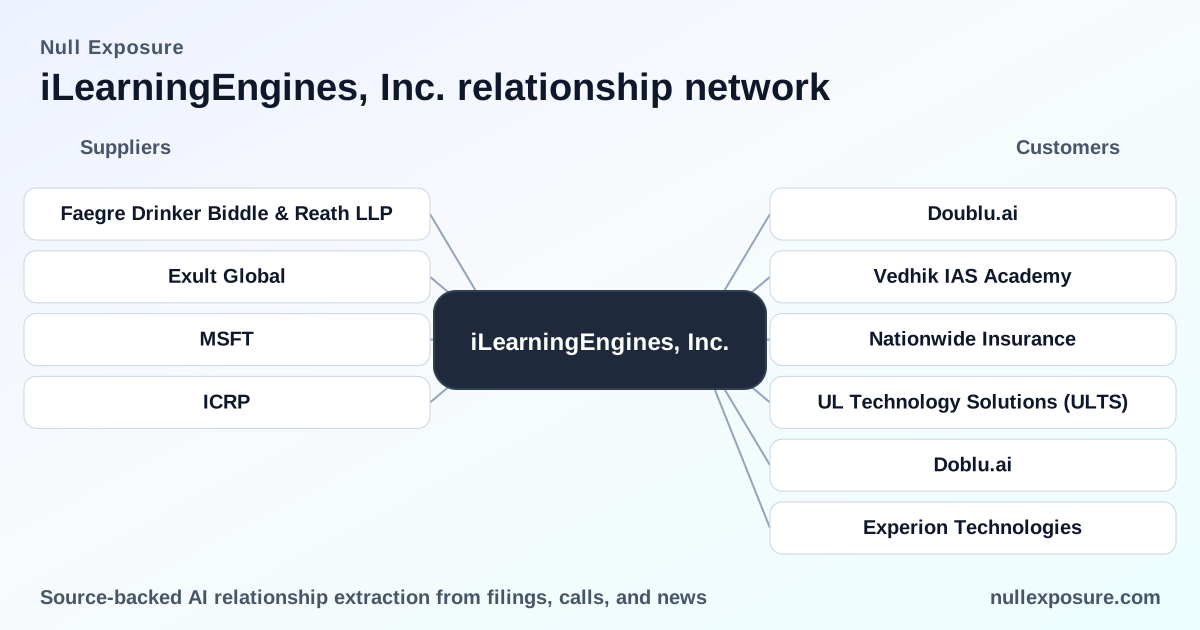
iLearningEngines (AILE): Customer relationships that drive an enterprise AI learning platform
Thesis: iLearningEngines builds and sells an Enterprise AI Platform for learning automation and information intelligence, monetizing through enterprise subscriptions, partnerships, and structured deals with education and corporate customers; its revenue base and go‑to‑market depend on a mix of education providers, corporate training partners, and enterprise adopters that validate platform utility and scale. For a focused read on partner exposure and customer concentration, visit https://nullexposure.com/ for a concise evidence-backed view of commercial relationships.
Business model and how it makes money iLearningEngines operates a B2B SaaS platform that packages AI-enabled content generation, personalization and analytics for corporate training and educational institutions. Revenue flows come from platform licences, integration partnerships and bespoke enterprise engagements, creating recurring streams when deployments scale across organizations and episodic revenue when tied to pilots or co‑developed products.
Key operating-model signals investors should weigh
- Contracting posture: The company sells enterprise-grade solutions and forms partnership arrangements to co‑launch offerings, implying negotiated contracts with implementation and support terms rather than purely transactional sales.
- Concentration: Public partner names span insurance, corporate training and education; this breadth reduces single‑sector dependence but raises the importance of a few large enterprise customers for scale economics.
- Criticality: Customers integrate the platform into learning and risk‑management workflows, indicating medium to high criticality once deployed — switching costs rise with content and analytics investments.
- Maturity: Announcements show a product in active commercial expansion through co‑developed engines and event showcases, signaling a company in growth commercialization rather than purely early stage.
Relationship deep-dive — who is on the books and what it means Below are every customer or partner cited in the compiled coverage, with a short assessment and source note for each.
Doublu.ai / Doblu.ai
iLearningEngines has announced a partnership to support Doublu.ai by providing enterprise AI platform capabilities that deliver insights and operational efficiencies to Doublu and its clients; the deal positions iLearningEngines as the technology backbone for Doublu’s AI‑driven offerings. According to a Yahoo Finance press release in March 2026, the company will support Doublu.ai and its clients via the Enterprise AI Platform. (Source: Yahoo Finance, March 9, 2026)
Note: The record includes both "Doublu.ai" and "Doblu.ai" entries in coverage; both refer to partnership activity focused on platform support and business insights. StockTitan also reported a tie-up framed as empowering AI‑driven business advantages. (Source: StockTitan, March 2026)
Vedhik IAS Academy
Vedhik IAS Academy uses iLearningEngines’ platform to deliver AI‑powered learning experiences and distribute educational materials across India, signaling traction in large academic customer deployments where content scale and personalization matter. This placement was described in a March 2026 news release highlighting the academy’s deployment of the platform for students in India. (Source: Yahoo Finance, March 9, 2026)
UL Technology Solutions (ULTS)
iLearningEngines and UL Technology Solutions partnered to launch the Microverse AI Engine for corporate training, a co‑developed product that demonstrates iLearningEngines’ strategy to scale through white‑label or joint offerings with established training vendors. The partnership launch was reported in March 2026 as a push to revolutionize corporate training. (Source: StockTitan, March 2026)
Nationwide Insurance
Nationwide showcased how it uses iLearningEngines’ Enterprise AI Platform to drive proactive risk management, indicating enterprise adoption by a major insurer and validating use cases beyond pure learning — into analytics and operational risk workflows. This showcase was reported in March 2026 in the context of an industry conference presentation. (Source: StockTitan, March 2026)
DSS
A SEC filing disclosed that iLearningEngines (through an affiliation listed as AIL/ALSET language in the filing) is involved in a financing arrangement to provide a $2.45 million loan to DSS in the form of a convertible note and warrants, reflecting a financial rather than a pure customer relationship that could affect capital deployment and exposure. The transaction was noted in an Intellectia.ai summary of the SEC filing in May 2026. (Source: Intellectia.ai / SEC filing, May 2026)
Experion Technologies
Short‑seller and litigation coverage has tied Experion Technologies to allegations that a material portion of iLearningEngines’ revenue was routed through an undisclosed related party, with reports asserting that Experion was the conduit for inflated revenue claims — a reputational and financial risk that investors must factor into customer‑revenue quality assessments. Hindenburg‑style allegations and ensuing scrutiny were covered in a GlobeNewswire release recounting those claims. (Source: GlobeNewswire report summarizing activist findings, Dec 2024 and cited again in 2026 coverage)
What these relationships collectively tell investors
- Commercial diversification across sectors (education, corporate training, insurance) reduces sector concentration but raises dependence on a handful of anchor customers and partners to achieve scale economics.
- Partnerships that co‑develop products (e.g., ULTS Microverse Engine) accelerate time‑to‑market but typically involve revenue‑share or margin dilution compared with direct platform licences.
- Customer criticality is growing as the platform moves into analytics and risk management use cases (e.g., Nationwide), which increases stickiness and long‑term revenue potential if deployments broaden.
- Corporate governance and related‑party allegations (Experion) remain a material risk to revenue quality and investor confidence, requiring careful monitoring of audited disclosures and SEC developments.
Risks, concentration and contracting posture — a concise investor checklist
- High insider ownership (reported ~79%) and low institutional ownership (~5%) suggest capital and control concentration, which can affect governance outcomes and liquidity.
- Financials show meaningful top‑line scale (RevenueTTM of $485.8M) but negative operating margins and EBITDA, indicating aggressive growth spending and execution risk as the company scales deployments.
- Contracting leans toward enterprise agreements and partnerships, creating higher switching costs but longer sales cycles and implementation dependencies.
Conclusion and action items iLearningEngines is expanding commercial reach through targeted partnerships and marquee customer showcases that validate platform utility across education and enterprise risk/training use cases, while also carrying execution and governance risks that directly influence revenue quality. For investors and operators performing diligence, the dual priorities are: 1) confirm the durability of enterprise contracts and co‑development economics; and 2) monitor regulatory and related‑party disclosures tied to revenue recognition. For a concise, evidence‑forward view of AILE’s customer relationships and what they imply for financial exposure, see https://nullexposure.com/.
Key takeaway: partner‑led expansion accelerates adoption but elevates the need for transparent audited disclosures and contract-level diligence before assuming recurring revenue stability.