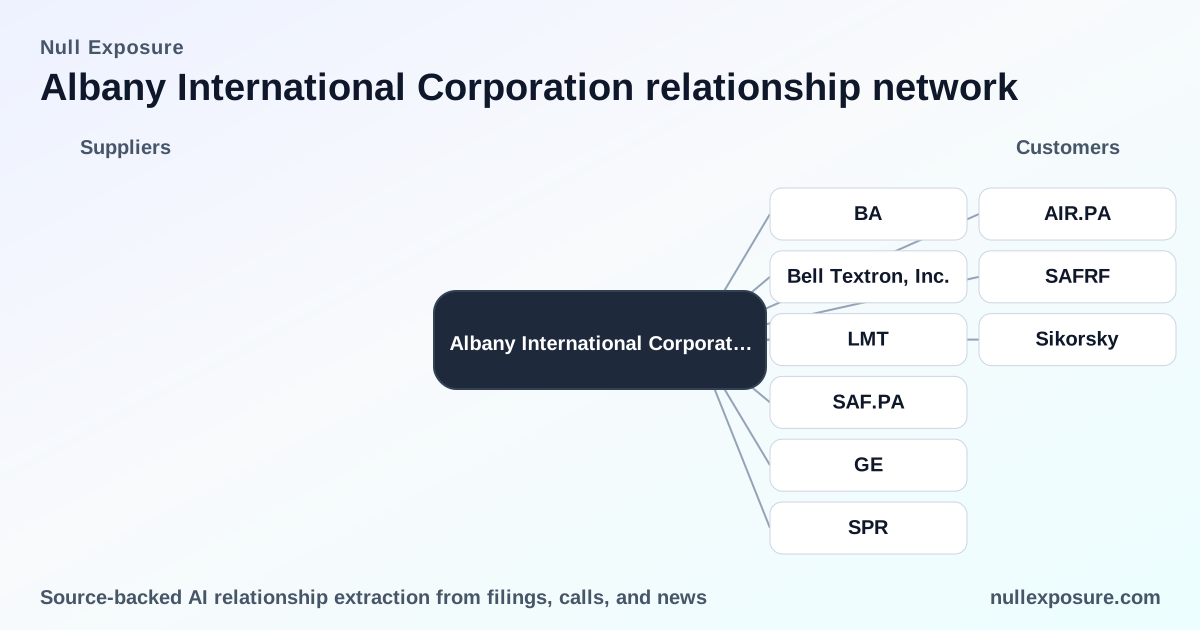
Albany International (AIN): Customer relationships that underpin engineered composites and specialty textiles
Albany International operates as a dual‑segment industrial manufacturer: Engineered Composites (AEC) supplies advanced composite structures and long‑term engine and airframe components to aerospace and defense prime contractors, while Manufacturing Components (MC) sells advanced textile products into paper and industrial end markets. The company monetizes through a mix of long‑term aerospace supply contracts and recurring commercial product sales, with AEC driving outsized program revenues and MC delivering higher‑frequency, shorter‑cycle orders. For investors evaluating counterparty risk, the customer base is concentrated around a handful of aerospace OEMs and defense primes, globally distributed, and a meaningful portion tied to government programs. Learn more at https://nullexposure.com/.
How to read these customer signals (quick investor takeaway)
Albany’s revenue profile blends programmatic, multi‑year aerospace contracts with high‑volume, transactional manufacturing sales. Key strengths are embedded supply positions on engine programs and defense platforms; key risks are customer concentration in aerospace, government program exposure, and cyclical demand for widebody aircraft and industrial paper markets.
The customer roster — name by name, plain English summaries
Boeing (BA)
Albany Engineered Composites supplies structural components including fuselage parts and vacuum waste tanks for most Boeing commercial aircraft, and provides fan cases for the GE9X engine that powers certain Boeing models. This relationship is cited in both Albany’s FY2024 10‑K and multiple March 2026 press reports outlining AEC program scope. (Sources: Albany 2024 10‑K; MarketScreener, Mar 2026)
SAFRAN / Albany Safran Composites (SAFRF / Albany Safran Composites)
SAFRAN is Albany’s largest aerospace customer, and sales to SAFRAN through Albany Safran Composites (ASC) accounted for about 14% of consolidated net revenues in 2024, principally fan blades and cases for CFM’s LEAP engine. Albany also reports ASC as an exclusive long‑term supplier to LEAP under defined scope parameters. (Source: Albany 2024 10‑K; Yahoo Finance / Albany press, FY2024–FY2025)
General Electric (GE)
Albany provides engine‑related components such as the fan case for the GE9X and supplies vacuum waste tanks on Boeing airframes that interact with GE‑powered platforms. Market commentary and company filings reference GE engine program participation. (Sources: MarketScreener, Mar 2026; Albany 2024 10‑K)
Pratt & Whitney (RTX / Pratt & Whitney)
AEC announced contract awards and production readiness with Pratt & Whitney for engine components extending through 2036, indicating a multi‑year supplier relationship focused on high‑performance engine parts. The story was reported in industry coverage in May 2026. (Source: QuantisNow, May 2026)
Lockheed Martin (LMT)
Albany’s AEC segment supplies composite components for defense platforms, including the F‑35 and missile bodies like JASSM, positioning Lockheed Martin as a defense prime customer for structural parts. The 2024 10‑K lists these programs explicitly. (Source: Albany 2024 10‑K)
Airbus (AIR.PA)
Albany collaborates with Airbus on wing and other composite applications, including participation in Airbus’s Wing of Tomorrow programs and other composite programs across commercial and defense applications. This relationship has been discussed in Albany investor calls and industry transcripts. (Source: Fool.com earnings transcript, FY2021)
Bell Textron, Inc.
Albany Engineered Composites was awarded a seven‑year contract to produce composite structural components for the Bell 525 helicopter, reflecting long‑duration program supply into rotary‑wing platforms. (Source: Yahoo Finance press release, FY2025)
Spirit AeroSystems (SPR)
Albany has a technology collaboration with Spirit AeroSystems to apply proprietary 3D woven composite technology for hypersonic and high‑temperature structural applications, signaling a development and supply relationship for advanced programs. (Source: Fool.com earnings transcript, FY2021)
Sikorsky
Albany’s AEC business supplies components for Sikorsky programs such as the CH‑53K helicopter, placing Sikorsky among defense prime customers for mission‑critical composite parts. (Source: Fool.com earnings transcript, FY2021)
Albany Safran Composites (internal / ASC)
Beyond being listed as a customer relationship in press coverage, ASC is Albany’s joint venture / business unit focused on 3D‑woven parts for SAFRAN and related engine programs; it operates as both strategic partner and revenue vehicle for LEAP and other engine products. (Sources: Albany 2024 10‑K; Yahoo Finance, FY2025)
What the customer relationships collectively imply about Albany’s operating model
- Contracting posture: AEC contains material long‑term supply contracts—explicitly including exclusive LEAP program supply—providing predictable revenue streams for engine programs. Conversely, MC backlog is short horizon with most orders recognized within 12 months, producing revenue visibility on a shorter cycle. (Company filings: 10‑K; management commentary FY2024–FY2025)
- Concentration and criticality: Aerospace program revenues are concentrated: SAFRAN alone represented ~14% of consolidated revenue in 2024, and AEC derives roughly 36% of its revenues from U.S. government‑related programs, making several customer relationships commercially critical to Albany’s top line. (Source: Albany 2024 10‑K)
- Geographic maturity and scale: Manufacturing footprint and sales are global, with facilities across Europe, the Americas and Asia, supporting OEMs and primes worldwide and exposing the company to foreign exchange and global supply‑chain dynamics. (Source: Albany 2024 10‑K)
- Segment dynamics: MC is a high‑volume, lower‑concentration seller (no single MC customer >10% of MC revenue), while AEC is program‑centric and manufacturer‑led with significant portion of revenue under long‑term agreements. This duality creates diversification but also mixed working‑capital profiles. (Source: Albany 2024 10‑K)
Key investor takeaways and risks
- Positive: Embedded, long‑duration engine and airframe programs with primes (Safran, GE, Pratt & Whitney, Boeing, Lockheed) give Albany structural revenue anchors and technical differentiation in composites.
- Risk: Customer concentration in aerospace and defense, program timing (widebody demand, LEAP/GE9X production schedules), and a meaningful government contract mix introduce cyclical and program‑risk exposure.
- Operational implication: Expect a managed mix of predictable long‑term program cash flows from AEC and faster turnover but lower individual customer materiality from MC; investors should monitor program awards, backlog conversion, and OEM production rates.
For a deeper, relationship‑level scorecard and to monitor how these counterparty exposures evolve over time, visit https://nullexposure.com/ for the full investor view.