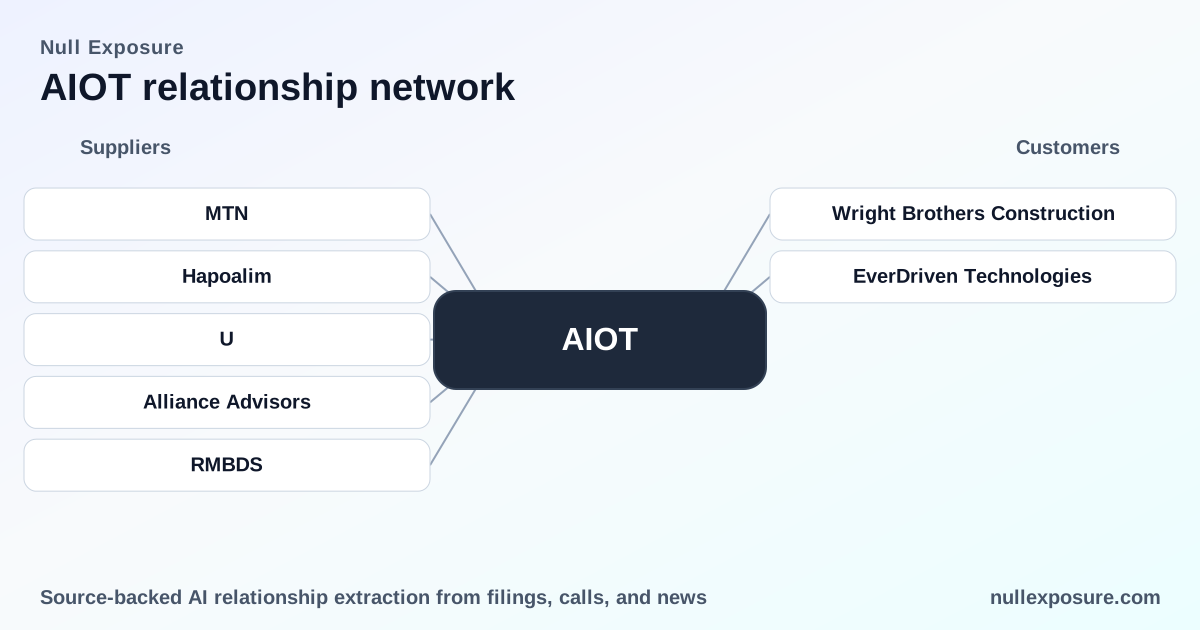
PowerFleet (AIOT): Customer Relationships Driving Recurring AIoT Revenue
PowerFleet operates a unified AIoT platform that combines hardware telemetry, device management, and cloud-hosted AI video and analytics under recurring contracts. The business monetizes through a mix of hardware sales, multi-year SaaS subscriptions, and hosting/maintenance services, producing predictable deferred revenue and recurring cash flows that support steady gross margins. For investors tracking customer traction and commercial momentum, the latest partnerships illustrate a clear move into AI video safety for large and mid-market fleets. Learn more about coverage and signals at https://nullexposure.com/.
How PowerFleet actually makes money and why that matters to investors
PowerFleet sells integrated solutions: devices and systems recognized at delivery, and cloud-hosted software and managed services recognized ratably over contract life. Company disclosures state that hosting and SaaS agreements are typically multi-year, recognized over service periods, and that billings for future services are deferred and amortized over contract lives ranging from one to five years. That accounting posture creates revenue visibility and sticky customer relationships because service delivery and recognition continue after the initial hardware sale.
The business model is a three-legged stool:
- Hardware sales generate upfront cash but are recognized at a point in time when control transfers.
- Software (Unity) and AI video SaaS produce recurring, subscription-style revenue that is recognized over the contract term.
- Hosting, maintenance, and professional services increase contract breadth and length and are typically bundled into multi-year agreements.
These characteristics translate into predictable recurring revenue with incremental upsell potential, improving enterprise valuation comparables in AIoT and telematics. PowerFleet reported TTM revenue of roughly $433 million and gross profit of $236 million, which underlines scale for an AIoT pure-play and validates the mixed product/service monetization approach.
News-driven customer wins: where Unity is being adopted
PowerFleet’s Unity AI video and analytics platform continues to land customers across construction, student transportation, and telecommunications, demonstrating cross-industry demand for safety and operational oversight.
Wright Brothers Construction — enterprise construction safety (FY2025)
Wright Brothers Construction deployed PowerFleet’s Unity AI video SaaS to transform operational oversight, mitigate risk, and drive measurable driver-safety improvements across its enterprise operations. The announcement was published via PR Newswire on March 9, 2026, confirming a targeted move into heavy civil construction safety programs. (PR Newswire, March 9, 2026: https://www.prnewswire.com/news-releases/us-construction-leader-wright-brothers-selects-powerfleet-unity-to-advance-on-road-safety-with-leading-ai-video-saas-solution-302543329.html)
EverDriven Technologies — expanded student-transport safety deployment (FY2025)
PowerFleet announced an expanded deployment of its AI video safety solution with EverDriven Technologies, a specialist in alternative student transportation, signaling deeper penetration in the education-transport vertical where safety and compliance drive procurement. This expansion was reported on March 9, 2026 through sector news coverage. (StockTitan report, March 9, 2026: https://www.stocktitan.net/news/AIOT/ever-driven-expands-ai-video-safety-partnership-with-powerfleet-to-oe954xsxidnb.html)
TELUS — North American launch partner to scale AI video SaaS (FY2026)
PowerFleet launched its advanced AI video SaaS solution with TELUS to amplify North American go-to-market reach, positioning the company to access TELUS’s enterprise and carrier customer base and distribution channels. The partnership was disclosed in a corporate release tied to investor outreach on May 2, 2026. (PR Newswire / company presentation, May 2, 2026: https://www.prnewswire.com/news-releases/powerfleet-to-present-at-the-38th-annual-roth-conference-302717979.html)
What these customer relationships imply for revenue quality and risk
These announced relationships collectively reinforce several company-level operating signals drawn from PowerFleet’s filings and disclosures:
- Contracting posture: PowerFleet operates with a long-term subscription orientation; its hosting and SaaS revenues are recognized over contract lives and the company defers billings for future services, reflecting multi-year revenue recognition and built-in renewal cadence.
- Revenue mix and criticality: The firm sells hardware but derives steady cash from software and hosting; this combination makes Unity a missionally important service for safety and asset oversight, increasing renewal stickiness and upsell potential.
- Counterparty profile: PowerFleet serves a mix of large enterprises and mid-market customers and markets to government entities as well, indicating diversified buyer types and lower single-customer concentration risk at scale.
- Geographic footprint: Reported revenue breakdown shows material North America exposure with significant EMEA and APAC receipts, supporting a global addressable market but with North American revenue predominance.
- Maturity of contractual backlog: Disclosures indicate the company expects to recognize revenues through future years (references to revenue recognized through 2030 in filings), which signals a mature, contracted backlog and measurable forward revenue.
These traits produce higher revenue visibility and recurring cash flow, but investors must monitor renewal rates, potential hardware refresh cycles, and the commercial effectiveness of distribution partnerships like TELUS to drive scale.
Investment implications: growth, margins, and value drivers
PowerFleet’s hybrid model supports attractive unit economics: hardware sales drive immediate cash while SaaS and hosting lift lifetime customer value. With TTM gross profit of roughly $237 million on ~$433 million revenue, the company demonstrates meaningful gross margins for an IoT provider. However, the company’s diluted EPS remains negative, underscoring that continued scaling of higher-margin SaaS revenue and operational leverage are the next value inflection points.
Key drivers to watch:
- SaaS and hosting ARR growth and contribution to total revenue.
- Renewal rates and average contract length given the explicit multi-year recognition policy.
- Channel effectiveness from partners such as TELUS to convert enterprise pipeline.
- Geographic revenue mix, particularly North America versus EMEA and APAC contributions.
For active investors, these customer wins validate the product-market fit of Unity in safety-critical fleets; ongoing quarterly disclosures on deferred revenue and subscription metrics will be the clearest indicators of sustainability.
For additional signal coverage and rolling updates on AIoT customer relationships, visit https://nullexposure.com/.
Bottom line
PowerFleet is executing a hardware-plus-recurring-software model that is already winning enterprise and mid-market safety customers, with distribution partners extending reach. The company’s contractual posture—multi-year, subscription-oriented, and globally distributed—creates predictable recurring revenue and positions Unity as a growing margin driver; the next phase of value creation depends on scaling SaaS ARR, improving unit economics, and converting channel partnerships into sustained enterprise bookings.