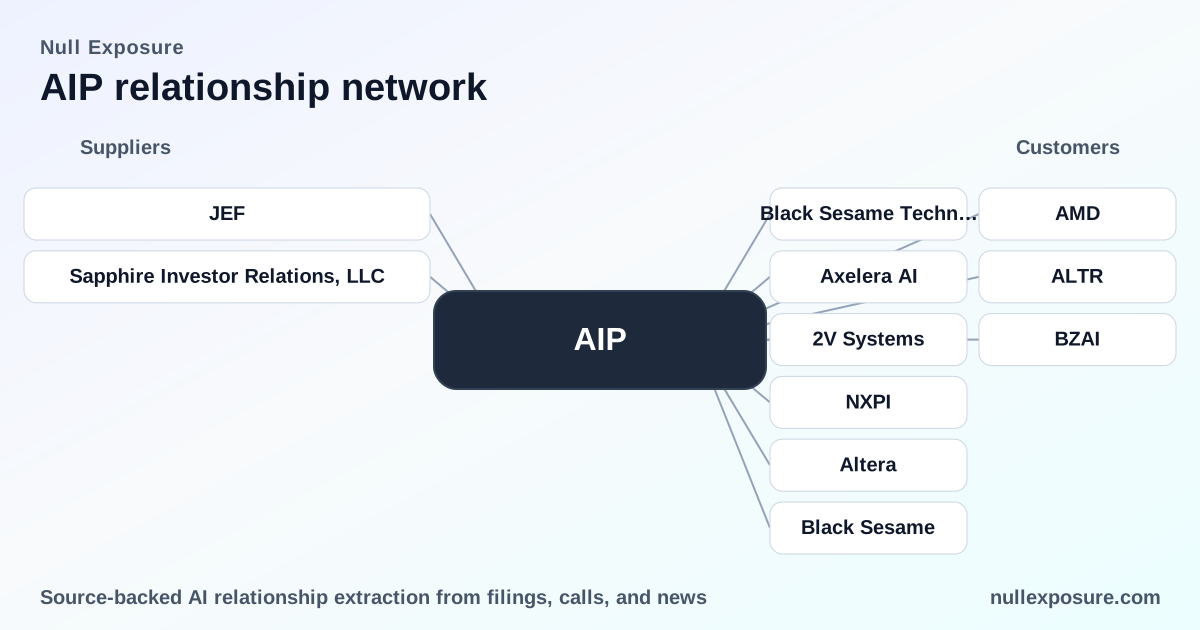
Arteris (AIP): Customer relationships powering a physical‑AI inflection
Arteris monetizes semiconductor interconnect know‑how through multi‑year licensing, support contracts and usage‑based royalties tied to licensees’ product sales. The business combines steady, contracted license and support fees with variable royalty upside, and recent customer wins position the company to capture design dollars from automotive, edge AI and data‑center chip programs. For investors, the value proposition is scale in design adoption rather than hardware manufacturing — revenue growth comes from expanded design wins, longer design tails and royalty streams.
For a concise portal to the underlying coverage and monitoring, visit the Null Exposure homepage: https://nullexposure.com/.
How Arteris sells and what constraints shape its economics
Arteris is a licensor of interconnect IP and a provider of engineering services that support customers through design, verification and productization. Company disclosures describe a three‑part commercial model: (1) upfront design licenses and access to integration tools, (2) recurring support and maintenance fees, and (3) usage‑based royalties recognized as licensees ship products. The firm reports material deferred revenue and contracted but unsatisfied performance obligations — $112.4 million as of December 31, 2025 — which implies multi‑year revenue visibility with roughly half expected to convert within 12 months.
Several operating characteristics define the risk/reward profile:
- Contracting posture: predominately licensing with embedded service support and a measurable royalty component, creating a hybrid recurring + variable revenue mix.
- Concentration & geography: revenue is concentrated in Asia Pacific (47.6% of 2025 revenue) and the Americas (41.5%), with modest EMEA exposure (10.9%), which gives growth sensitivity to APAC OEM cadence.
- Customer role & criticality: Arteris functions as a licensor and a technical service provider; its IP is integrated into customers’ SoC architectures and therefore is functionally critical once adopted.
- Maturity: license terms typically run two to three years, and the company carries significant deferred revenue, indicating established multi‑year engagements rather than one‑off projects.
- Government exposure: Arteris discloses the potential for government contracts with atypical termination and rights, a corporate‑level legal/contractual consideration.
Financially, licensing, support and maintenance comprised the bulk of revenue ($63.9M of FY2025), with variable royalties contributing materially ($6.6M) — a profile that amplifies upside as customers move from prototypes to production.
Customer roster: what every cited relationship tells investors
Below I catalog every customer relationship cited in the collected coverage, with a concise plain‑English description and source reference for each mention.
NXP Semiconductors (NXPI / NXP)
NXP has expanded deployment of Arteris system IP across AI‑enabled silicon for intelligent vehicles, industrial systems and consumer edge products, indicating larger, cross‑portfolio integration rather than a single product win. Source: Arteris press releases and investor communications reported in February 2026 via The Globe and Mail / Manila Times and echoed in MarketScreener and StockTitan (FY2026 disclosures, Feb 2026).
Black Sesame Technologies (Black Sesame)
Black Sesame licensed Arteris’ Ncore 3 cache‑coherent NoC and FlexNoC 5 non‑coherent NoC with physical awareness for next‑generation automotive SoCs, a direct design win in advanced driving platforms. Source: Arteris announcement reported on StockTitan and echoed in The Globe and Mail (Dec 2 / FY2025–FY2026 coverage).
Axelera AI
Axelera licensed FlexNoC 5 for the Axelera Europa platform, an adoption that supports Axelera’s expansion from edge inference into larger‑scale inference platforms. Source: Arteris announcement reported Oct 23, 2025 and indexed by StockTitan (FY2025).
2V Systems
2V Systems licensed both Ncore 3 and FlexNoC 5 for a server IO chiplet, positioning Arteris IP at the center of multi‑die, RISC‑V based SoCs for data center AI workloads. Source: StockTitan coverage of the 2V Systems design win (FY2025).
AMD
AMD is listed among customers increasing adoption of Arteris’ AI‑focused products (FlexGen, Ncore, FlexNoC), reflecting enterprise‑grade validation from a leading CPU/GPU/accelerator supplier and supporting claims of broader market momentum. Source: Arteris earnings and business update summarized by MarketBeat in the February 2026 earnings alert (FY2026).
Altera
Altera licensed Arteris IP and tools for next‑generation FPGA and SoC FPGA designs, marking a strategic pairing where interconnect IP is embedded into programmable logic product development. Source: StockTitan coverage of the November 4, 2025 customer announcement (FY2026 references).
Blaize (BZAI / Blaize)
Blaize adopted FlexNoC 5 to enhance its Blaize AI platform, integrating Arteris interconnect technology to deliver energy‑efficient, scalable edge AI solutions. Source: Arteris announcement reported Nov 11, 2025 and referenced across StockTitan and The Globe and Mail (FY2025–FY2026).
Renesas
Renesas licensed and deployed FlexNoC for the R‑Car Gen 5 automotive AI SoC series, a high‑visibility automotive program that underscores Arteris’ traction in safety‑critical, compute‑heavy vehicle platforms. Source: TradersUnion and InsiderMonkey summaries referencing the March 2026/2025 collaboration (FY2026).
MIPS (GlobalFoundries / MIPS)
MIPS agreed to integrate Arteris’ FlexGen smart NoC IP and Magillem SoC integration software into RISC‑V‑based platforms, accelerating physical‑AI computing platforms for automotive MCUs, ADAS, robotics and embedded computing. Source: EmbeddedComputing coverage and SimplyWall.St reporting on the April 21, 2026 collaboration announcement (FY2026).
What these relationships collectively mean for valuation and risk
- Demand validation across end markets: design wins at NXP, Renesas, Black Sesame and major customers like AMD and Altera confirm cross‑industry relevance — automotive, edge AI and data center programs are all active drivers.
- Revenue mix levered to production ramps: with licensing and support providing baseline revenue and royalties delivering upside, Arteris' top line will expand materially only as these design wins reach production scale; royalty recognition ties financial performance to customers’ unit economics.
- Geographic exposure accentuates execution risk: nearly half of revenue is APAC‑based (47.6% in 2025), creating sensitivity to regional OEM cycles and geopolitical trade dynamics.
- Contracted visibility but long design tails: $112.4M of contracted but unrecognized obligations provide near‑term visibility, yet multi‑year design cycles mean revenue realization will be staggered.
Key takeaways for investors
- Arteris is a pure‑play interconnect IP licensor whose upside is correlated to the production success of large SoC programs. Recent wins broaden its addressable footprint into automotive and physical‑AI compute.
- The revenue model combines stable licensing/support fees with variable royalties, a configuration that reduces downside on missed ramps while offering asymmetric upside on successful product deployments.
- Monitor production ramps at NXP, Renesas, Black Sesame, Blaize and MIPS partnerships — those are the critical inflection points that convert design wins into recurring and royalty revenue streams.
For ongoing tracking of Arteris customer momentum and signal alerts, visit our coverage hub: https://nullexposure.com/.