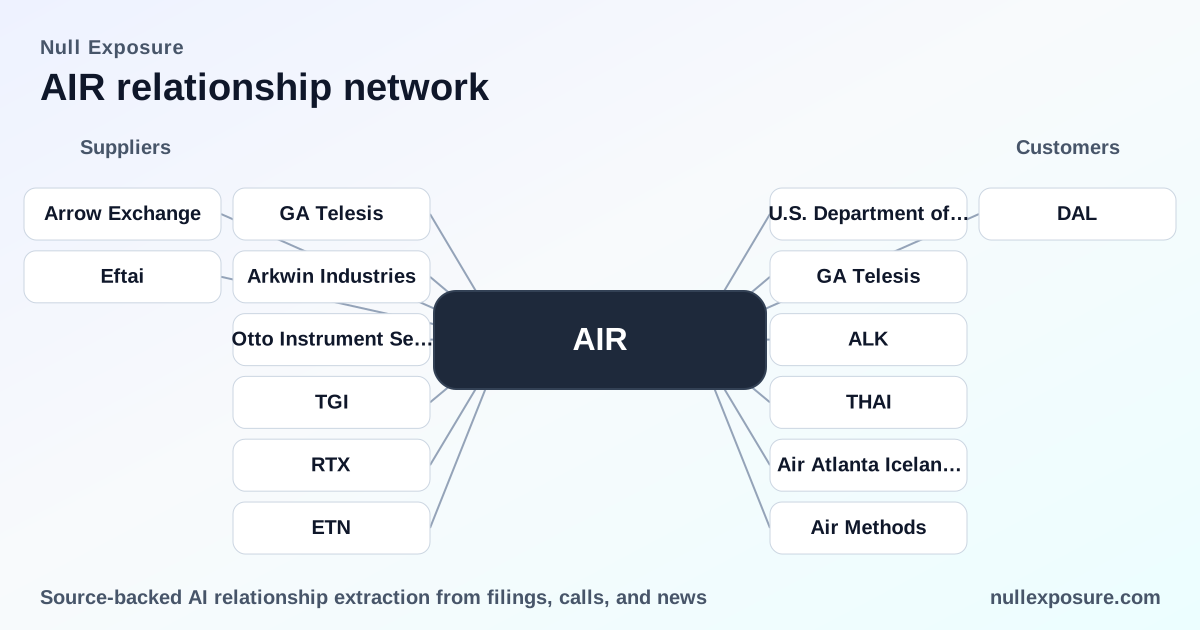
AAR Corp (AIR): Customer relationships that underpin backlog, margins and recurring revenue
Thesis: AAR is a vertically integrated aviation aftermarket operator that monetizes through three durable revenue streams — parts distribution, airframe/component MRO and integrated software/logistics services — supplemented by government logistics and manufacturing contracts; the company converts long-term government and large commercial engagements into predictable backlog and recurring revenue while scaling new software-led offerings like Trax and Airvoyant. Learn more at https://nullexposure.com/.
Why the customer map matters to investors
AAR’s revenue mix is not diffuse: Parts Supply (≈40% of sales), Repair & Engineering (≈32%) and Integrated Solutions (≈25%) together form the economic core and explain the firm’s margin profile, cash conversion and backlog behavior. Its customer base combines large commercial airlines, lessors, and government defense agencies — the latter representing ~28.9% of sales in FY2025 — creating a hybrid exposure to cyclical commercial volumes and multi-year, option-rich government contracts. The FY2025 10‑K reports $537.2 million of firm backlog with most recognition scheduled in FY2026–2027, underlining revenue visibility for investors.
- Contracting posture: AAR operates both long-term, optioned government programs (including a ten‑year DoS performance contract) and short‑term commercial sales under standard 30‑day terms, which creates a mix of predictable program revenue and higher‑turnover distribution sales.
- Concentration & criticality: Government and defense customers are material to consolidated sales; defense programs and manufacturer distribution agreements create high criticality but concentrated cash flows.
- Maturity & segmentation: The customer base is mostly recurring and mature, while the integration of Trax and the new Airvoyant procurement platform introduce growing software annuity streams.
- Spend scale: Company-level signals place government and large program spend in the $100M+ band, reinforcing the strategic importance of a small number of large customers and contracts.
If you want a consolidated view of these customer dynamics and how they feed AAR’s valuation thesis, visit https://nullexposure.com/.
Customer relationships and what they mean for revenue (compact walk-through)
Below I list every named relationship in the provided results with a concise plain-English takeaway and the source context.
- GA Telesis — AAR agreed to divest its LGO business to GA Telesis for $51 million on December 19, 2024, reflecting portfolio pruning and capital redeployment; source: AAR FY2025 10‑K (filed May 31, 2025).
- U.S. Department of Defense (DoD) — AAR reports measurable sales into DoD‑linked programs and joint ventures, with disclosed ASAS JV support fees included in fiscal results; source: AAR FY2025 10‑K.
- American Airlines (AAL) — Mentioned in coverage of engine orders that affect aftermarket parts and services demand tied to A321neo fleet activity; source: American Airlines press coverage (Mar 2026).
- Delta Air Lines (DAL) — Delta is both an MRO customer and an Airvoyant subject‑matter partner; AAR cites deployments and user growth tied to Delta’s adoption of its software; source: SahmCapital / AeroTime coverage (Mar–May 2026).
- Alaska Airlines (ALK) — AAR completed an Oklahoma City airframe MRO expansion specifically to support a long‑term maintenance commitment for Alaska, with imminent aircraft inductions; source: PR Newswire and industry coverage (Mar 2026).
- U.S. Air Force — AAR secured two long‑term pallet contracts reported at up to $450 million, expanding its defense backlog and multi‑year revenue visibility; source: SimplyWall / SahmCapital coverage (Apr–May 2026).
- United States Marine Corps — AAR landed an approximately $305 million follow‑on contract for C‑40A fleet contractor logistics support covering Navy and Marine assets; source: PR Newswire / Investing.com (Apr–May 2026).
- United States Navy — The $305 million C‑40A contractor logistics award covers Navy fleet support and deepens AAR’s defense backlog; source: PR Newswire / Investing.com (Apr–May 2026).
- JetBlue (JBLU) — JetBlue is named as a launch partner and advisor for Airvoyant, AAR’s AI‑driven procurement platform, providing early operational feedback; source: PR Newswire (May 2026).
- Air Canada (AC / AC.TO) — Air Canada is collaborating with AAR on Airvoyant as a subject‑matter partner to shape the platform’s development; source: AeroTime / AviationBusinessNews (May 2026).
- Frontier Group (listed as ULCC) — Industry reports on Frontier’s fleet deferrals and lease terminations provide market context for lessor and MRO demand dynamics that affect AAR; source: Investing.com / Finviz (Mar–May 2026).
- Eaton (ETN) — AAR entered an agreement to be an authorized service center for Eaton’s commercial aerospace customers across EMEA, expanding authorized distribution/service roles; source: SimplyWall (May 2026).
- Woodward (WWD) — AAR signed a multi‑year commercial distribution agreement to be Woodward’s preferred distributor for high‑demand consumables (CFM LEAP, GEnx, CF34 parts) to airlines; source: GlobeNewswire press release (Apr 22, 2026).
- Air Methods — AAR subsidiary Airinmar extended a multi‑year warranty management and value engineering services agreement with Air Methods, reflecting stable aftermarket services revenue; source: StockTitan news (Dec 2025).
- Air Atlanta Icelandic — Trax extended a multi‑year contract with Air Atlanta Icelandic, boosting recurring software revenue and international footprint for AAR’s software segment; source: TradingView / Zacks summary (Mar 2026).
- Aercap (AER) — Market commentary on large A320neo orders and long‑term LEAP engine leases is relevant to AAR’s parts and leasing support activities that follow lessor fleet placements; source: SahmCapital / Marketscreener (Mar–May 2026).
- Air Lease Corporation (AL) — Aircraft lease placements and deliveries reported by lessors underpin aftermarket and MRO demand relevant to AAR’s parts business; source: aviation24.be / Marketscreener (FY2023–2025 coverage).
- Atlas Air (AAWW) — Named as an Airvoyant launch partner/advisor, linking AAR software to a large cargo operator’s operational needs; source: PR Newswire / AeroTime (May 2026).
- Allegiant (ALGT) — Allegiant is a launch partner for Airvoyant and is separately referenced for fleet modernization trends that affect aftermarket demand; source: PR Newswire / Aerotime / SimplyWall (Mar–May 2026).
- Thai Airways (THAI) — Trax was selected by Thai Airways to modernize its digital MRO operations, supporting Trax recurring revenue outside North America; source: StockTitan / InsiderMonkey (Jan–Mar 2026).
- Air Europa — Named as an Airvoyant launch partner and advisor, contributing to AAR’s go‑to‑market validation for the procurement platform; source: PR Newswire / AeroTime (May 2026).
- Virgin Atlantic — Included among Airvoyant launch advisors, validating international airline interest in AAR’s procurement platform; source: PR Newswire / AeroTime (May 2026).
- GVH — Cited in a press summary as an IATA‑accredited cargo agent with ties to major carriers, an example of the broader cargo and logistics ecosystem AAR serves indirectly; source: ABN Newswire (FY2024 context).
- LATAM (LTM) — Fleet disclosures for LATAM provide context on aircraft types and potential aftermarket demand in South America relevant to AAR’s global reach; source: Yahoo Finance / Marketscreener (Mar 2026).
- Bristow / VTOL — Industry notes on helicopter deliveries and medium‑twin H160 leases illustrate adjacent MRO demand drivers in rotary support markets; source: Marketscreener (Mar 2026).
- KTOS (Kratos) — Mentioned in sector comparisons that assess aerospace services peers and program wins; included for competitive benchmarking context; source: TradingView (May 2026).
What investors should take away
- Backlog and long‑dated government contracts are the clearest sources of revenue visibility; FY2025 disclosures and program wins (C‑40A, pallet contracts) materially extend defense backlog into the early 2030s.
- Parts distribution remains the cash engine, while MRO expansions (Oklahoma City) and Airvoyant/Trax software lift margin mix toward more recurring, higher‑margin streams.
- Customer concentration is real but manageable: government customers are material (nearly 29% of sales), while a diversified airline launch partner set validates global commercial demand for AAR’s new software and procurement offerings.
- Risk profile is a blend of airline cyclical exposure (fleet timing, deferrals) and program execution on multi‑year government contracts; recent divestitures and distributor agreements (Woodward) optimize capital and revenue mix.
This is a concise, investor‑facing map of AAR’s customer relationships and the operating signals they generate. For deeper counterparty scoring and an integrated credit/revenue model, visit https://nullexposure.com/.