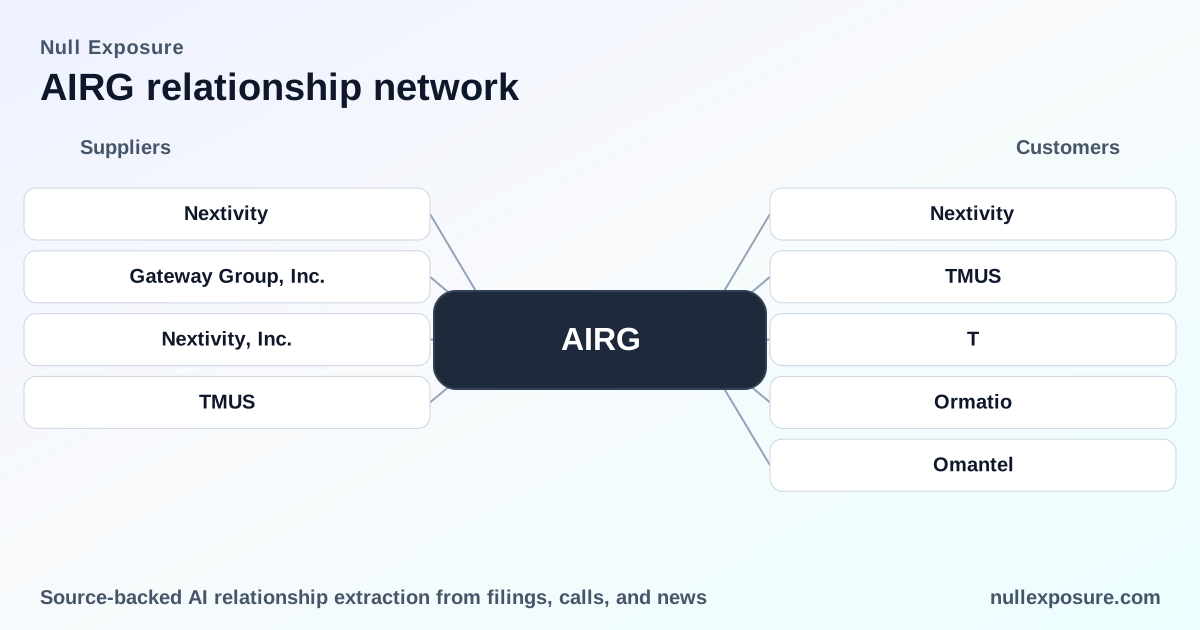
Airgain (AIRG) — Customer Map and Commercial Thesis
Airgain commercializes high-performance antennas, embedded cellular modems (NimbeLink/Skywire), and networked connectivity services by selling hardware to OEMs, carriers and enterprise customers while layering subscription and engineering services for recurring revenue. The company's revenue model is fundamentally hardware-led — product sales account for ~95% of revenue — supplemented by subscription-based device enablement (NLink) and design/testing services that lift lifetime customer value. For investors, the critical lens should be on customer concentration, channel certifications with major carriers, and the pipeline of enterprise and IoT partners converting pilot projects into multi-million-dollar commercial deals.
For additional investor intelligence, visit https://nullexposure.com/.
What this relationship map tells investors about Airgain's operating posture
Airgain operates with a mix of short-term, shipment-driven contracts and a growing recurring layer. Contracts are principally spot or short-term product sales (recognition at shipment; payment terms 30–90 days), but the company is explicitly building subscription revenue through NLink and data plans. Geographic revenue is concentrated in North America and APAC but the business is global in scope. Customer concentration is material — customers representing 10%+ of revenue were ~54% of sales in 2024 — which makes each large account commercially important and increases volatility if one tier-one partner reduces orders. Product sales are critical to the P&L (95% of revenue), so scale and win-rate for hardware programs determine near-term cash flow more than the nascent services line.
Key operating characteristics:
- Contracting posture: predominantly short-term/spot hardware sales with emerging subscription and services contracts.
- Concentration: material customer concentration; large enterprise and carrier deals drive outsized revenue swings.
- Criticality: hardware is critical to revenue; certifications and carrier approvals materially open addressable markets.
- Maturity: mixed — proven hardware business with early-stage recurring services and nascent international rollouts.
Customer relationships — who is buying Airgain's technology today
Below I cover every customer relationship surfaced in public reporting and call transcripts.
Coco Robotics — autonomous delivery robots (FY2026)
Coco Robotics has selected Airgain’s NimbeLink cellular modems for its next-generation autonomous delivery robots, a win characterized in press reports as a multi‑million‑dollar opportunity for Airgain. This deal signals traction in robotics/automation OEM channels where embedded connectivity and rugged modems are central to productization (Investing.com, May 2026).
Source: Investing.com reports (May 2, 2026).
Nextivity — reseller agreement tied to acquisition (FY2026)
As part of an acquisition announced by Airgain, the company entered into a reseller agreement with Nextivity, expanding channel reach for certain products and creating a partner sales route into enterprise and operator customers. This arrangement was disclosed on Airgain’s earnings call transcripts (InsiderMonkey, Q4 2025).
Source: InsiderMonkey transcript, Q4 2025 earnings call.
T‑Mobile — key priority certification for AirgainConnect (FY2025)
Airgain announced T‑Mobile key priority certification for AirgainConnect, which validates the product for mission‑critical connectivity and opens access to T‑Mobile’s public safety and enterprise network segments. Carrier certification materially enlarges procurement opportunities with enterprises and public-safety integrators (InsiderMonkey, Q3 2025).
Source: InsiderMonkey transcript, Q3 2025 earnings call.
AT&T / FirstNet — certification momentum (FY2025)
Airgain referenced AT&T FirstNet trustee certification in the same set of investor disclosures, indicating carrier-level validation that supports sales to public-safety and enterprise customers reliant on FirstNet. Carrier certifications are gating items: once secured, they accelerate enterprise procurement cycles and large deployments (InsiderMonkey, Q3 2025).
Source: InsiderMonkey transcript, Q3 2025 earnings call.
GRID20/20 — wildfire monitoring deployment (FY2026)
GRID20/20 selected Airgain Skywire® modems for a new wildfire monitoring solution, placing the company into utility/critical‑infrastructure use-cases where remote connectivity is a mission requirement and reliability is monetizable. This is an industry-specific use case supporting recurring device and service demand (FinancialContent/Markets press release, May 2026).
Source: Markets FinancialContent press release (May 2026).
Ormatio — Middle East pilot and joint rollout planning (FY2025)
Airgain reported installations progressing with Ormatio in the Middle East, with plans for a joint sales and marketing rollout in 2026 — a signal of regional expansion through local partners for managed deployments. This relationship represents a go‑to‑market push into APAC/Middle East verticals (InsiderMonkey, Q3 2025).
Source: InsiderMonkey transcript, Q3 2025 earnings call.
Omantel — Middle East channel partner with revenue prospects (FY2026)
Airgain identified Omantel as a Middle East partner and expects the relationship to meaningfully contribute to revenue in the second half of 2026, underscoring operator partnerships as a route to scale in international markets. Local operator buy‑in provides both distribution and credibility for enterprise projects across the region (InsiderMonkey, Q4 2025).
Source: InsiderMonkey transcript, Q4 2025 earnings call.
Implications for revenue quality and downside risk
- Revenue concentration is a material company-level risk. With customers representing more than half of revenue in aggregate, a pause from one or two major buyers would depress topline and margins quickly.
- Commercial cadence is hardware-driven. Product shipments dominate revenue recognition and working capital dynamics (shipment recognition; 30–90 day payment terms), which amplifies quarterly volatility.
- Carrier certifications are high‑value enablers. T‑Mobile and AT&T/FirstNet certifications convert proofs‑of‑concept into procurement opportunities; losing or failing to secure these would materially limit addressable market access.
- Emerging recurring revenue improves stickiness over time. NLink and subscription-based data plans provide margin diversification, but today they are still a smaller proportion of revenue — the company is transitioning from pure hardware to a hybrid model.
Commercial maturity and spend profile
Airgain’s customer wins include multi‑million-dollar engagements with tier‑one operators and MSOs (spend band evidence highlights contracts in the $1M–$10M range), indicating the company is competing for enterprise-scale programs rather than only small OEM buys. Geographic revenue split (North America heavy, China/APAC material) supports a global enterprise sales effort, but with operator/regulatory nuance in each market.
If you’re modeling Airgain’s next two years, build scenarios where:
- Carrier certifications and Omantel/Ormatio regional rollouts drive phased revenue in H2 2026;
- Coco Robotics and GRID20/20 convert into multi‑unit deployments that scale hardware orders;
- and subscription revenue grows steadily but remains a minority of total revenue in the near term.
For a deeper, relationship‑level view and monitoring of carrier certifications and partner rollouts, visit https://nullexposure.com/.
Bottom line for investors
Airgain is a hardware-first connectivity supplier moving into subscription services and international operator channels. The investment case rests on converting certified carrier access and pilot deployments into repeatable, multi‑million‑dollar programs while managing client concentration risk and the short‑term nature of hardware contracts. Operational execution on carrier rollouts and the pace of recurring revenue adoption will determine whether Airgain’s revenue becomes less cyclic and more predictable over the medium term.