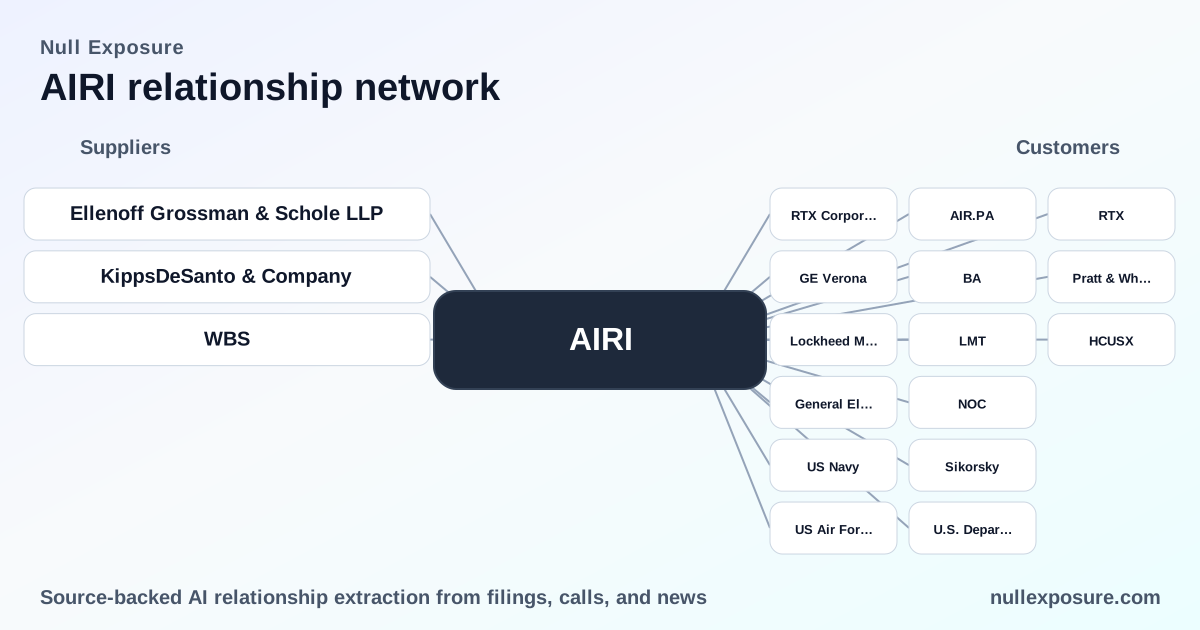
AIRI: Customer Relationships that Drive a Tier‑One Aerospace Supplier
Air Industries Group (AIRI) manufactures precision structural parts and assemblies and monetizes by selling these components directly to large aerospace primes and government agencies under a mix of long‑term agreements (LTAs) and spot purchase orders; revenue concentration is high and the company operates as a Tier‑1/2 supplier to primes that ultimately supply the U.S. Government and global airlines. Investors should treat AIRI as a manufacturing play with high customer concentration, contractually durable revenue from LTAs, and operational exposure to prime contractor procurement cycles. Read more at https://nullexposure.com/.
How AIRI contracts, gets paid, and where the exposure lives
Air Industries’ filing and public reporting show a dual contracting posture: LTAs provide recurring backlog and visibility, while spot orders supplement near‑term production. The FY2024 10‑K explicitly differentiates backlog arising from LTAs versus spot customer purchase orders, signaling formal program commitments alongside transactional business. The company’s customer base is concentrated among a small number of large aerospace primes; four customers accounted for roughly 73.4% of net sales in FY2024, which converts supplier performance into a material single‑point risk for revenue and cash flow. The firm’s end markets are predominantly U.S.-based revenue streams, but ultimate end‑users include international governments and commercial airlines, so program awards have both domestic and global implications.
- Contracting posture: combination of LTAs (longer duration, backlog) and spot orders (transactional).
- Counterparties: large aerospace primes and government customers (Defense Logistics Agency and DoD programs).
- Concentration and criticality: top customers drive the majority of sales and products are integrated into mission‑critical platforms.
- Maturity and role: relationships are mature; AIRI functions as a Tier‑1/Tier‑2 manufacturer delivering certified, precision assemblies.
If you want an investor‑grade customer map built from filings and market coverage, visit https://nullexposure.com/ for structured insights.
Customer roster — company filings and press mentions, one by one
The list below reproduces every relationship item disclosed in source filings and news coverage, with plain‑English takeaways and the originating document.
RTX Corporation — FY2024 Form 10‑K
Air Industries reports long‑standing sales to RTX Corporation and to several RTX business units, including Collins Aerospace and Pratt & Whitney, indicating program‑level work across landing systems and engine components. This relationship is documented in the FY2024 Form 10‑K filing.
GE Verona — FY2024 Form 10‑K
The 10‑K states AIRI supplies GE Verona with precision components used in ground‑based turbines for power generation, illustrating a commercial industrial revenue stream outside pure airframe applications. (FY2024 10‑K)
General Electric Aerospace — FY2024 Form 10‑K
Air Industries supplies GE Aerospace with high‑precision parts used in jet turbine aircraft engines for commercial platforms, indicating exposure to engine OEM procurement cycles. (FY2024 10‑K)
Lockheed Martin Corporation — FY2024 Form 10‑K
The company sells directly to Lockheed Martin’s subsidiary Sikorsky Aircraft Corporation, establishing a direct line into rotorcraft platforms and government helicopter programs. (FY2024 10‑K)
US Navy — Naval Today (2022)
A 2022 Naval Today report documents an award to Air Industries Machining Corp. to produce landing gear and ancillary components for the US Navy’s E‑2D Advanced Hawkeye, confirming program‑level naval work. (Naval Today, Feb 9, 2022)
US Air Force — ASDNews (2025)
Air Industries announced a $5.4 million contract for landing gear steering collar components for the USAF B‑52 aircraft, reflecting continuing prime contractor and DoD procurement for legacy bomber sustainment. (ASDNews, July 10, 2025)
RTX — TradingView coverage (FY2026)
TradingView’s FY2026 market note highlights a recent shift in AIRI’s sales concentration toward RTX and Lockheed, signaling changes in program mix and customer weighting year‑over‑year. (TradingView, FY2026 coverage)
Lockheed Martin Corp — Finviz company summary (FY2026)
Finviz coverage lists AIRI products deployed across multiple military platforms including Lockheed systems, underscoring Lockheed’s importance in AIRI’s installed base. (Finviz, March 2026)
Northrop Grumman Corp — Finviz company summary (FY2026)
Finviz notes AIRI’s products on Northrop platforms such as the E‑2C/D, confirming sales relationships with Northrop programs. (Finviz, March 2026)
Sikorsky — Finviz company summary (FY2026)
Finviz identifies Sikorsky platforms (e.g., Black Hawk) as users of AIRI components, consistent with the company’s reported sales to Sikorsky in filings. (Finviz, March 2026)
U.S. Department of Defense — Finviz company summary (FY2026)
Market coverage characterizes Air Industries as a prime contractor to the U.S. Department of Defense, highlighting direct government program participation beyond subcontracting. (Finviz, March 2026)
US Air Force — TheDefensePost (2025)
The Defense Post reports AIRI secured contracts to supply landing gear components for the USAF B‑1B Lancer and F‑16, indicating breadth across bomber and fighter sustainment programs. (TheDefensePost, Mar 4, 2025)
US Navy — TheDefensePost (2025)
The Defense Post confirms AIRI accepted a December 2024 award to deliver landing gear systems for the E‑2D Hawkeye, reinforcing the company’s naval sustainment pipeline. (TheDefensePost, Mar 4, 2025)
Lockheed — TradingView coverage (FY2026)
TradingView’s FY2026 note reiterates increased sales concentration toward Lockheed alongside RTX, reinforcing media coverage of shifting customer mix. (TradingView, FY2026 coverage)
Northrop — TradingView coverage (FY2026)
TradingView documents a year‑over‑year decline in Northrop’s share of AIRI sales, signaling customer mix dynamics relevant for revenue forecasting. (TradingView, FY2026 coverage)
Airbus — Finviz company summary (FY2026)
Finviz mentions AIRI products are deployed on commercial aircraft manufactured by Airbus, indicating commercial OEM exposure in addition to defense primes. (Finviz, March 2026)
Boeing — Finviz company summary (FY2026)
Finviz likewise notes deployment on Boeing platforms, confirming AIRI’s presence in major commercial airframe supply chains. (Finviz, March 2026)
LMT — Finviz company summary (FY2026)
Finviz references Lockheed (ticker LMT) again in its coverage of AIRI product deployments on defense platforms. (Finviz, March 2026)
The U.S. Government / HCUSX — FY2024 Form 10‑K
The FY2024 10‑K states AIRI supplies certain components directly to the Defense Logistics Agency (DLA), a combat support agency of the DoD, showing direct government procurement channels. (FY2024 10‑K)
Northrop Grumman — FY2024 Form 10‑K
The company’s FY2024 filing specifies supply of products used on the E‑2D Hawkeye airborne warning and control aircraft for Northrop Grumman programs. (FY2024 10‑K)
NOC — FY2024 Form 10‑K
The 10‑K repeats the Northrop relationship (ticker NOC) and program‑level work on the E‑2D Hawkeye. (FY2024 10‑K)
Pratt & Whitney — MarketScreener coverage (FY2026)
MarketScreener’s FY2026 note lists Pratt & Whitney and other platforms that incorporate AIRI parts, indicating AIRI’s exposure to major engine OEM programs. (MarketScreener, March 2026)
RTX — MarketScreener coverage (FY2026)
MarketScreener reiterates RTX‑related program exposure in its summary of platforms served by AIRI, reinforcing RTX’s centrality across multiple sources. (MarketScreener, March 2026)
US Navy — Naval‑Technology (2022)
Naval‑Technology reported that Air Industries’ Long Island subsidiary secured a contract to deliver complete landing gear for the E‑2D Advanced Hawkeye, supporting earlier press and filing disclosures. (Naval‑Technology, 2022)
Investment takeaways — concentration is opportunity and risk
- Revenue durability from LTAs provides backlog visibility but does not eliminate program execution risk; expect lumpiness when program phases change.
- High customer concentration (four customers ≈ 73% of sales in FY2024) amplifies the impact of awards, cancellations, or pricing disputes with any single prime.
- Direct government channels (DLA/DoD prime contractor work and multiple USAF/USN awards) diversify contract types but increase compliance and program‑management overhead.
- Mature, long‑standing prime relationships and certified manufacturing capability position AIRI to capture sustainment work across high‑value platforms, which supports margins when utilization is steady.
For a concise, investor‑oriented map of AIRI’s customer exposure and program timelines, see Null Exposure’s analysis at https://nullexposure.com/.
Air Industries operates a concentrated, mission‑critical supply model: attractive for investors who value program visibility and defense demand, but inherently exposed to prime customer concentration and program timing.