AirJoule Technologies: commercialization through partner-led hardware sales and service revenue
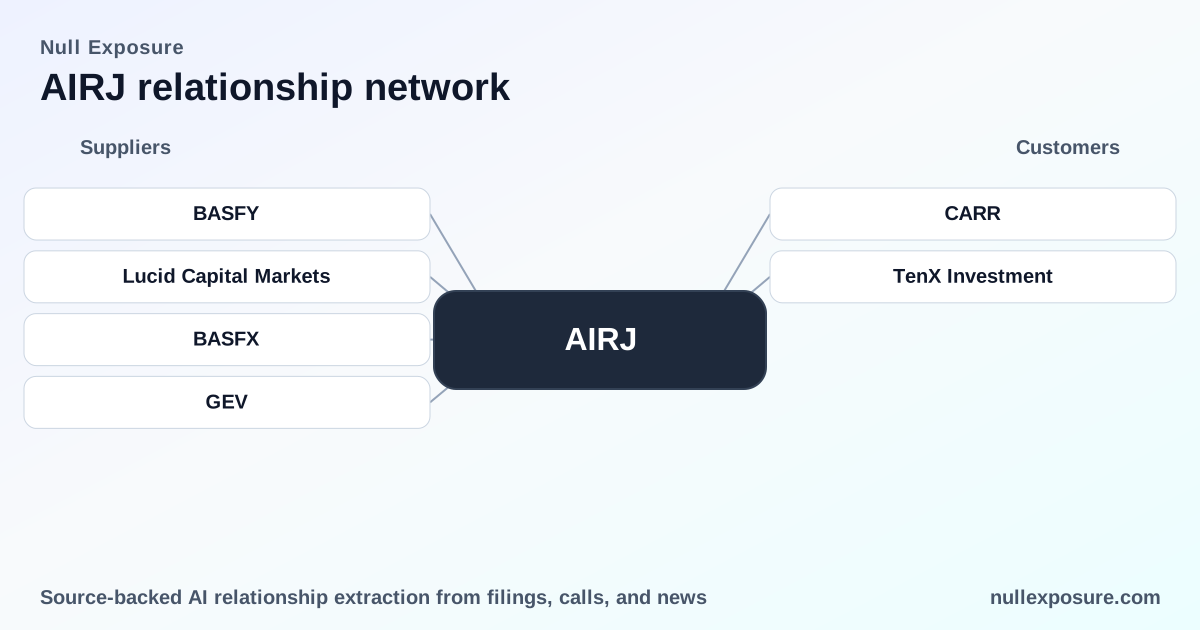
AirJoule Technologies operates as a hardware-first developer of atmospheric energy and water-harvesting systems that it intends to monetize through direct sales of AirJoule units, recurring maintenance and service contracts, and exclusivity/licensing agreements with global HVAC and distribution partners. The company is early in commercialization: its balance sheet and filings show minimal revenue to date, while strategic relationships — notably a joint venture with Carrier and a Middle East distribution tie‑up with TenX — provide the distribution channels and go‑to‑market scale investors should model into revenue ramp scenarios. For a quick view of the company positioning and partner evidence visit https://nullexposure.com/.
What the business model actually looks like in practice
AirJoule is structured as a hardware vendor with an aftermarket service profile. Company disclosures state the intent to manufacture and sell full AirJoule systems for dehumidification and water harvesting and to generate recurring revenue from maintenance and service agreements, indicating a classic capex + opex monetization mix rather than pure licensing.
- Contracting posture: the company’s language and filings present AirJoule as a seller of systems and a service provider, not merely a technology licensor. That implies direct project execution and customer-facing operations will be necessary for early commercial deals.
- Concentration and criticality: the business is partner‑heavy for distribution and commercialization — exclusivity agreements and a Carrier joint venture centralize go‑to‑market execution with a small number of large partners, increasing concentration risk but also offering rapid scale if partners execute.
- Maturity and revenue profile: AirJoule’s public financials show near-zero reported revenue on a trailing basis, negative EBITDA, and early nominal receipts through partnered channels — consistent with a technology in the commercialization phase rather than a mature product business.
These company-level signals come directly from AirJoule’s own disclosures describing its intended sales and service model and its working capital needs for project execution and relationship development.
Partnerships and customers you must price into forecasts
Below I cover every relationship flagged in visible reporting and press coverage, with concise takeaways and source attribution for each.
Carrier / Carrier Global Corporation (CARR)
- Carrier has signed an agreement and formed a joint venture structure with AirJoule to develop and commercialize the AirJoule dehumidification and cooling technology, and Legacy Montana granted Carrier the exclusive right to commercialize AirJoule into HVAC equipment in the Americas for three years, subject to milestones. This positions Carrier as AirJoule’s primary commercialization engine in the Americas and significantly accelerates market access if milestones are met. According to the company’s FY2024 disclosure and press coverage, Carrier described the technology as “transformational,” and the arrangement includes milestone-based exclusivity in the Americas (PR Newswire; Cooling Post; FacilitiesDive; AirJoule FY2024 filing).
- Sources: company FY2024 filing and PR Newswire first-quarter 2024 release describing the exclusivity; Cooling Post reporting on the joint venture; FacilitiesDive coverage of Carrier’s commercialization role.
Arizona State University
- The Carrier joint venture recorded its first nominal revenue of about $110,000 in Q4 2025 from core AirJoule system sales to Arizona State University, representing early proof-of-concept commercial receipts through partner channels rather than direct large-scale market demand. This transaction validates system sell-through in a university / institutional environment and supplies a concrete early revenue datapoint for modeling initial adoption.
- Source: market reporting summarizing Q4 2025 JV revenue generation to Arizona State University (Globe and Mail coverage of FY2026 commentary).
TenX / TenX Investment (Middle East distributor)
- AirJoule announced an exclusive Middle East distribution agreement with TenX, granting regional distribution access into water-stressed markets where demand for air‑to‑water and dehumidification solutions is high; the agreement also introduces geopolitical and concentration risk given the region’s complexity. The partnership is structured to push AirJoule products into markets with acute water stress and cooling demand, but investors must model execution and regional risk premia.
- Sources: company announcement via GlobeNewswire and coverage in financial press noting the exclusive Middle East distribution agreement and associated geopolitical considerations (GlobeNewswire; Globe and Mail commentary).
Key takeaways for investors and operators
- Distribution-led commercialization is the core go-to-market strategy. Carrier’s JV and the TenX exclusive distribution deal convert technology development into potential installed base growth through established channels rather than AirJoule building global distribution from scratch.
- Revenue today is immaterial but evidence of commercialization exists. The JV’s Q4 2025 sale to Arizona State University produced a small, traceable revenue event (~$110k) that signals product readiness for institutional buyers.
- Concentration and milestone dependency are primary risks. Exclusive commercialization periods and limited partner set mean partner performance and milestone achievement directly affect AirJoule’s near-term addressable sales; model downside scenarios where milestones are delayed or exclusivity is narrowed.
- Business economics are hardware-centric with an aftermarket revenue stream. Filings explicitly communicate intentions to sell full systems and to capture maintenance/service revenue, underlining the need to model both one-time system receipts and recurring service margins.
Operational constraints and balance-sheet signals investors should not ignore
AirJoule’s public statements and filings supply company-level constraints that shape how relationships convert into cash flow:
- The company explicitly frames itself as a seller of hardware and a service provider, planning to earn initial cash through unit sales with subsequent recurring maintenance revenue. This creates capital intensity around manufacturing, inventory, and project delivery.
- Primary working capital demands are focused on project execution and technology development — procurement of materials, services, payroll, and strategic relationship development. Expect capital needs to cycle with pilot projects and initial commercial rollouts.
- The hardware product focus increases unit-level gross margin sensitivity to component costs and manufacturing scale; meanwhile, high insider ownership and low institutional ownership indicate concentrated equity control that could influence governance around partner negotiations and capital raises.
Investment implications and next steps
AirJoule’s valuation is a forward-looking bet on partner execution: if Carrier executes the milestone path and TenX opens scalable Middle East channels, AirJoule converts R&D into recurring revenue with meaningful leverage to installed base growth. Conversely, the commercial path is concentrated and milestone-dependent, making downside scenarios tied to partner underperformance credible.
For operators and analysts building models, prioritize:
- Milestone timing and contractual terms in the Carrier agreement when available.
- Order cadence from pilot customers like Arizona State University as a leading indicator of pipeline conversion.
- Geopolitical and credit risk assessments for Middle East distribution through TenX.
If you want a concise, investor-oriented summary of partner risks and near-term revenue triggers, see the company overview and partner evidence on the NullExposure site: https://nullexposure.com/.
Conclusion: AirJoule is transitioning from technology developer to partner-led hardware vendor with an aftermarket service revenue strategy; its near-term investment case hinges on Carrier’s commercialization milestones and the TenX distribution channel translating into repeatable system orders.