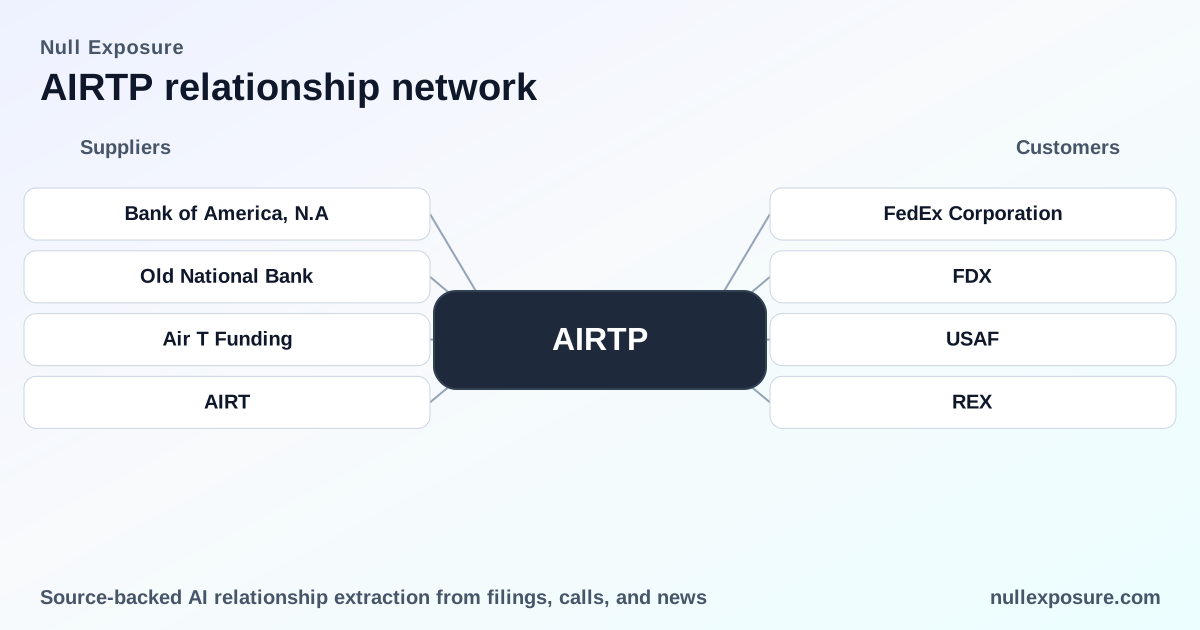
Air T (AIRTP) — The FedEx Feeder That Investors Should Evaluate First
Air T monetizes a diversified aviation services portfolio by operating overnight feeder flights for major couriers, leasing and selling commercial aircraft and engines, manufacturing ground support equipment, and selling aviation software subscriptions. The company’s cash flow is concentrated in its overnight air cargo operations for FedEx, while manufacturing (GGS) and aftermarket parts (Contrail/CASP) provide lumpy, higher-margin pockets and recurring software/subscription streams. Learn more about how we surface customer relationships at https://nullexposure.com/.
Why FedEx defines Air T’s economics
Air T’s business model is built around contractually providing aircraft and operational services to the FedEx group through its MAC and CSA feeder companies. FedEx accounted for roughly 39% of consolidated revenue in FY2025 and generated 92% of the overnight air cargo segment’s revenues, making the relationship both material and critical to Air T’s cash flows. Air T’s FY2025 10‑K highlights the multi-decade nature of this partnership and the concentration risk that investors must underwrite.
-
FedEx Corporation — Air T runs overnight express feeder flights under long-standing contracts that together represent a material portion of consolidated revenue and operating segment revenue. According to Air T’s FY2025 Form 10‑K (filed for the year ended March 31, 2025), the loss of FedEx would have a material adverse effect on Air T’s business.
Source: Air T FY2025 Form 10‑K (March 31, 2025). -
FDX (FedEx symbol referenced in news) — Market and press coverage repeatedly reference Air T’s feeder operations as primarily supporting FedEx deliveries; recent releases note Overnight Air Cargo revenue growth tied to FedEx contract scale while adjusted EBITDA faced one‑time pressures.
Source: Newswire / News reports citing Air T results and FedEx exposure (Newswire release March 9, 2026; related press coverage December 2025–March 2026). -
FedEx Express — Operational descriptions in trade press emphasize that Air T operates as Mountain Air Cargo on behalf of FedEx Express from FedEx’s Memphis hub, underlining the operational-control model where Air T provides crew and aircraft services to FedEx.
Source: Aerotime article on Air T and Rex (March 2026).
The company disclosed that key dry‑lease agreements covering aircraft operated by MAC and CSA were renewed on June 1, 2021 and are set to expire on August 31, 2026, which creates a discrete contract renewal cliff to watch in the next reporting cycle. This explicit contractual expiration is a direct source-level signal investors must model into contract renewal and downside scenarios.
Government contracting and the GGS manufacturing leg
Air T’s ground support equipment (GGS) business sells mobile deicers and other specialized equipment into airports, airlines and the military. GGS brings predictable backlog and a government counterparty that reduces single-customer concentration risk in that segment.
- USAF (United States Air Force) — GGS was awarded a contract to supply deicing trucks to the U.S. Air Force in October 2021, with option years that, if exercised, extend the contract to October 21, 2027. This positions government business as a stable revenue stream for GGS under a multi‑year award.
Source: Air T FY2025 Form 10‑K (filed March 31, 2025).
GGS reported a backlog of roughly $14.3 million as of March 31, 2025, which management expects to fill during fiscal 2026; that backlog places GGS squarely in the $10m–$100m spend band for near‑term revenue recognition.
Rex acquisition: expansion and immediate integration risk
Air T has been acquisitive in FY2026 events, closing a transaction to acquire Regional Express (Rex) from administrators and setting up a five‑year A$50 million loan facility to support the deal. This transaction accelerates Air T’s regional reach into Australia but introduces integration and financing execution risk.
-
Regional Express Holdings Limited (Rex Express) — Air T entered into a Sale and Implementation Deed with Rex administrators and subsequently closed the acquisition; filings indicate a nominal purchase price (A$1) accompanied by a five‑year A$50 million loan facility to finance working capital and restart operations.
Source: StockTitan SEC filing summary / 8‑K‑A reporting and related press (March 2026). -
REX (alternate ticker reference) — Market notices and press picks catalog the Rex purchase as a strategic push into international feeder/regional operations, consistent with Air T’s playbook of feeding major integrators while expanding route density.
Source: Press coverage and Air T event filings (December 2025–March 2026).
Other demand drivers: parts, software and parts-of-aircraft sales
Outside of FedEx and GGS, Air T generates revenue from parts sales, asset management and cloud software for aftermarket customers. These segments diversify revenue but are naturally more cyclical and inventory‑sensitive than overnight feeder operations.
-
Contrail — Recent analyst and press commentary attribute revenue declines to weakness in the commercial aircraft, engines and parts segment, where lower component sales at Contrail reflect reduced inventory purchases over the prior 12 months. This highlights the sensitivity of the parts business to airline procurement cycles.
Source: TradingView summary of analyst commentary (May 2026 / Zacks-related coverage). -
MAC and CSA (mentioned in filings) — MAC and CSA together represent two of eight U.S. companies holding North American feeder contracts with FedEx and contributed roughly 39% and 36% of consolidated revenue in FY2025 and FY2024, respectively, underscoring both the concentration and the internal operating structure that feeds the FedEx relationship.
Source: Air T FY2025 Form 10‑K (filed March 31, 2025).
What the relationship constraints reveal about Air T’s operating model
Air T’s public disclosures and news reporting combine into a clear set of operating characteristics investors should use in valuation and risk analysis:
- Contracting posture: A mix of long‑term dry‑lease agreements with FedEx (explicit expirations in August 2026) and shorter operating leases for aircraft and engines (1–4 year terms), plus subscription‑style recurring revenue in digital solutions. The combination creates both runway for renewal negotiations and near‑term lumpy exposure.
- Concentration and criticality: FedEx is a critical, material customer — responsible for roughly 39% of consolidated revenue and 92% of one operating segment — signaling concentrated counterparty risk that dominates upside and downside.
- Maturity and tenure: The FedEx relationship is mature (customer since 1980), which supports operational stickiness but does not eliminate contract renewals or volume risk.
- Geography and spend: Revenue is North‑America weighted with discrete international expansion via Rex; segment spend bands include $10–$100m pockets (GGS backlog, CASP aircraft sales).
- Role diversity: Air T operates simultaneously as a service provider (feeder operator), manufacturer (GGS deicers), and distributor (commercial parts and asset sales), which diversifies business-model drivers but complicates capital allocation.
Learn more about how these customer relationships change the investment case at https://nullexposure.com/.
Investment takeaways and how to read the risk
- Primary valuation lever: FedEx volumes and contract renewals. Model scenarios around the August 31, 2026 dry‑lease expirations and potential changes in the number of aircraft operated for FedEx. The FY2025 10‑K explicitly warns that termination or adverse modification of FedEx contracts would have a material adverse effect.
- Stabilizers: GGS backlog and the USAF award provide near‑term revenue certainty in manufacturing, while software/subscription revenues introduce recurring margins over time.
- Risks from M&A and integration: The Rex acquisition accelerates growth but adds debt and integration risk; the A$50m loan facility supporting the deal is a financing item to monitor in liquidity analysis.
Bottom line: Air T is a FedEx‑centric operator where investor returns pivot on contract renewal and feed‑volume stability, with manufacturing and software as meaningful but secondary stabilizers. For analysts and operators, the immediate priorities are modeling FedEx contract expiries, monitoring Rex integration, and tracking GGS order fill timing.
If you want a structured customer relationship brief or ongoing alerts tied to these counterparties, visit https://nullexposure.com/ for extended coverage and dataset access.