Airship AI’s government customer footprint: what investors should price in
Airship AI Holdings (AISP) principally sells bundled edge hardware and software systems plus post-contract support and professional services to large government and commercial customers, generating revenue from point-in-time hardware/software sales and recurring support/subscription contracts. The company monetizes through a mix of one-time system sales (Outpost AI, Acropolis, Airship Command), ongoing support/maintenance (PCS/SMA), and growing subscription and services revenue tied to custom model training and cloud delivery. For an investor, the thesis is straightforward: revenue upside depends on converting pilot deployments into multi-year contracts and reducing customer concentration while scaling higher-margin software/subscription streams. Learn more at https://nullexposure.com/.
Why customers and contract structure drive the investment case
Airship’s commercial design is a hybrid of equipment seller and recurring service provider. The firm historically booked most product revenue from bundled on-premise hardware/software systems, while PCS and professional services provide the recurring backbone. The company’s disclosures show support contracts typically run one to five years with an average near four years, which gives predictability when conversions succeed, but the sales mix remains weighted to capital sales today. The operating posture therefore combines:
- Contracting posture: A mix of short-term pilots and one-to-five year support/subscription deals; pilots are used to win later multi‑year engagements.
- Revenue concentration: Company-level disclosure flagged that one customer accounted for 57% of 2024 revenue, a material and critical concentration that elevates counterparty risk.
- Customer profile and criticality: Primary buyers are large government agencies and major enterprises globally; government contracts are strategically important and can drive outsized revenue in lumpy wins.
- Segment mix and margins: Hardware and bundled systems drive point-in-time revenue ($18.7M in bundled systems in 2024 vs $7.4M in 2023), while services/PCS and software subscriptions are smaller but strategic for margin expansion.
- Spend scale: Federal purchase orders exceeding $16M shipped in 2024 imply institutional-sized engagements consistent with a $10M–$100M agency-level spending band.
These dynamics create high upside in contract wins and conversion to recurring revenue, but elevated near-term revenue volatility and dependency on a small number of large customers.
All of the government relationships the market is watching
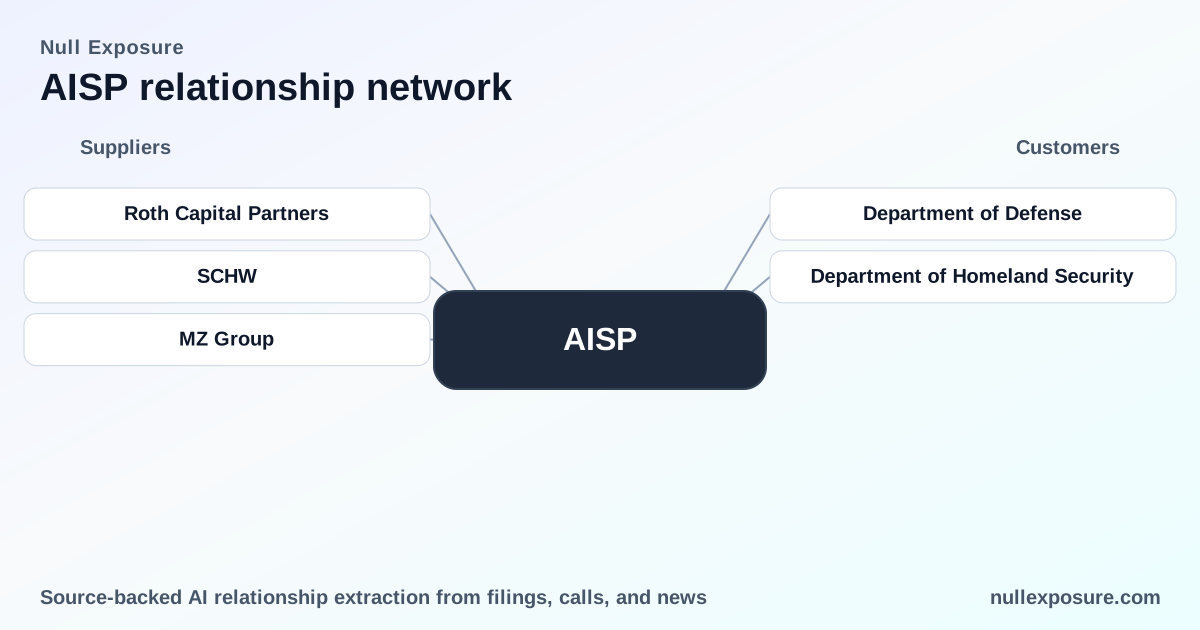
Department of Homeland Security — active awards to build scale
Airship announced a $2.1 million firm fixed-price award from the Department of Homeland Security, reflecting direct federal procurement for the company’s edge solutions and validating Airship’s product fit with homeland security use cases. This was publicized in a GlobeNewswire release referenced in MarketBeat coverage in April 2026. (GlobeNewswire / MarketBeat, April 16, 2026)
Department of Justice — multiple contract wins reported
Company filings and press coverage note that Airship AI has been awarded 16 contracts across the Department of Justice and Department of Homeland Security, indicating a sustained win-rate across investigative and law-enforcement use cases and reinforcing government channel traction reported in FY2025. (Investing.com report on Airship AI SEC filing, FY2025)
Department of Defense — material program-level award noted
Earlier coverage cited a ~$13 million contract tied to Department of Defense requirements, a win that the market interpreted as a material commercial validation and a driver of a large February 2025 stock move. This indicates the company is competing for and winning defense-relevant deployments of its edge AI systems. (SAHM Capital coverage, February 27, 2025)
What those relationships mean for revenue quality and risk
The government wins display two important characteristics for valuation: scale and concentration. Federal awards provide the potential for sizable, creditworthy counterparties and follow-on expansion across agencies. At the same time, the company’s stated concentration—one customer generating 57% of 2024 revenue—renders the revenue line sensitive to individual procurement cycles. Government contracts introduce lumpy procurement timing and seasonality; Airship’s use of short-term pilot deployments means some revenue is contingent on conversion to longer-term contracts.
Operational characteristics implied by the company statements include:
- Mix of short- and long-term contracts: The firm offers multi-year support agreements but also runs one-year subscriptions and low-cost pilots that require active conversion to lock in recurring revenue.
- Seller + service provider posture: Revenue is driven by hardware/system sales with a growing share of PCS, professional services, and software licensing; historically the majority of product revenue has been bundled hardware/software sold on-premise.
- Global but US-centric expansion priorities: Offerings are deployed globally, but growth emphasis is on expanding within major U.S. government agencies and commercial accounts.
Growth levers and risk vectors investors should watch
Airship’s path to higher valuation depends on several measurable transitions. Key growth levers are converting pilots into multi-year support contracts, expanding software subscription delivery (cloud), and diversifying customer concentration. The company already collects meaningful federal purchase orders—over $16M shipped in 2024—which validates pipeline scale. Conversely, principal risks include continued customer concentration, lumpy federal procurement cycles, and the transition from hardware‑centric sales to recurring software/subscription revenue.
Investor monitoring checklist:
- Conversion rate from pilots to multi-year contracts and the mix of PCS vs point-in-time sales.
- Trajectory of standalone software or cloud subscription bookings versus bundled hardware sales.
- Revenue diversity progress: reduction from the 57% single-customer concentration metric.
- New federal awards cadence and total contract backlog disclosed in quarterly SEC filings.
Bottom line: position, valuation, and where to go next
Airship AI combines credible government and defense channel wins with a legacy hardware-heavy revenue mix. The company’s government relationships provide both scale and volatility: they validate product-market fit but concentrate revenue around a few large buyers. For investors, the attractive upside is in margin expansion and multiple expansion as software/subscription mix grows; the primary downside is concentrated counterparty risk and procurement timing. Track the company’s quarterly disclosures for evidence of subscription growth, pipeline conversions, and customer diversification.
For professional research and to follow these relationship signals on an institutional timeline, visit https://nullexposure.com/ for continued coverage and customer intelligence.