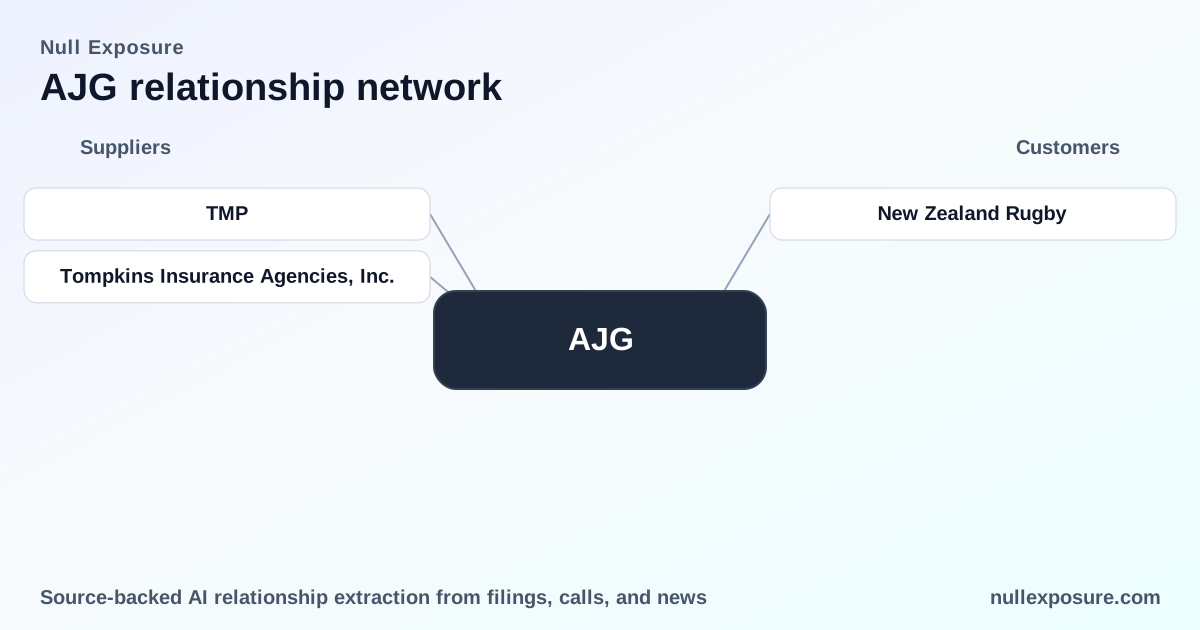
Arthur J. Gallagher & Co. (AJG): Customer Relationships, Revenue Mechanics and What Investors Should Know
Arthur J. Gallagher & Co. operates as a global insurance brokerage and risk-management services provider that monetizes through brokerage commissions, client fees for consulting and claims administration, and recurring contractual arrangements across its brokerage and risk-management segments. The company reported roughly $14.2 billion in trailing revenue and trades with a market capitalization near $53.2 billion, generating recurring cash flows from both commission-based placements and fee-for-service risk management contracts. For investors tracking client exposure and contract economics, Gallagher’s model is a blend of high-volume, geographically diversified client work and pockets of multi-year service commitments. For deeper customer-level insight, visit https://nullexposure.com/.
How Gallagher actually makes money — the operating posture that drives margins
Gallagher’s core revenue drivers are straightforward: the brokerage segment earns commissions from underwriting enterprises and fees charged to clients, while the risk-management segment sells per-claim and per-service fees, plus consulting. The firm’s financial profile — steady operating margin (~28%) and a forward P/E near 15.6 — reflects the value of recurring client relationships and the scalable nature of advisory and claims-administration services.
- Contracts tilt toward short-term, annual arrangements in brokerage, but the company also carries meaningful remaining performance obligations on multi‑year engagements. As disclosed in Gallagher’s public filings, the company reported $604.3 million of remaining performance obligations as of December 31, 2024, with material recognition stretching into multiple years, indicating a hybrid contracting posture that mixes annual renewals with select multi-year guarantees.
Contracting, billing and revenue recognition — the characteristics investors must weigh
Gallagher’s contracts exhibit four distinct characteristics that shape revenue predictability and risk:
- Short-term renewals are the norm: The company states that the majority of brokerage contracts are for one year or less, implying frequent renewal cycles and exposure to client churn.
- Subscription-style prepayments exist: Supplemental revenues are often paid upfront on an annual or quarterly basis, creating deferred revenue balances that smooth recognition.
- Usage-based economics in risk management: A substantial portion of risk-management revenues are negotiated on a per-claim or per-service basis, which links revenue to claim activity.
- Select long-term performance obligations: Gallagher nonetheless reports multi-year performance-based contracts and RPOs in its filings, providing a base of committed future revenue.
Taken together, these characteristics produce a mix of predictability (from prepaid subscriptions and RPOs) and variability (from per-claim billing and annual renewals) — a dynamic that supports attractive margins but requires active client retention and deployment of advisory capabilities.
Customer mix, concentration and geographic footprint: diversification is strategic
Gallagher deliberately serves a broad set of counterparties: individuals, middle-market and very large enterprise clients, nonprofits, and government entities. The company is evidently global, with operations or networks covering roughly 130 countries and meaningful revenue across the U.S., U.K., Canada, Australia and New Zealand. Despite its scale, Gallagher reports low client concentration: its largest single client represented ~1% of combined brokerage and risk-management revenues in 2024, and the top ten together about 3%, which signals material diversification and limited client-level revenue dependence.
- Practical implications for investors: low revenue concentration reduces single-client tail risks, while the global footprint and diversified counterparty types help hedge geographic or sector-specific shocks.
Relationship inventory — what we found and why it matters
The source material returned one named customer relationship. Below is the plain-English take on that relationship with a direct source reference.
- New Zealand Rugby — Gallagher serves as the Official Insurance Broker of New Zealand Rugby, providing insurance brokerage services to the national governing body for the sport. This is a sponsorship/partnership-style client engagement that aligns with Gallagher’s retail and specialty sports risk practices. (Reported March 2026 on StockTitan.) Source: a March 2026 news report on StockTitan noted Gallagher as the Official Insurance Broker of New Zealand Rugby.
This relationship illustrates Gallagher’s approach to institutional and nonprofit clients in international markets: targeted brokerage and advisory work that leverages local office capabilities and global underwriting relationships.
Service role, spend scale and segment implications — company-level signals
Several company-level signals in filings and disclosures clarify Gallagher’s role in client ecosystems:
- Gallagher functions primarily as a service provider and intermediary; it does not assume underwriting risk but connects clients to underwriting enterprises and provides third-party claims administration.
- The business is classified primarily in a services segment, with revenues coming from commissions, fees and negotiated per-claim charges.
- The firm’s reported $604.3 million in remaining performance obligations and a disclosed spend-band signal of >$100 million indicate meaningful forward revenue tied to contractual commitments rather than one-off transactions.
- Counterparty mix includes mid-market, large enterprises, government, nonprofit and individual clients, reinforcing diversification of demand sources.
Key investor takeaways — risks and opportunities
- Diversified revenue stream: Gallagher’s combination of commissions, upfront subscription-style payments and per‑service billing supports resilient cash flows and margin stability.
- Low client concentration: With the largest client at about 1% of revenue, the company avoids outsized client-specific risk.
- Contracting complexity: The coexistence of short annual renewals and multi-year performance obligations means investors should monitor renewal rates and deferred revenue trends to assess forward revenue quality.
- Geographic reach as a competitive moat: Presence in ~130 countries plus established operations in Australia, Canada, New Zealand and the U.K. creates scale benefits for large, multinational clients.
- Exposure to claim cycles: Usage-based billing for claims and services ties a portion of revenue to loss activity, which introduces volatility correlated to insurance cycles.
Final perspective and next steps
Arthur J. Gallagher & Co. is a scaled, service-oriented broker whose business model combines high-volume transactional brokerage with fee-based risk-management services and committed multi-year obligations. That combination delivers attractive margins and diversified revenue but requires disciplined client retention and execution across geographies.
For analysts and operators tracking customer-level exposures, Gallagher’s low client concentration and substantial RPOs are critical confidence builders — yet watch renewal dynamics and claim-driven variability as the primary near-term risk vectors. Learn more about client relationships and customer intelligence at https://nullexposure.com/.