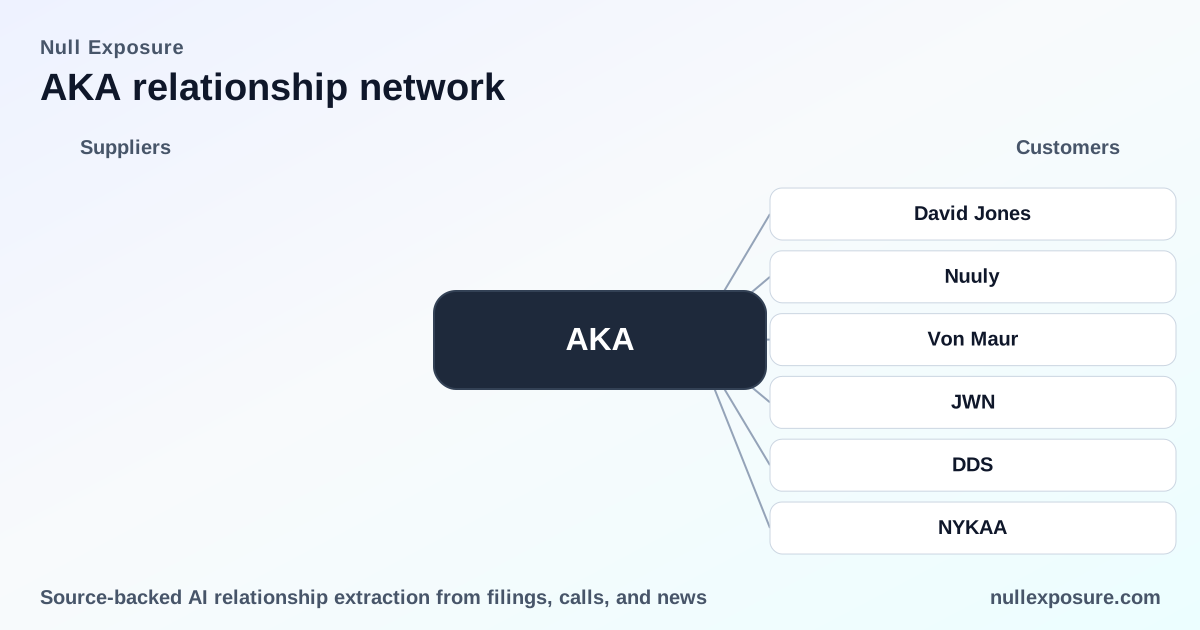
AKA Brands: How wholesale partnerships are reshaping growth and distribution
AKA Brands (AKA) operates and monetizes by designing and selling apparel through a hybrid model that emphasizes direct-to-consumer online sales while scaling wholesale and retail partnerships to accelerate brand reach. Revenue is driven by online retail, wholesale placements, and selective third‑party distribution, with recent efforts focused on rolling new sub‑brands—most notably Petal & Pup and Princess Polly—into department stores, rental platforms, and international marketplaces to lift topline and brand awareness. Learn more about our coverage at https://nullexposure.com/.
Why these partner moves matter to investors
AKA’s strategic play is straightforward: use wholesale and retail partners to amplify distribution while preserving online unit economics. Wholesale placements deliver fast reach and validation, rental-platform launches extend product lifecycle and sampling, and international rollouts add incremental revenue without replicating full operating infrastructure. That combination supports revenue scale but also increases dependence on third‑party channel execution and timing.
The partner map — line by line
Below I cover every relationship referenced in the underlying records. Each entry is a one‑to‑two sentence investor summary with the supporting source.
- David Jones: Petal & Pup launched through Australian department store David Jones in Q4 2025 and produced strong initial results, with AKA planning further expansion on that platform (AKA Q4 2025 earnings call).
- Nuuly: Petal & Pup went live on rental platform Nuuly in Q4 2025; AKA reports strong initial results and plans to expand rental distribution where it supports brand discovery (AKA Q4 2025 earnings call).
- Von Maur: AKA confirmed a planned 2026 launch for Petal & Pup with Von Maur to extend U.S. department store distribution (AKA Q4 2025 earnings call).
- JWN (SGB Online report): SGB Online highlighted that AKA’s wholesale debuts—across Nordstrom’s fleet—provided encouraging early reads on customer demand for Princess Polly and Petal & Pup (SGB Online, March 2026).
- JWN (BM Outdoor report): BM Outdoor noted that Petal & Pup’s rebrand finds commercial traction through wholesale partnerships with Nordstrom and David Jones, giving the relaunch tangible retail context (BM Outdoor, March 2026).
- Nordstrom (BM Outdoor item): Coverage frames Nordstrom as a material wholesale channel for AKA brands, amplifying marketing investments through national store distribution (BM Outdoor, March 2026).
- Nordstrom (FashionUnited): After a successful fourth‑quarter pilot, FashionUnited reported that Princess Polly and Petal & Pup expanded to all Nordstrom U.S. locations in early 2025, signaling wholesale scalability (FashionUnited, March 2025).
- JWN (FashionUnited entry): FashionUnited’s reporting reiterates Nordstrom’s role as a primary wholesale partner for AKA’s key brands, validating the company’s wholesale growth thesis (FashionUnited, March 2025).
- Nordstrom (SGB Online duplicate): SGB Online additionally cited Nordstrom as a distribution vector that drove positive early wholesale performance for AKA (SGB Online, March 2026).
- Dillard’s: AKA announced a Petal & Pup launch with Dillard’s slated for 2026 as part of an expanded U.S. wholesale rollout (AKA Q4 2025 earnings call).
- DDS (duplicate Dillard’s entry): The same Q4 2025 earnings call reiterated planned launches with Dillard’s to broaden reach and awareness (AKA Q4 2025 earnings call).
- Nordstrom (AKA earnings call): In the Q4 2025 call, management said wholesale “continued to perform well” and that the Nordstrom partnership exceeded expectations, with both Princess Polly and Petal & Pup delivering strong results (AKA Q4 2025 earnings call).
- JWN (AKA earnings call duplicate): AKA’s management specifically pointed to the Nordstrom relationship as a top wholesale success, reinforcing the company’s go‑to‑market cadence (AKA Q4 2025 earnings call).
- Nykaa Fashion: Petal & Pup launched on Nykaa Fashion in India in Q4 2025, marking a deliberate channel entry into the Indian market (AKA Q4 2025 earnings call).
- NYKAA (duplicate Nykaa entry): The Q4 2025 earnings call reiterated the Nykaa Fashion rollout as part of AKA’s international distribution push (AKA Q4 2025 earnings call).
What the relationship map implies about the operating model
The relationship list shows a clear, repeatable go‑to‑market motion: validate new or rebranded labels via online channels, pilot wholesale placements with tier‑one department stores, then scale distribution across store fleets and international e‑marketplaces. From the company disclosures and press coverage, several operating characteristics become evident:
- Contracting posture: AKA operates predominantly as a seller to major retail partners rather than long‑term, exclusive licensee arrangements; partnerships are channel relationships intended to scale product distribution quickly (company filings).
- Concentration: North America and Australia remain primary geographies; total non‑U.S./ANZ sales are modest by comparison, which concentrates revenue and operational risk regionally (company FY figures).
- Criticality: Wholesale partners such as Nordstrom and Dillard’s function as critical amplification mechanisms—successful in‑store execution directly affects revenue growth and brand velocity.
- Maturity: Brands are aggregated into one reportable segment, implying centralized merchandising, production, and distribution processes that favor scalable rollouts but also create single‑segment exposure for investors.
If you want a concise, data‑driven view of how these partner exposures map to revenue leverage and customer acquisition economics, visit https://nullexposure.com/.
Investment implications and risk checklist
- Growth lever: Wholesale expansion into Nordstrom, Dillard’s, Von Maur, and international partners like Nykaa materially increases addressable retail reach and shortens the path to scale.
- Margin pressure: Wholesale typically carries lower gross margin than direct online sales; expanding this channel will lift volume but press unit economics unless offset by SKU productivity and pricing power.
- Execution risk: Retail distribution depends on partner in‑store presentation, inventory cadence, and promotional timing; underperformance at any partner can meaningfully affect near‑term topline.
- Concentration risk: Heavy reliance on North American department stores concentrates commercial exposure to a single retail cycle and customer cohort.
- Optionality: Rental platform placements (Nuuly) and marketplace rollouts (Nykaa) provide low‑capex routes to new customer segments and extend product lifetime value.
Bottom line
AKA is executing a hybrid growth model that uses wholesale and third‑party channels to scale brand distribution quickly while retaining an online direct channel that preserves higher margins. Nordstrom stands out as the most consequential partner given reported outperformance, while newer entries—Dillard’s, Von Maur, David Jones, Nykaa, and Nuuly—expand reach and diversify distribution levers. Investors should value revenue upside from wholesale expansion against margin dilution and execution risk tied to partner performance.
For analysts and operators requiring deeper partner-level exposure mapping or to integrate these relationship signals into investment models, visit our platform at https://nullexposure.com/ for additional research and monitoring.